
How to Disarm the Narcissist: Phrases, Strategies, and the Gray Rock Method
Dealing with a narcissist can feel like walking through a minefield blindfolded. Every conversation has the potential to explode. Every interaction leaves you second-guessing yourself.
But here’s what you need to know: disarming a narcissist doesn’t mean changing them, diagnosing them, or winning arguments against them. It means lowering the conflict, neutralizing manipulation, and protecting your peace so you can reclaim your life.
This guide is built for people who need practical help right now—whether you’re navigating a relationship with a narcissistic partner, co-parenting with a difficult ex, managing a toxic family member, or surviving a workplace nightmare. Everything here is immediately actionable.
Before we dive in, let’s establish what we’re working with. Narcissistic traits typically include:
Grandiosity and inflated self-importance that masks deep insecurity
Entitlement to special treatment without reciprocity
Lack of empathy or unwillingness to recognize others’ feelings
Constant need for admiration and validation from others
Fragile self-esteem that reacts explosively to criticism
Research suggests narcissistic personality disorder affects roughly 1-2% of the population, but narcissistic behavior exists on a spectrum. You don’t need a clinical diagnosis to recognize patterns that harm you.
Safety first: If you’re experiencing narcissistic abuse that includes threats, physical violence, financial control, or isolation from loved ones, your priority is protection—not phrases. Seek professional help from a therapist, contact domestic violence resources, or consult legal counsel. This article is about managing difficult personalities, not surviving dangerous situations alone.
Here’s what we’ll cover:
Quick phrases you can use today to stop taking the bait
Emotional self-control techniques to avoid giving them power
The gray rock method for unavoidable contact situations
Boundary setting that actually works with narcissists
Documentation strategies to protect your reality
When to walk away and how to protect your mental health

Quick Start: 10 Phrases You Can Use Today to Disarm a Narcissist
Narcissists thrive on emotional reactions. They feed off your anger, your tears, your desperate attempts to explain yourself. The moment you realize this, you understand why calm, rehearsed phrases are your first line of defense.
These aren’t magic words that will suddenly make them respect you. They’re tools to end unproductive conversations, protect your boundaries, and stop you from getting hooked into arguments you’ll never win.
Practice these phrases until they feel natural. Say them in a calm, steady voice—no sarcasm, no raised volume, no emotional charge. Your goal isn’t to hurt them or prove a point. It’s to disengage with your dignity intact.
1. “That doesn’t work for me. I’m choosing something different.”
This phrase shuts down attempts to manipulate your decisions without requiring you to explain yourself. Use it when your partner demands you cancel plans with a friend, or when a parent insists you spend holidays their way. You’re not asking permission—you’re stating a fact.
2. “I hear what you’re saying; I just don’t share that view.”
When they insist their interpretation of reality is the only valid one, this response acknowledges them without agreeing. It works well in workplace conflicts where a narcissistic boss dismisses your contributions or rewrites project history.
3. “That’s not how I remember it.”
Simple, direct, and devastating to gaslighting attempts. You’re not arguing about facts or demanding they admit they’re wrong. You’re simply holding your version of reality. Use this when they claim conversations never happened or twist past agreements.
4. “I’m willing to talk when we can both stay respectful.”
This creates a conditional boundary around the conversation itself. When your ex escalates during custody discussions or a family member starts yelling, you’re offering continued dialogue—but only under terms that protect you.
5. “This is important to me, even if it isn’t to you.”
Many narcissists dismiss your concerns as trivial, oversensitive, or irrational. This phrase validates your own experience without seeking their approval. Use it when they mock your feelings or minimize things that matter to you.
6. “I’m not available for that conversation.”
Some topics are simply off-limits. When a narcissistic parent demands to know details about your finances, therapy, or dating life, this phrase closes the door without slamming it. You’re not being rude—you’re simply unavailable.
7. “If this keeps going in this direction, I’m going to take a break.”
This is a warning that gives them a choice. If they continue escalating, you leave—physically or by ending the call. The key is following through. Use it during arguments that are spiraling toward rage or contempt.
8. “I’m not going to defend myself right now.”
Narcissists often put you on trial, forcing you to justify your actions, thoughts, or very existence. Refusing to play defendant is profoundly disorienting for them. You don’t owe them a legal defense of being human.
9. “I’m stepping away to calm down; we can revisit later if needed.”
This models healthy conflict behavior while protecting you from saying something you’ll regret. Notice you’re not promising to revisit—you’re leaving that option open “if needed.” Sometimes it won’t be.
10. “Thanks for thinking of me, but I’ll pass this time.”
Perfect for declining invitations, requests, or obligations without lengthy explanations. Use it when a narcissistic friend tries to rope you into their drama, or when a manipulative colleague volunteers you for extra work.
The most important thing to remember: Your tone matters more than your words. Calm, neutral, brief. No explaining, no defending, no engaging with their provocations.
Understanding Narcissistic Tactics So You Can Stop Taking the Bait
One of the most exhausting aspects of dealing with a narcissist is the constant confusion. You walk away from conversations wondering if you’re the problem. You lie awake replaying arguments, trying to figure out what just happened.
This confusion isn’t accidental. It’s the result of specific manipulation tactics that narcissists deploy—sometimes consciously, sometimes instinctively. When you can recognize these patterns, something shifts. Instead of drowning in self-doubt, you can think, “Oh, this is gaslighting,” and respond from a position of clarity rather than emotion.
Gaslighting: Making You Question Reality
Gaslighting involves denying facts, rewriting history, or dismissing your perceptions until you no longer trust your own memory. Common phrases include:
“That never happened.”
“You’re being too sensitive.”
“I never said that—you’re making things up.”
“You’re crazy. Everyone thinks so.”
Example: You bring up that your partner promised to handle childcare on Saturday. They insist they never agreed to that, and suddenly the fight isn’t about responsibilities—it’s about whether you can trust your own memory.
Projection: Accusing You of What They’re Doing
Projection happens when a narcissist attributes their own behavior to you. If they’re lying, they accuse you of lying. If they’re cheating, they become obsessed with your faithfulness. If they’re selfish, they call you self-centered.
Example: Your coworker takes credit for your project, and when you confront them, they accuse you of “always trying to steal the spotlight.”
Deflection: Changing the Subject When Cornered
When you raise a legitimate concern, a narcissist will often suddenly shift to attacking you. They might bring up something you did months ago, criticize your tone, or turn the conversation into a different argument entirely.
Example: You ask your mother why she shared private information about your divorce with extended family. Instead of answering, she explodes about how you never call her anymore and you’ve always been ungrateful.
Smear Campaigns: Turning Others Against You
Narcissists often work to isolate you by poisoning your relationships with friends, family, or colleagues. They may tell half-truths, spread outright lies, or position themselves as the victim of your “abuse.”
Example: During a divorce, your spouse tells mutual friends that you’re “unstable” and “impossible to live with,” priming people to dismiss your perspective before you can share it.
Love-Bombing Then Devaluing: The Cycle of Control
Early in the relationship, a narcissist may shower you with attention, affection, and admiration. This intense phase—love-bombing—creates attachment. Then comes devaluation: criticism, contempt, withdrawal. Many narcissists cycle between these states to keep you off-balance.
Example: Your partner treats you like a soulmate for months, then suddenly becomes cold and dismissive. When you try to discuss what changed, they act like you’re overreacting.
The Emotional Impact on You
Long-term exposure to these tactics creates real psychological harm:
Chronic self-doubt and second-guessing
Walking on eggshells to avoid triggering anger
Anxiety, depression, and exhaustion
Difficulty trusting your own perceptions
Isolation from your support network
This is why recognition matters. When you can name what’s happening, you stop trying to solve the unsolvable. You stop arguing about details and start protecting yourself with the neutral phrases and strategies in this guide.

How to Respond to a Narcissist Without Losing Your Cool
Emotional reactions are the currency narcissists trade in. Your tears prove they have power. Your anger gives them ammunition (“See how unstable you are?”). Your desperate explanations keep you trapped in a conversation you’ll never win.
This doesn’t mean your emotions are wrong. Feeling hurt, frustrated, or angry when someone mistreats you is completely normal. The skill isn’t erasing your emotions—it’s choosing how you respond despite them.
The Pause Rule
Never respond to provocative texts, emails, or accusations immediately. Urgency is a manipulation tactic. Very few things genuinely require an instant response.
Read the message, then close it.
Give yourself a minimum of 30 minutes—longer if possible.
Ask yourself: “What response (if any) actually serves my interests?”
Draft your reply, then wait again before sending.
This simple practice prevents you from saying things you’ll regret and denies them the emotional reaction they’re seeking.
The Neutral Tone
When you do respond—whether in person, by phone, or in writing—aim for:
Slow speech with deliberate pauses
Lower volume than normal
Simple language without insults or diagnoses
No sarcasm, even when you’re dying to use it
Avoid ever saying, “You’re a narcissist” or labeling their behavior in clinical terms. This escalates conflict and gives them grounds to paint you as the aggressor.
Stop JADE-ing
JADE stands for Justifying, Arguing, Defending, and Explaining. When dealing with a narcissist, JADE-ing keeps you trapped.
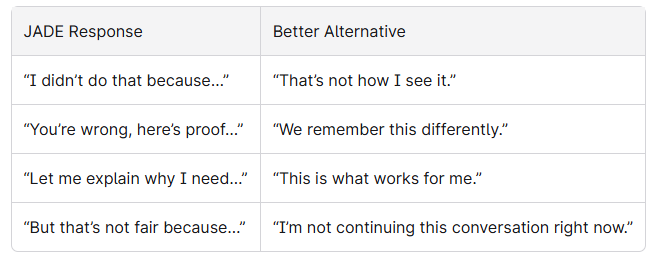
Every explanation you offer becomes ammunition. Every justification invites another attack. Keep responses short and firm.
A Simple Internal Script
When you feel yourself getting pulled into an emotional response, try this sequence:
Observe & Label – Mentally note: “This is projection” or “They’re trying to provoke me.”
Ground – Take a breath. Feel your feet on the floor. Slow down.
Respond briefly or disengage – Use one of your rehearsed phrases, or simply end the interaction.
Example in practice:
Your ex texts: “You’re such a terrible parent. The kids hate going to your house. Everyone can see what a failure you are.”
Observe & Label: “This is an attempt to hurt me and get a reaction.”
Ground: Deep breath. Check in with reality—your children seem happy with you.
Respond or disengage: Either ignore completely, or reply only to logistics: “I’ll have them ready at 5 p.m. on Sunday.”
Staying Calm and Composed Under Provocation
Narcissists may escalate when their usual tactics fail. Expect yelling, silent treatment, threats, accusations, or even playing the victim to bystanders. Your job is to stay regulated even when they’re not.
Box breathing: Inhale for 4 counts, hold for 4, exhale for 4, hold for 4. Repeat until you feel steadier. You can do this silently during a conversation.
Sensory grounding: Name 5 things you see, 4 you can touch, 3 you hear, 2 you smell, 1 you taste. This pulls you out of emotional flooding and back into the present moment.
Internal mantra: Choose a phrase to repeat silently, such as:
“I don’t have to prove my self worth right now.”
“Their opinion is not my reality.”
“I can leave this conversation.”
Reactive vs. Regulated Response:
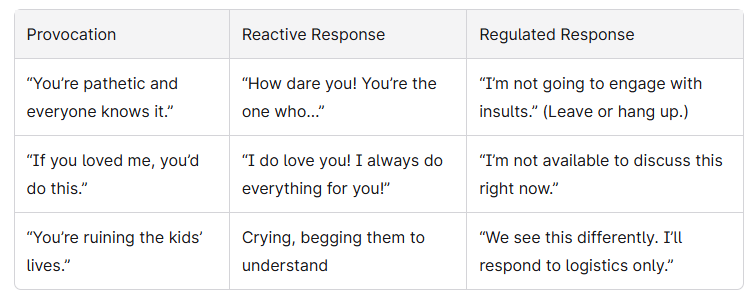
Feeling hurt or upset is human. Choosing your behavior despite those feelings is power.
Keeping Your Responses Brief and Low-Information
Every piece of personal information you share with a narcissist can become a weapon. Your fears, insecurities, hopes, and dreams are all potential ammunition for future manipulation.
Become deliberately boring and low-information:
Answer questions politely but minimally
Avoid oversharing about your emotional state
Don’t explain your reasoning in detail
Keep texts and emails factual and brief
Instead of: “I can’t come to dinner because I’ve been really stressed about work and I just need some time alone to decompress, and honestly being around family right now is too much for my mental health…”
Try: “I’m not able to come this weekend.”
No explanation required. No details to pick apart. No vulnerabilities exposed.
Privacy matters. Keep passwords, journals, therapy notes, and legal strategies completely private. If you’re in a custody situation, assume anything you share may be used against you.
The Gray Rock Method: Becoming Boring on Purpose
The gray rock method is one of the most effective strategies for disarm a narcissist when you can’t avoid contact entirely. The concept is simple: become so emotionally uninteresting that the narcissist loses interest in engaging with you.
Think of an actual gray rock. It’s not shiny. It doesn’t react. It’s just… there. That’s what you’re aiming for.
This isn’t about suppressing all emotion in your life. It’s about not showing your emotional reactions to the narcissist specifically.
Core Behaviors
Neutral facial expression and body language:
Keep your face relaxed, neither smiling nor frowning
Avoid animated gestures or dramatic sighs
Maintain comfortable but minimal eye contact
Don’t lean in with interest or pull back in disgust
Short, factual responses:
“Yes.”
“No.”
“I’m not sure.”
“That’s interesting.”
“I’ll think about it.”
What you avoid:
Sharing opinions, especially controversial ones
Gossiping or discussing drama
Revealing vulnerabilities or personal struggles
Showing excitement, anger, hurt, or fear
Giving them anything interesting to work with
A Practical Example
Situation: You share custody with a narcissistic ex. During pickup, they try to provoke a reaction.
Without gray rock:
Ex: “The kids told me they hate staying at your place. You’re clearly doing something wrong.”
You: “That’s a lie! They love being with me. You’re the one poisoning them against me. I’m sick of your manipulation!”
With gray rock:
Ex: “The kids told me they hate staying at your place. You’re clearly doing something wrong.”
You: (neutral expression) “Mm.” (turns to children) “Ready to go?”
No engagement. No defense. No emotion to feed on.
Expect Escalation Before Peace
When you first implement gray rock, narcissists often push harder. They’re confused that their usual tactics aren’t working, so they escalate—bigger accusations, more dramatic behavior, attempts to find new buttons to push.
This is normal. Stay consistent. Over time (usually weeks to months), many narcissists will reduce engagement because you’re no longer providing the narcissistic supply they crave.

When and Where to Use the Gray Rock Method
Gray rock works best in situations where:
You can’t go no-contact (co-parenting, shared workplace, caring for elderly parents)
The person is difficult but not dangerous
You need to reduce conflict, not eliminate the relationship
Gray rock is NOT recommended when:
You’re in immediate physical danger (prioritize safety planning)
The narcissist has already escalated to stalking or threats
You’re so exhausted you can’t maintain the approach consistently
Quick decision checklist:
Do I have to respond to this right now? If no, wait.
Can someone else handle this interaction? If yes, delegate.
Is this purely about provoking me? If yes, gray rock or ignore.
Gray rock is a medium-term coping tool, not a permanent solution. Pair it with long-term planning—whether that’s an exit strategy, stronger boundaries, or building a support network.
Setting, Communicating, and Enforcing Boundaries
A boundary is a limit on what you will accept or do. It’s not an attempt to control another person—it’s a statement about your own behavior.
With narcissists, this distinction matters enormously. You can’t make them stop insulting you. But you can decide that when they insult you, you leave the room.
Types of Boundaries
Time boundaries:
“I won’t answer calls after 9 p.m.”
“I’m limiting our conversations to 15 minutes.”
“I’m not available on weekends.”
Conversation boundaries:
“I won’t discuss my dating life with you.”
“I’m not going to talk about my finances.”
“That topic is off-limits.”
Behavior boundaries:
“If you insult me, I will leave the room.”
“If you raise your voice, I’m ending this call.”
“If you show up unannounced, I won’t answer the door.”
The Boundary Formula
Use this simple structure: “If X happens, I will do Y.”
The consequence (Y) must be something you can realistically follow through on. Empty threats destroy your credibility and teach the narcissist that your words mean nothing.
Good: “If you continue yelling, I will hang up the phone.” Bad: “If you continue yelling, I’m cutting you out of my life forever.” (Unless you truly mean it.)
Sample Boundary Scripts
For a narcissistic spouse/partner: “I won’t continue conversations where I’m being insulted. If that happens, I’ll leave the room and we can try again when things are calmer.”
For a narcissistic parent: “I’m happy to visit, but I won’t discuss my weight or appearance. If that comes up, I’ll end the visit early.”
For a narcissistic ex (co-parenting): “I’ll respond to texts about the children’s schedules, health, and education. I won’t respond to personal attacks or discussions about our past relationship.”
For a narcissistic boss/coworker: “I’m committed to this project, but I need communication to stay professional. If meetings become personal, I’ll need to step out and reschedule.”
Expect Testing and Resistance
Narcissists almost always test new boundaries. They may:
Escalate to see if you’ll cave
Play victim (“I can’t believe you’d treat me this way”)
Triangulate by complaining to others about how “unreasonable” you are
Pretend the boundary was never communicated
Consistency over weeks and months is what makes boundaries work. Every time you don’t follow through, you teach them that your boundaries are negotiable.
Getting Things in Writing and Protecting Your Reality
One of the most maddening aspects of narcissistic behavior is how easily they rewrite history. Conversations you clearly remember suddenly “never happened.” Agreements dissolve into disputes about who said what.
Documentation protects your sanity and your credibility.
Communication strategies:
Use email or text for important agreements so there’s a record
Follow up verbal conversations with written confirmation: “Just to confirm our conversation, we agreed you’ll pick up the children at 5 p.m. Friday.”
Use co-parenting apps that create timestamps and prevent message deletion
Keep a shared calendar for custody schedules, appointments, and exchanges
Personal documentation:
Maintain a private journal of major incidents with dates, times, and any witnesses
Take screenshots of relevant text exchanges
Save emails in a secure folder
Note patterns over time (helpful for therapy or legal proceedings)
Digital safety reminder: Secure your devices with passwords the narcissist doesn’t know. Don’t store sensitive notes where they might access them. Consider a separate email account for documentation that they’re unaware of.
This isn’t about building a case for endless arguments with the narcissist. It’s about having a clear record of reality when you need it—for yourself, for a therapist, or for legal situations.

Protecting Your Mental Health and Knowing When to Walk Away
Long-term exposure to narcissistic behavior takes a genuine toll. The chronic stress, constant self-doubt, and emotional whiplash aren’t signs that something is wrong with you—they’re normal responses to an abnormal situation.
Many victims of narcissistic abuse experience:
Anxiety and hypervigilance
Depression and hopelessness
Difficulty trusting their own perceptions
Chronic exhaustion
Isolation from friends and family
Physical symptoms from ongoing stress
Here’s what you need to hear: Their rage, their blame, their rejection—none of it proves you’re defective. Narcissistic behavior reflects their internal wounds, their fragile ego, and their distorted need for control. You are not responsible for fixing them.
Warning Signs It’s Time for Stronger Action
Sometimes the strategies in this guide aren’t enough. Consider seeking professional help, creating distance, or consulting legal counsel if:
You feel constant fear or dread around the person
You’ve become isolated from your support network
Your work performance, physical health, or sleep are suffering
There is any threat or act of physical violence
You notice yourself losing your sense of who you are
Building Your Support System
You cannot do this alone—and you shouldn’t have to.
Trusted friends and family who believe you and won’t enable the narcissist
A trauma-informed therapist or clinical psychologist who understands narcissistic dynamics
Support groups (including online communities) where others share similar experiences
Legal counsel if you’re navigating divorce, custody, workplace harassment, or protective orders
Disarming Doesn’t Mean Staying
Everything in this article is about reducing conflict and protecting yourself. But here’s something crucial to realize: sometimes the most powerful way to disarm a narcissist is to detach completely.
No contact—when it’s safe and feasible—removes their narcissist’s power entirely. Limited contact, with firm boundaries and gray rock, can be a sustainable middle ground. The choice depends on your specific situation, your safety, your obligations, and your wellbeing.
You cannot cure a narcissist. You cannot love them into changing. You cannot explain yourself clearly enough that they’ll finally understand.
What you can do is:
Regulate your own emotions so they lose their leverage
Use neutral phrases that end conversations without escalation
Employ gray rock when you must interact
Set boundaries and enforce them consistently
Document reality so you don’t lose your sense of what’s true
Build a support system that reminds you who you are
Choose your level of involvement rather than letting them choose for you
A Final Word
Dealing with a narcissist is exhausting, confusing, and often deeply painful. You may feel like you’re going crazy. You may wonder if you’re the problem. You may have tried everything to make the relationship work.
But you’re reading this article. That means some part of you already knows something isn’t right—and that part of you is ready to protect yourself.
Start small. Pick one phrase to practice this week. Set one boundary you’ll actually enforce. Document one conversation. Reach out to one person who supports you.
You don’t have to do everything at once. You just have to start.
And if you’re in a situation involving custody, divorce, or legal matters with a narcissistic individual, consider consulting with professionals who understand the unique dynamics of high-conflict cases. Judge Anthony’s platform offers resources focused on legal empowerment through family law mediation and advocacy that may provide valuable guidance.
Key Takeaways:
Narcissists feed on emotional reactions—starve them by staying calm and brief
Learn to recognize tactics like gaslighting and projection so you stop taking the bait
Use rehearsed neutral phrases to exit conversations without escalating
The gray rock method works for unavoidable contact by making you boring
Set boundaries with clear consequences you can actually enforce
Document everything important in writing
Protect your mental health—their behavior is not your fault
Sometimes the most powerful disarmament is distance or no contact
You deserve relationships built on mutual respect, honest communication, and genuine empathy. That may not be possible with a narcissist—but it’s absolutely possible in your life.