
How to Fix Narcissism: A Practical Guide for Real Change
Narcissistic traits can be reduced and managed—but let’s be clear from the start: “fixing” narcissistic personality disorder isn’t an overnight transformation. It’s a long-term process that requires sustained effort, honest self-reflection, and usually professional support.
This guide breaks down concrete, research-informed strategies you can start using today. Whether you’re recognizing concerning patterns in yourself or supporting someone who wants to change, the fact that you’re here matters. Seeking change is already a meaningful first step toward healing.
Key takeaways before we dive in:
Narcissistic traits exist on a spectrum—having some doesn’t mean you have diagnosable NPD
Real change takes 12–24 months minimum for personality-level shifts
Self-help strategies help, but moderate to severe cases require a qualified mental health professional
Backsliding is expected; the goal is progress, not perfection
Understanding Narcissism vs. Narcissistic Personality Disorder
Before you can fix something, you need to understand exactly what you’re dealing with. There’s a significant difference between having narcissistic traits and meeting the clinical threshold for narcissistic personality disorder NPD.
Narcissistic traits—like seeking admiration, struggling with criticism, or occasionally being self absorbed—are common in the general population. Most people display some of these tendencies at various points in their lives. That’s normal.
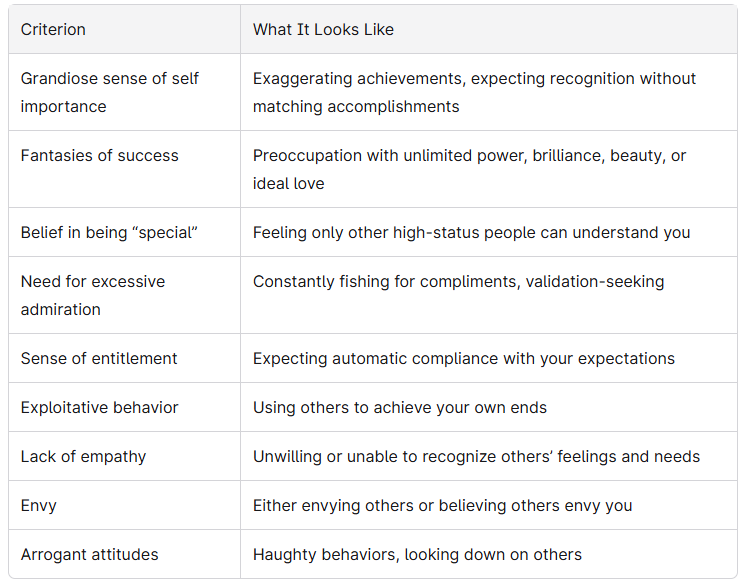
Narcissistic personality disorder is different. According to the american psychiatric association’s diagnostic and statistical manual (DSM-5), NPD is a pervasive pattern of grandiosity, need for admiration, and lack of empathy that begins in early adulthood and shows up across multiple areas of life. To receive a formal diagnosis, someone must exhibit at least five of nine specific criteria.
The 9 DSM-5 Criteria in Plain English
Common Subtypes
Understanding which pattern fits helps target your approach:
Grandiose narcissism: The classic type—obvious self-promotion, dominance-seeking, low sensitivity to criticism
Covert narcissism (also called vulnerable narcissism): Less obvious, marked by hypersensitivity, passive-aggressiveness, and hidden feelings of inadequacy beneath a quiet exterior
Antagonistic narcissism: Characterized by competitiveness, aggression, and willingness to exploit others
Communal narcissism: Inflated sense of self importance tied to being the most helpful, generous, or morally superior person
A covert narcissist might appear shy or self-deprecating on the surface while harboring deep resentment and entitlement underneath. This makes covert narcissism harder to detect—and sometimes harder to treat.

Self-Assessment: Signs You Might Have a Narcissism Problem
Online quizzes claiming to tell you if you’re a narcissist are everywhere. You can certainly take a test online for self-reflection, but here’s what matters: no quiz can provide a formal diagnosis. Only a licensed mental health professional can do that.
That said, honest self-assessment is where change begins. Use these reflection questions over the next 30 days—not as a one-time checklist, but as an ongoing practice in developing self awareness.
Questions to Ask Yourself
How you handle criticism:
Do you immediately get defensive, even when the feedback has merit?
Do you dismiss critics as jealous, stupid, or uninformed?
Does criticism trigger rage, withdrawal, or the silent treatment?
Your empathy patterns:
When someone shares a problem, do you quickly redirect to your own experiences?
Do you struggle to understand why people feel hurt by things you said or did?
Have multiple people called you “cold,” “selfish,” or “uncaring”?
Entitlement in relationships:
Do you expect special treatment without reciprocating?
Do you feel rules that apply to others shouldn’t apply to you?
When things don’t go your way, do you believe someone must pay?
At work and in leadership:
Do you take credit for team successes while blaming others for failures?
Is your reaction to a subordinate’s mistake disproportionately harsh?
Do you surround yourself with people who validate you rather than challenge you?
Social media and public image:
Are you preoccupied with how many likes, followers, or compliments you receive?
Do you feel genuine distress when your physical appearance or status is questioned?
Do you craft a public persona that differs significantly from who you are privately?
What to Do With Your Answers
Journal your reactions to criticism, conflict, and disappointment for at least 30 days. Look for recurring themes. If you’re spotting narcissistic tendencies across multiple areas of life—and especially if relationships keep failing in similar ways—it’s time to consider professional help.
The goal isn’t to label yourself. It’s to gain insight into patterns that may be hurting you and the people around you.
Core Mindset Shifts to Begin Fixing Narcissism
Sustainable change starts with mindset, not just behavior hacks. Narcissistic patterns usually developed over many years as defense mechanisms—often in response to fragile self esteem, childhood trauma, or inconsistent parenting. You can’t just “decide” to stop being this way. But you can shift how you think.
Three Essential Mental Shifts
1. Accept that narcissism is harmful, not just “confidence.”
Many people with narcissistic characteristics rationalize their behavior as simply being driven, ambitious, or honest. But there’s a difference between healthy self worth and an inflated sense of superiority that damages relationships.
Example: “I just tell it like it is” often translates to “I say hurtful things without considering the impact on others.”
2. Recognize that other people’s inner lives are as real and important as your own.
This sounds obvious—but for someone with narcissistic patterns, it isn’t. Other people aren’t supporting characters in your story. They have their own needs, fears, hopes, and pain that exist independently of you.
Example: When your partner is upset about something unrelated to you, their feelings aren’t a problem to be fixed or dismissed. They’re valid experiences that deserve attention.
3. View feedback as data, not attack.
Defensiveness blocks growth. When someone offers criticism, the narcissistic response is to attack back, dismiss them, or spiral into shame. A healthier response treats feedback as information—even the uncomfortable ones—that might contain something useful.
Example: Instead of “You’re wrong and you’re just trying to hurt me,” try “That’s hard to hear. Can you give me a specific example so I understand better?”
Set Realistic Expectations
Personality-level change takes 12–24 months of consistent work. Anyone promising a “30-day narcissism cure” is selling you something that doesn’t exist.
This isn’t meant to discourage you—it’s meant to protect you from giving up when change doesn’t happen immediately. Personal growth at this level is incremental. Celebrate small wins. Keep going.
Practical Steps to Reduce Narcissistic Behaviors
Once you’ve committed to change, you need concrete actions. Here are specific behaviors to work on, starting today.
Daily Practice Checklist
Pause before reacting to criticism. Count to ten. Take a deep breath. Ask one clarifying question before responding. This interrupts the automatic defensive response.
Practice genuine apologies. A real apology names the impact on the other person, not your intent. “I’m sorry you felt that way” isn’t an apology. “I’m sorry I dismissed your concerns—that must have felt invalidating” is.
Schedule daily “other-focused” time. Spend 10 minutes asking a partner, friend, or family member about their day—without redirecting to yourself. Listen. Ask follow-up questions.
Limit bragging and one-upmanship. In conversations, notice when you’re tempted to top someone’s story with your own. Instead, stay with their experience. Give others equal airtime.
Eliminate manipulative tactics. Stop using the silent treatment, guilt trips, or “tests” of loyalty. These are harmful behaviors that erode trust, not strategies that get you what you want long-term.
Track your behavior. Use a simple sheet or app to log instances of narcissistic reactions: defensiveness, dismissing others, seeking excessive validation. What gets measured gets managed.
Set specific, measurable goals. “Be less narcissistic” is vague. “Go one full week without interrupting during disagreements” is concrete and trackable.
Practice receiving compliments simply. Instead of deflecting or fishing for more, just say “Thank you.” This works both ways—it reduces both false modesty and excessive validation-seeking.
When You Backslide
You will backslide. This is not a sign of failure—it’s part of the process.
The key is noticing slips without rationalizing them away (“They deserved it”) or catastrophizing (“I’ll never change”). Simply observe: “That was a narcissistic reaction. What triggered it? What could I do differently next time?”
Building Empathy: Learning to See from Someone Else’s View
Low empathy is the engine that drives most narcissistic harm. Without the ability to understand how your actions affect others, you’ll keep hurting people while believing you’re justified.
Here’s the good news: empathy can be developed. It’s not fixed at birth. Research shows that structured practices can increase empathy over time—and certain therapy types like mentalization-based therapy (MBT) are specifically designed to build this capacity.

Empathy-Building Exercises
Daily perspective-taking practice After any conflict or difficult conversation, write one paragraph from the other person’s point of view. Not what you think they should feel—what they likely actually felt, given their history, their personality, and the situation.
Consume media featuring people unlike you Watch films or read memoirs where the protagonist is very different from you—different background, different values, different struggles. Deliberately reflect on their inner world. What would it feel like to be them?
Paraphrase before responding In conversations, especially emotionally charged ones, paraphrase what the other person said before sharing your view. “So you’re saying you felt ignored when I didn’t ask about your presentation. Is that right?” This forces you to actually listen.
Notice dismissive thoughts—and challenge them When you catch yourself thinking “They’re just too sensitive” or “That’s not a big deal,” stop. These thoughts are empathy-blockers. Ask instead: “Why might this matter to them, even if it wouldn’t matter to me?”
Role-reversal exercises In therapy or on your own, practice imagining specific situations from another person’s perspective. What were they thinking? What were they afraid of? What did they need that they didn’t get?
Addressing Common Objections
The narcissistic mind generates excellent reasons why empathy practice is unnecessary:
“If they communicated better, we wouldn’t have problems.” (Translation: it’s their responsibility to adapt to you.)
“I’m just more logical/rational than most people.” (Translation: emotions aren’t valid data.)
“They know I love them—they’re choosing to be offended.” (Translation: your intent matters more than your impact.)
Each of these blocks greater self awareness. Recognizing them is half the battle.
Repairing Relationships Damaged by Narcissism
Fixing narcissism isn’t just about behaving better going forward. It includes repairing past damage where possible. Narcissistic behaviors leave specific wounds: broken trust, emotional neglect, chronic invalidation, and cycles of rage or withdrawal.
A Relationship Repair Protocol
Step 1: Identify 3–5 key relationships you’ve harmed. Be specific. Your spouse. Your adult children. A close friend. A colleague. These are your repair priorities.
Step 2: Ask if they’re open to a conversation. Don’t demand reconciliation. Respect “no” or “not yet” as valid answers. Pushing someone who isn’t ready is another narcissistic pattern, not genuine healing.
Step 3: Listen more than you speak. When they share how your behavior affected them, resist the urge to defend, explain, or re-argue the past. Your job is to understand, not to be understood.
Step 4: Offer specific amends. Vague promises mean nothing. “I’ll be better” has no weight. “I’m willing to attend couples counseling every week,” “I’ll stop making financial decisions without consulting you,” or “I’ll text before calling so you have space” are concrete.
Step 5: Accept that some relationships may not be repairable. Some people may not want reconciliation. They’ve been hurt too deeply, or they’ve done the work to move on. Trying to force forgiveness—through guilt, pressure, or grand gestures—is just more narcissism wearing different clothes.
The Difference Between Repair and Performance
Genuine repair focuses on the other person’s healing. Performance focuses on your image—being seen as the reformed person, getting credit for growth, or using “I’ve changed” as leverage.
If your primary motivation is how the repair makes you look, you’re not actually repairing. You’re managing your reputation.
When You’re Dealing with Your Own Narcissism in Court or Legal Conflict
Narcissistic traits often intensify during high-conflict situations: divorce, child custody battles, business disputes, or defamation cases. The courtroom becomes a stage, and the temptation to “win at all costs” can override common sense.
If you recognize narcissistic patterns in yourself and you’re currently involved in legal conflict, this section is critical.
How Courts Trigger Narcissistic Behavior
Legal settings are built for conflict. Someone is right; someone is wrong. There are winners and losers. For someone with narcissistic tendencies, this structure feeds the impulse to:
Grandstand and make everything about principle rather than practical resolution
Attack the other party’s character rather than addressing specific issues
Disregard court orders that feel like personal affronts
Use legal processes purely for revenge or humiliation
Modern family courts, especially in custody matters, are increasingly attuned to these patterns. Judges and mediators in the 2020s have become more willing to penalize bad-faith tactics, parental alienation attempts, and litigation abuse.
Concrete Guidance for Legal Proceedings
Listen to your attorney and the judge, even when it clashes with your need to be right. Your lawyer has seen dozens of cases like yours. Your ego hasn’t.
Avoid using legal processes for revenge. Courts have mechanisms to identify and penalize parties who file motions purely to harass, delay, or punish. This will backfire.
Focus on verifiable facts. Timelines. Documents. Specific incidents with dates. Emotional narratives that center only your experience are less persuasive than evidence.
Consider mediation. Mediation offers a path to resolution that bypasses the adversarial structure triggering your worst impulses. A skilled mediator can help both parties reach agreements without the escalation of traditional litigation.
Work with a therapist during the legal process. Someone familiar with high-conflict personalities can help you recognize when you’re about to self-sabotage—and stop before you damage your case.
If you’re dealing with family conflict or partnership disputes where narcissistic dynamics are at play, exploring mediation services like those offered at judgeanthony.com can provide a path toward compassionate resolution rather than courtroom combat.
Getting Professional Help: Therapies That Actually Work
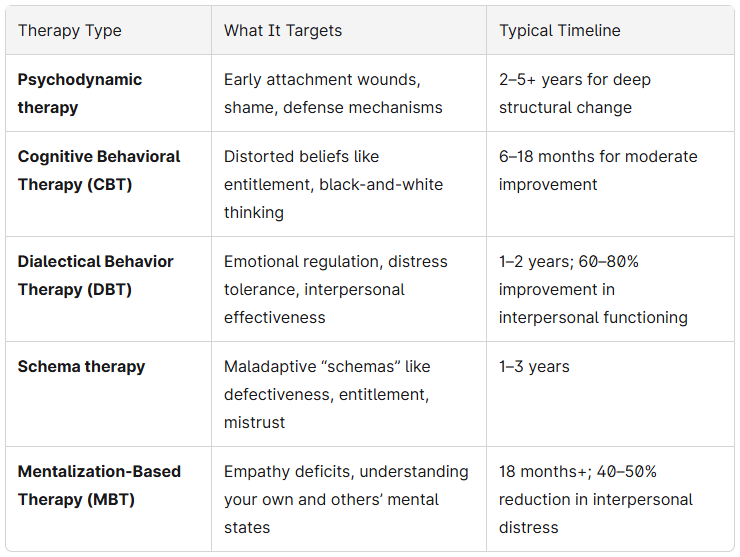
Here’s the reality: entrenched narcissistic patterns and diagnosed NPD almost always require professional treatment. Self-help strategies are valuable, but they’re rarely sufficient for moderate to severe cases.
No FDA-approved medication specifically treats narcissism. However, several therapy types have demonstrated effectiveness in treating NPD and reducing narcissistic behaviors.
Evidence-Based Approaches
What to Expect in Therapy
Therapy for narcissistic patterns is uncomfortable. You’ll be asked to confront long-standing defenses. You’ll feel shame. You’ll want to quit.
Progress is gradual. There are no breakthrough moments where everything suddenly clicks. Instead, you’ll notice over months that you’re reacting slightly less defensively, recovering from criticism faster, or catching manipulative impulses before you act on them.
How to Find the Right Therapist
Search specifically for therapists experienced with personality disorders or NPD
During consultations, ask about their approach and experience with narcissism
Be honest from session one—even about things that feel threatening to admit
Expect to feel judged initially (that’s the narcissistic defense talking, not reality)
Medication may help with co-occurring issues like depression, anxiety, or impulsivity. SSRIs show effectiveness in 50–70% of NPD cases with comorbid depression. But medication doesn’t “cure” narcissism—it addresses symptoms that make therapy harder.

Supporting a Loved One Who’s Trying to Fix Their Narcissism
If someone you love is attempting to change narcissistic patterns, you’re in a difficult position. You want to support their growth while protecting your own mental health and well being.
Here’s how to navigate it.
Key Strategies for Supporters
Maintain firm, clear boundaries. Decide what you will and won’t tolerate—and enforce those limits consistently. Healthy boundaries aren’t punishment; they’re necessary for any healthy way forward.
Use “I” statements and calm, specific feedback. “You’re such a narcissist” shuts down conversation. “I feel dismissed when you interrupt me” gives actionable information.
Judge progress by consistent behavior over months, not tearful promises after a blow-up. Words mean nothing without sustained change. Track patterns, not individual incidents.
Protect your own health. Consider therapy for yourself. Join support groups for people who’ve experienced narcissistic abuse or emotional abuse. Take time away when you need it.
Recognize your own needs matter. You are not required to sacrifice your well being for someone else’s growth process.
Develop coping strategies. Learn to reduce stress in your own life. Practice practicing self care regularly—not as an indulgence, but as a necessity.
Build a strong support system. Friends, family, therapists—people outside the relationship who can offer perspective when you’re too close to see clearly.
The Line Between Support and Codependency
Supporting someone’s growth is different from becoming their unpaid therapist, emotional punching bag, or public relations manager.
If you find yourself constantly managing their image, making excuses for their behavior, or walking on eggshells to avoid triggering them, you’ve crossed from support into enabling.
It’s acceptable—and sometimes necessary—to leave or reduce contact if abuse continues despite repeated attempts at change.
When Change Isn’t Happening: Red Flags and Next Steps
Not everyone who claims to want change actually wants it. Some individuals use therapy language as a weapon, apologize without modifying behavior, or blame everyone else for lack of progress.
Signs That “Change” Is Superficial or Manipulative
Love-bombing after abuse: Grand gestures, excessive affection, and promises that disappear once you’ve forgiven them
Apology without behavioral change: “I said I was sorry—what more do you want?” while continuing the same patterns
Using therapy terms as weapons: “You’re being codependent” or “You’re projecting” deployed to deflect accountability
Blaming external factors: The therapist doesn’t understand them, you’re not supportive enough, work is too stressful
Quick therapy dropout: Starting treatment but leaving within weeks or months when it gets uncomfortable (up to 50% drop out in the first year)
Self-Protection Steps
If you’re dealing with someone who isn’t genuinely changing—or if you’re in immediate danger:
Create a written safety and exit plan if there is emotional, financial, or physical abuse
Document incidents with dates, times, and specific examples; this is essential if custody or legal issues arise
Expand your support network with trusted friends, family member connections, and licensed professionals
Consult legal professionals if needed for protection orders, divorce, or custody matters
You cannot force insight or empathy into someone who refuses it. Your responsibility is to your own safety and emotional balance.
Long-Term Outlook: What “Better” Actually Looks Like
Let’s set realistic expectations about what improvement looks like over time.
Timelines for Progress
6 months of sincere work:
Increased awareness of narcissistic reactions (catching them in the moment, not just afterward)
Fewer explosive reactions to criticism
Beginning to ask genuine questions about others’ experiences
Some reduction in self criticism spirals after acknowledging mistakes
1 year of consistent effort:
Noticeable decrease in defensiveness observed by others
Ability to sit with shame without lashing out
Early signs of genuine empathy in close relationships
Fewer relationship crises and faster repair after conflicts
5 years of sustained treatment:
Stable, mutually supportive relationships possible
Significant reduction in entitlement beliefs and exploitation
Ability to receive feedback, even the uncomfortable ones, without destabilizing
Narcissistic vulnerabilities still present but causing far less harm
Factors That Improve Prognosis
Early intervention: Starting therapy in your 20s–30s rather than waiting until repeated crises force the issue
Strong motivation: Genuine desire to keep relationships, not just fear of consequences
Consistent treatment: Staying in therapy even when it’s uncomfortable
Willingness to tolerate shame: This is perhaps the most important factor
A Grounded But Hopeful Conclusion
Research suggests that 50–70% of motivated patients with milder symptoms achieve meaningful symptom reduction within two years. Severe NPD cases with entrenched traits show lower improvement rates (30–40%), often compounded by the insight problems that define the disorder.
Some people will always retain narcissistic vulnerabilities. A true narcissist doesn’t disappear—but they can build a life where those traits do far less damage.
Personality change is measured in slightly better choices over time, not sudden transformations. The person who can now tolerate their partner’s criticism without rage, who can celebrate a friend’s success without envy, who can acknowledge a mistake without spiraling into self importance or self-loathing—that’s what progress looks like.
If you’re recognizing narcissistic patterns in yourself, the path forward exists. It’s hard. It takes longer than you want. And it almost certainly requires professional help.
But meaningful positive change is possible with sustained effort, honest self reflection, and the right support. Start today—not with promises to be different, but with one concrete action. Journal for 30 days. Schedule a therapy consultation. Ask someone you’ve hurt if they’re open to talking.
That’s how change actually happens: one choice at a time, over a long time, until those choices become who you are.