
How to Get Over a Narcissist Ex
Breaking up with a narcissistic ex feels nothing like a normal breakup. There’s no clean grief, no simple sadness—just a confusing storm of relief, longing, anger, and self-doubt that cycles without warning. You find yourself missing someone who hurt you deeply, questioning your own memories, and wondering if maybe you were the problem all along.
This confusion makes sense. Narcissistic relationships operate on a fundamentally different dynamic than healthy ones. You experienced love-bombing that felt like a dream, followed by gaslighting that made you question reality. Blame-shifting taught you to apologize for their behavior. Silent treatments conditioned you to walk on eggshells. And hoovering—those sudden sweet gestures after you tried to leave—kept pulling you back into the cycle. These aren’t typical relationship struggles. They’re manipulation tactics that leave psychological marks.
If you’re experiencing anxiety, insomnia, obsessive rumination, or a persistent sense that something is deeply wrong with you, know this: you are not crazy. You are not too sensitive. These are common trauma responses after narcissistic abuse, and many survivors experience them. This article provides practical, step-by-step strategies you can start using today to detach from your narcissist ex, recover your sense of self, and rebuild your life. Healing is absolutely possible—even when it doesn’t feel that way right now.

Step 1: Recognize That You Were in a Narcissistic Relationship
The first real step to getting over a narcissist ex is naming what happened. Not minimizing it. Not excusing it. Simply acknowledging that you were in a narcissistic relationship changes everything—it shifts you from confusion to clarity, from self-blame to understanding.
Take a moment to recall specific behaviors from the relationship. Not vague feelings, but concrete patterns. Did they constantly criticize your appearance, intelligence, or decisions? Were they jealous of your friends, your career, or anyone who took your attention away from them? Did they rage over small issues—you being ten minutes late, or not texting back fast enough—then act like nothing happened hours later? Did you experience cycles of being idealized (treated like you were perfect) followed by sudden coldness or contempt?
These patterns point to something deeper than “a difficult relationship.” Narcissistic abuse involves specific tactics:
Gaslighting: Denying things that clearly happened (“I never said that,” “You’re imagining things”)
Projection: Accusing you of exactly what they were doing (calling you selfish while ignoring your needs)
Emotional blackmail: Using guilt, fear, or obligation to control you (“If you really loved me, you would…”)
Intermittent reinforcement: Mixing cruelty with occasional kindness to keep you off-balance
Try writing down a timeline of your relationship. Mark the first three months—usually the intense romance phase. Then note when the control, put-downs, or isolation began. Seeing patterns instead of isolated incidents helps your brain recognize that this was systematic, not accidental.
You don’t need an official diagnosis of narcissistic personality disorder for your experience to be valid. What matters is the impact of the narcissist’s behavior on your mental health and well being. If their actions left you feeling smaller, more confused, and less like yourself, you were dealing with something serious.
How Narcissistic Exes Keep You Emotionally Hooked
One of the cruelest aspects of a narcissistic relationship is how it hijacks your brain chemistry. Intermittent reinforcement—periods of kindness mixed with cruelty—creates a powerful psychological trap. Your brain becomes wired to crave the next “good moment,” like a gambler waiting for the slot machine to pay out.
Think about specific examples from your experience. Maybe they sent affectionate texts after days of silent treatment. Maybe dramatic apologies followed—complete with tears and promises—only to repeat the exact same behavior weeks later. Maybe rare moments of tenderness felt so precious because they were surrounded by coldness.
Here’s the truth that can feel hard to accept: you may miss the “idealized” version of your ex. The person from the first months of love bombing, or the person who showed up during apology phases. But that version was never the complete picture. The person who consistently disrespected you, who made you feel worthless, who controlled and manipulated—that was also them.
Understanding this trauma bond isn’t about blaming yourself for staying. It’s about recognizing the psychological trap you were placed in. The confusion you feel is a feature, not a bug, of narcissistic abuse.
To combat the urge to romanticize the relationship, make a list right now of at least five specific times you were mistreated. Be concrete: the date, what they said, what they did, how you felt. Keep this list somewhere accessible. Read it when your brain starts rewriting history.
Step 2: Assess the Damage and Validate Your Experience
Getting over a narcissist ex isn’t just about heartbreak. It’s about recovering from psychological abuse—specifically, from emotional abuse that may have been invisible to others but was devastatingly real to you. Before you can heal, you need to honestly assess what happened to you.
Start with a self-inventory of symptoms since the relationship or breakup:
Panic attacks or chronic anxiety
Hypervigilance when your phone pings (is it them?)
Trouble concentrating at work or school
Feeling like you’ve lost your personality
Second-guessing every decision
Difficulty trusting your own perceptions
Sleep disruption or nightmares
Loss of interest in things you used to enjoy
Compare your life “before” and “after” the relationship in concrete ways. How many friendships did you maintain? What hobbies did you pursue? How was your sleep? Your work performance? Your confidence level? Many survivors realize they lost far more than they recognized while in the abusive relationship.
Try journaling a detailed account of one particularly hurtful incident. Include the date, exactly what was said, and how you felt afterward. This exercise isn’t about dwelling on pain—it’s about validating that what happened was serious. When you see it written down, it’s harder to minimize or gaslight yourself.
Feelings of shame, confusion, and self-doubt are common outcomes of long-term gaslighting and control. They don’t mean you’re weak. They mean you were systematically trained to doubt your own thoughts and perceptions. Recognizing this is part of reclaiming your true self.
Facing the Emotional and Physical Fallout
Betrayal trauma from narcissistic abuse can show up in ways that surprise you:
Intrusive memories that pop up without warning
Startle responses to sounds or situations that remind you of them
Checking their social media accounts late at night
Obsessively re-reading old texts, trying to make sense of what happened
Physical symptoms like headaches, digestive issues, or chronic fatigue
Some people develop depression, anxiety, or symptoms similar to PTSD after a narcissistic relationship. This is especially common when there was chronic emotional abuse, financial abuse, or when the relationship lasted years. If this describes you, please hear this: your reaction is proportional to what you experienced.
Create a simple two-column list to structure your healing goals:
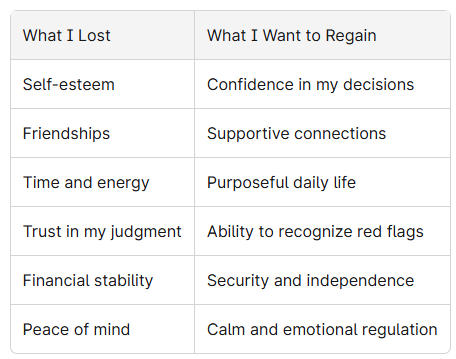
Think of your recovery like rehabilitating from a serious injury. You wouldn’t expect to run a marathon two weeks after breaking your leg. You need time, care, and professional support when necessary.
If you notice persistent suicidal thoughts, self-harm urges, or inability to function at work or school, prioritize reaching out to a licensed mental health professional promptly. These symptoms signal that your nervous system needs more support than self-help alone can provide.
Step 3: Commit to No Contact or Safe Low Contact
The fastest way to get over a narcissist ex is to remove their access to your mind and emotions as completely as possible. This isn’t about being petty or dramatic. It’s about protecting your healing process from interference.
No contact means exactly what it sounds like:
Blocking their phone number
Unfollowing and blocking on all social media accounts
Resisting the urge to check their profiles
Not asking mutual friends about them
Not responding to messages that come through alternate channels
Every interaction—even a single text exchange—can reset the trauma bond and trigger another wave of confusion and pain. Narcissists are skilled at hoovering: grand gestures, tearful apologies, or even manufactured crises designed to pull you back in. The only winning move is not to play.
Staying in touch “just as friends” almost never works after a narcissistic relationship. It gives your ex partner continued access to manipulate, and it keeps you emotionally entangled when you need distance to heal. The narcissist doesn’t want friendship—they want narcissistic supply, and you’ve been their source.
Set a specific start date for no contact. Write it down: “From [date], I will stop responding to all non-necessary communication.” This creates a clear boundary in your mind. Tell a trusted friend about this commitment so someone can hold you accountable when the urge to respond hits.

If You Must Stay in Contact (Co-Parenting or Legal Ties)
Sometimes full no contact isn’t possible. If you share children, a business, or ongoing legal matters with your narcissistic ex, safe low contact becomes your strategy instead.
The goal of low contact is strictly practical communication—nothing emotional, nothing personal. Use written-only methods for all necessary exchanges. Email and co parenting apps create records of interactions, which protects you legally and helps you maintain clear boundaries.
Keep every message brief, factual, and neutral. Do not defend yourself. Do not make accusations. Treat it exactly like business correspondence with a difficult colleague you’ll never need to impress.
Examples of effective one-sentence responses:
“I will follow the court-ordered schedule.”
“I am not available to discuss anything outside our parenting agreement.”
“Please communicate in writing only.”
“I’ve received your message and will respond to scheduling requests by [date].”
If you receive abusive, threatening, or manipulative messages, do not engage. Save them in a separate folder. These records serve two purposes: legal documentation if needed, and evidence to counteract your own future self-doubt. When you wonder if you’re overreacting, you can revisit the truth of what happened.
Remember: effective co parenting with a narcissist looks different than co-parenting with a reasonable person. Expect unacceptable behavior. Plan for it. But don’t engage with it emotionally.
Step 4: Break the Mental Loop of Obsessive Thoughts
Even after establishing no contact, your narcissistic ex may continue living rent-free in your mind. You replay old conversations. You imagine confrontations where you finally say the perfect thing. You analyze their behavior for hours, trying to understand why.
This obsessive thinking is your brain’s attempt to make sense of something that never truly made emotional sense. Narcissistic relationships violate basic expectations of reciprocity and fairness. Your mind keeps returning to the scene because it can’t file the experience away properly.
Here’s how to break the loop:
Create a “reality list.” Write down concrete bullet points of harmful things your ex did—specific lies, broken promises, cruel words, affairs, or manipulation tactics. Keep this list on your phone. When your brain starts idealizing them or minimizing the hurt, read it.
Set “analysis time.” Give yourself a daily 10-15 minute window where you’re allowed to journal questions and feelings about your ex. When the time ends, consciously shift to another activity. This contains rumination instead of letting it take over your entire day.
Replace rumination with action. When intrusive thoughts hit outside your analysis window, have a planned coping tool ready:
Physical movement (a walk, stretching, dancing)
Grounding exercises (name 5 things you can see, 4 you can hear…)
Calling a trusted friend
A hobby that requires focus (puzzles, cooking, crafts)
Listening to a podcast that has nothing to do with relationships
The goal isn’t to never think about them. It’s to spend time on healing rather than endless mental loops that go nowhere.
Reframing the Story You Tell Yourself
After narcissistic abuse, your internal narrative often sounds like the narcissist’s voice. “Why wasn’t I enough?” “What’s wrong with me?” “Why couldn’t I make them happy?”
These questions assume you were the problem. They keep you trapped. Practice self compassion by reframing them:
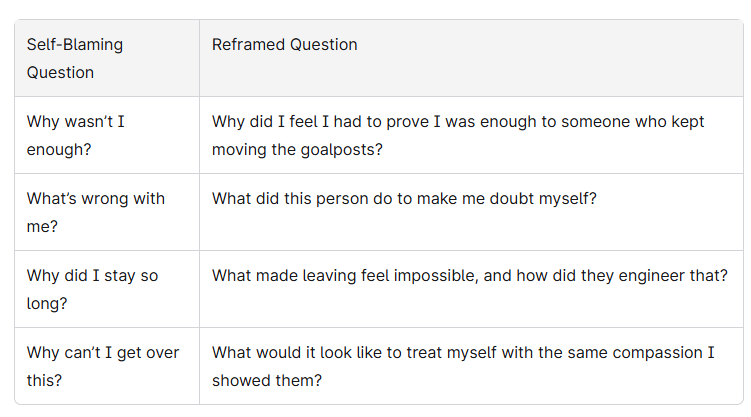
Try this exercise: Write a letter to your past self from the perspective of a protective older sibling. Tell that person what you see. Explain why they deserved better. This helps you practice self love and externalize the compassion you need.
Develop compassionate self-talk scripts: “I was manipulated, but I am learning. My mistake doesn’t define my future.” “I am not responsible for another adult’s emotional regulation.” “I deserve relationships where I don’t have to prove my worth.”
The goal of getting over a narcissist ex is less about understanding them perfectly and more about re-centering your own reality, values, and needs. You don’t need to solve the puzzle of who they really were. You need to recognize who you are and what you deserve.
Step 5: Rebuild Your Identity and Daily Life
Narcissistic partners systematically erode identity. They criticized your interests until you abandoned them. They punished independence, so you stopped asserting yourself. They isolated you from friends and family who might see through them. By the end, many survivors don’t recognize themselves anymore.
Rebuilding your sense of self requires intentional effort. You have to reconnect with parts of yourself that existed before the relationship—and discover new parts that will emerge through healing.
Start by answering these questions:
What activities did I enjoy before this relationship?
Which friends did I stop seeing?
What personal goals did I put aside?
What values matter most to me?
What brings me genuine peace or joy?
Create a simple weekly structure that anchors your healing process:
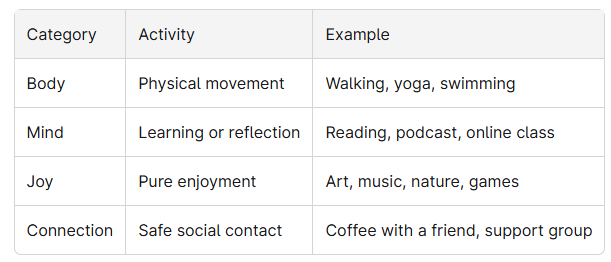
Set small, concrete goals with dates. For example: “By [date], I’ll attend one class or meetup that has nothing to do with my ex.” “By [date], I’ll have dinner with [friend’s name].” These feel manageable and create forward momentum.
At first, these activities may feel empty or forced. That’s normal. Your nervous system is still calibrated to the chaos of the narcissistic relationship. Stability might feel boring; peace might feel suspicious. Trust that moving forward through these motions helps your brain rewire. Motivation often follows action, not the other way around.

Relearning Healthy Connection With Others
Narcissistic relationships teach you to doubt your judgment and ignore red flags. Your “normal meter” is broken. Rebuilding trust in yourself and others takes time and practice.
Start with low-stakes connections rather than jumping into intense new friendships or relationships:
Group classes where interaction is structured
Volunteer activities with shared purpose
Reconnecting with one trusted long-time friend
Online communities focused on hobbies, not relationships
Practice setting healthy boundaries in small ways. Say “no” without overexplaining. Notice how safe people respond—they accept your boundaries without punishment, guilt-tripping, or silent treatment. Choose to spend time with people who respect your limits, and distance yourself from those who don’t.
Pay attention to how you feel around new people. Do you feel calm or anxious? Respected or criticized? Free to be yourself or performing to avoid disapproval? These internal signals matter more than whether someone “likes” you.
You do not need to rush into a new relationship. In fact, pausing on dating can help you avoid repeating patterns with another narcissist. Signs of readiness for a new relationship include:
Emotional neutrality toward your ex
Robust self-boundaries you’re willing to enforce
Comfort with solitude
Absence of the urge to find someone to “fix” or “save”
Ability to recognize red flags early
Give yourself permission to focus on yourself first. Healthy relationships will follow when you’ve rebuilt a healthy relationship with yourself.
Step 6: Build a Support and Professional Healing Plan
Getting over a narcissist ex is much easier—and safer—with a solid support system. No one should have to heal from abuse alone. Seeking support isn’t weakness; it’s wisdom.
Identify at least three potential support sources:
A trauma-informed therapist who understands narcissistic abuse
One or two trusted friends or relatives who believe you
A support group (local or online) specifically for narcissistic abuse survivors
When seeking professional help, look for therapists with experience in trauma, narcissistic abuse, and high-conflict relationships. They should be comfortable discussing gaslighting, coercive control, and trauma bonds. Evidence-based approaches that help many survivors include:
Trauma-Focused Cognitive Behavioral Therapy (TF-CBT): Reframes distorted beliefs like unworthiness
EMDR (Eye Movement Desensitization and Reprocessing): Desensitizes traumatic memories
Internal Family Systems (IFS): Integrates fragmented parts of self
Schema Therapy: Addresses vulnerability patterns from early experiences
Support groups offer something therapy sometimes can’t: validation from people who truly understand. Hearing others describe the same tactics—the love bombing, the discard, the hoovering—confirms you’re not crazy and you’re not alone. Many survivors report significant reduction in shame after finding community.
Have at least one honest conversation with a trusted person where you share concrete examples of what happened. Don’t minimize. Don’t sugarcoat. Let someone witness your truth.
Complement therapy with practical self-help tools:
Guided journals focused on healing from emotional abuse
Audio meditations for anxiety and grounding
Educational books on trauma bonds and narcissistic dynamics
Podcasts featuring expert discussions and survivor stories
Knowing When to Seek Urgent or Legal Support
Some situations require urgent intervention. Watch for red flags that signal immediate danger:
Threats (explicit or implied) to your safety, reputation, or finances
Stalking behavior (showing up uninvited, tracking your location)
Physical violence or escalating verbal aggression
Harassment that continues despite no contact
If you’re in an unsafe situation, contact local domestic violence hotlines or shelters. Emotional support is available even if there was no physical violence—emotional abuse and coercive control absolutely qualify for help.
Keep a simple log with dates, times, and descriptions of threatening or harassing incidents. Screenshots, saved voicemails, and documented phone calls can be crucial if you need to involve law enforcement or pursue protective orders.
Consulting with a lawyer familiar with high-conflict and abusive ex-partners is essential if you share finances, property, or children. Resources like Judge Anthony’s expertise in family law can provide guidance for dealing with narcissistic exes in divorce and custody contexts. Shifting focus from the narcissist’s needs to legal strategies that protect your future is a powerful form of healing.
Seeking legal or protective help is not overreacting. It’s a boundary in action. It’s you prioritizing your absolute top priority: your safety and your life moving forward.
What Healing Looks Like Over Time
Healing from a narcissist ex rarely follows a straight line. There will be good weeks where you feel strong and clear, followed by days when the pain crashes back. This is normal. Recovery from narcissistic abuse typically takes one to two years minimum for significant identity reclamation—longer if there was no professional support.
Common stages of healing include:
Crisis and emotional shock: Raw pain, confusion, and sometimes relief mixed with grief
Stabilization and no-contact maintenance: Learning to resist hoovering, building daily routines
Rebuilding daily life: Rediscovering identity, reconnecting with friends, setting goals
Integration: Processing the experience as part of your story without it defining you
Emotional neutrality: The ex becomes a lesson rather than a wound
These stages aren’t linear. You might feel integrated one month and crash back into crisis the next. Grief from narcissistic relationships includes denial, bargaining, anger, and acceptance—cycles that may loop for months before settling.
Expect “relapses.” Checking their profile once. Rereading old messages at 2 AM. Feeling a surge of hope when a text comes through (then disappointment when it’s not them). These moments don’t erase your progress. Treat them as signals to recommit to your boundaries, not as evidence that healing isn’t working.
Imagine a concrete future moment. One year from now, you’re meeting a friend for coffee. Your ex’s name comes up in conversation, and you notice—you feel nothing. Not anger. Not longing. Just neutral acknowledgment that this person was part of your past. That day will come.

The hope you need isn’t that your ex will change or that you’ll get closure from them. The hope is in you—in your capacity to break free from this cycle, to recognize truth from manipulation, to feel your own emotions without them being hijacked by someone else’s dysfunction.
Getting over a narcissist ex isn’t about forgetting. It’s about integration. The experience becomes a catalyst for profound self-reclamation, teaching you exactly what you will no longer accept and exactly what you deserve.
Choosing yourself—again and again—is the core of this healing process. Every boundary you set. Every time you resist checking their profile. Every moment you spend time on your own life instead of analyzing theirs. These are not small acts. They are the daily practice of reclaiming your sense of self.
You survived something that many people cannot understand until they’ve lived it. That survival took strength you may not yet recognize. The same strength will carry you through recovery—not in a constant battle, but in steady steps toward a future where your narcissistic ex is simply part of your history, and your peace belongs entirely to you.
For additional resources on navigating high-conflict separations and protecting yourself legally, visit Judge Anthony’s website for expert guidance on family law matters involving narcissistic dynamics.