
How to Move On After Narcissistic Abuse
Start Here: What Moving On Really Means After Narcissistic Abuse
Moving on after narcissistic abuse is not about “just getting over it.” It’s not about pretending the relationship never happened or forcing yourself to feel fine before you’re ready. Moving on is a deliberate, step-by-step process of reclaiming your safety, your sanity, and your self-respect.
If you’ve been in a narcissistic relationship, you already know that the damage runs deeper than arguments or hurt feelings. You’ve experienced a systematic erosion of your sense of reality, your confidence, and your ability to trust your own perceptions. Whether you left a 2-year relationship at 27 or a 20-year marriage at 52, the path forward is the same: it requires intention, support, and time.
The abuse was not your fault. This is worth stating clearly because many survivors carry a heavy burden of self doubt that was deliberately placed there by their abuser. The healing process is possible at any stage of life, and the fact that you’re reading this means you’ve already taken the first step.
What narcissistic abuse actually looks like:
Narcissistic abuse involves patterns of manipulation designed to control and destabilize you. These include:
Gaslighting: Making you question your memory, perception, or sanity
Love bombing: Overwhelming you with affection early on to create dependency
Devaluation: Criticizing, mocking, or dismissing you after the idealization phase
Silent treatment: Withdrawing attention as punishment
Emotional manipulation: Using guilt, shame, or fear to control your behavior
This is emotional abuse, and it creates real emotional trauma that affects your mental health, your nervous system, and your ability to function in daily life.
Moving on involves three overlapping tracks: physical safety, nervous system healing, and rebuilding your identity. You don’t complete one before starting the next—they work together throughout your recovery journey.
This guide draws on trauma-informed perspectives similar to what courts, family law professionals, and experienced therapists see in real cases. From custody battles and divorce filings to protection orders and documentation standards, the practical realities of leaving a narcissistic partner often require both emotional work and strategic action.

Step 1: Get Safe and Go No-Contact Wherever You Can
Nothing else in narcissistic abuse recovery really works until contact with the abuser is limited or ended. Safety comes first. This is the non-negotiable foundation of your healing journey.
When you try to move forward while still engaged with the narcissist—responding to late-night texts, meeting for “closure,” or allowing them access to your daily life—your nervous system stays in a constant state of alert. You cannot heal from narcissistic abuse while the source of that abuse continues to have access to you.
Research shows that narcissists typically respond to breakup attempts in predictable ways: begging you to return, making promises to change that rarely materialize, smearing your reputation to mutual friends and family, and making threats about your future. Understanding this pattern helps you prepare for what’s coming rather than being caught off guard.
Common forms of no-contact include:
Blocking their phone number, email, and all social media accounts
Changing locks if they had access to your home
Choosing a different gym, coffee shop, or grocery store to avoid encounters
Documenting any harassment attempts for potential legal use
Informing trusted people about your situation so they don’t inadvertently share information
When complete no-contact is impossible—such as with co-parenting, shared workplaces, or business partnerships—you shift to structured, minimal contact:
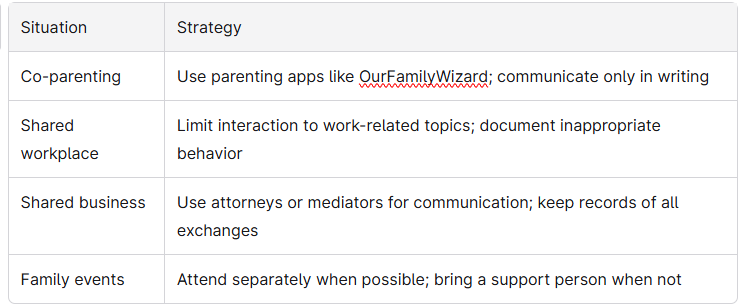
Choosing safety over drama means not responding to baiting messages, not defending yourself to flying monkeys (people the narcissist uses to gather information or pressure you), and saving evidence instead of arguing. Your goal is to break free from the cycle, not to win the final argument.
If there are threats, stalking, or custody issues, consult with a lawyer or legal aid organization. Restraining orders, parallel parenting plans, and documented communication through the court can provide real protection.
No-Contact vs. Low-Contact: What That Actually Looks Like Day to Day
No-contact means:
No checking their social media profiles
No replying to late-night apologies or explanations
No meeting “for closure” or to return belongings (mail them instead)
No responding to birthday or anniversary messages
No accepting calls from unknown numbers
No asking mutual friends about them
Low-contact for shared children or family means:
Only written communication (text or email) that you would be comfortable showing a judge
No personal updates about your life, health, or new relationships
No emotional topics—stick to logistics only
Firm time limits for calls and custody exchanges
Using third parties for drop-offs when possible
Sample scripts for low-contact communication:
“I will be there at 3:00 p.m. for pickup as per the schedule.”
“That doesn’t work for me.”
“Please put that request in writing.”
“This is not something I’m willing to discuss.”
Indirect contact—through friends, relatives, or shared group chats—keeps the trauma bond alive even when you’re not speaking directly. Consider muting group chats, curating your news feed, and creating distance from mutual enablers who carry information back and forth.
If You’re Afraid to Leave: Safety Planning and Legal Considerations
If you’re still in the abusive relationship and afraid of retaliation, financial ruin, or losing custody, your situation requires strategic planning rather than impulsive action.
Narcissistic abuse can escalate to a life threatening situation when the narcissist’s control is threatened. This is especially true if there has been any history of physical violence, threats, or extreme jealousy. Leaving safely may mean leaving strategically.
Basic safety planning steps:
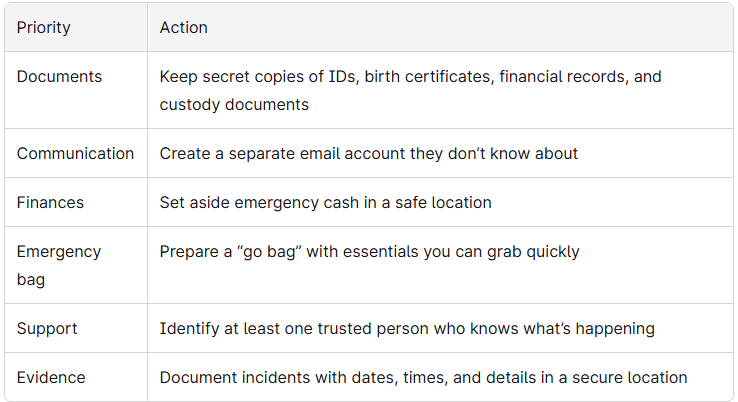
Contact domestic violence hotlines for guidance specific to your situation. Legal aid clinics can explain protective options such as temporary restraining orders, emergency custody motions, and documentation standards that courts require.
Step 2: Stabilize Your Nervous System and Stop the Emotional Whiplash
Narcissistic abuse conditions your nervous system into chronic states of fight, flight, freeze, or fawn. Your body learned to stay on high alert because the person who was supposed to be safe was actually dangerous. This isn’t weakness—it’s how trauma works in the brain and body.
Common symptoms include:
Insomnia or disrupted sleep
Startle responses to sounds, notifications, or unexpected contact
Obsessive rumination about conversations or incidents
Difficulty concentrating (brain fog)
Panic attacks or sudden waves of anxiety
Feeling numb or disconnected from your emotions
Emotional flashbacks are also normal. These are sudden waves of terror, shame, or longing that seem to come out of nowhere and aren’t connected to what’s actually happening in the present moment. They’re your nervous system replaying the past.
Simple daily regulation practices:
Slow breathing: Inhale for 4 counts, hold for 4, exhale for 6
Orienting to the room: Name 5 things you can see around you
Cold water on wrists or face: Activates the parasympathetic nervous system
Brief walks: Even 10 minutes outside can shift your state
Body scan before bed: Notice tension and consciously release it
In the first 90 days after leaving, structure signals safety to your body. Maintain consistent wake times, regular meals, daily movement, and a wind-down routine before sleep. Your system needs predictability to calm down.
Temporarily reduce stimulants that keep your system on high alert: caffeine, endless social media scrolling, conflict-heavy conversations, and news consumption. You’re not avoiding life—you’re giving your nervous system a chance to reset.

Handling Triggers, Flashbacks, and Cravings to Go Back
The urge to text the abuser, check their social media, or go back for “one more conversation” is part of trauma bonding and nervous system withdrawal. It’s not proof that the relationship was healthy or that you made a mistake by leaving.
Trauma bonds form when intermittent reinforcement—unpredictable cycles of abuse and affection—creates a chemical dependency similar to addiction. Understanding this helps you respond to cravings without acting on them.
The 24-hour rule:
When the urge to contact them hits, wait 24 hours before doing anything. During that time:
Write in a journal about what you’re feeling
Call a safe friend or support group
Go for a walk or do something physical
Read your reality-check list
Create a reality-check list:
Keep a collection of evidence from the relationship that you can review when nostalgia or cognitive dissonance makes you question whether it was really that bad:
Screenshots of cruel texts or messages
Journal entries from painful memories during the relationship
A list of specific incidents with dates
Notes from conversations with friends who witnessed the abuse
Old photos that remind you of how you felt, not just how things looked
Grounding technique for flashbacks:
Name 5 things you can see, 4 things you can touch, 3 things you can hear, 2 things you can smell, and 1 thing you can taste. This brings your attention back to the present moment and interrupts the flashback response.
Feeling attached or confused doesn’t mean you’re weak or that you made the wrong decision. It means you’re human, and you’re working through the natural process of breaking a trauma bond.
Step 3: Make Sense of What Happened Without Getting Stuck There
Education about narcissistic abuse, trauma bonding, gaslighting, and codependency is an important part of recovery. Understanding what happened—and that it has a name—validates your experience and helps you feel less alone.
However, there’s a difference between learning and getting stuck.
Endless consumption of content about narcissism can leave you frozen in anger, fear, or obsession. You end up knowing everything about the narcissist’s psychology but making no progress in your own life. Set limits: perhaps 20 minutes a day for education, then shift your focus to something else.
Write out your story in a timeline:
Creating a clear narrative helps you process the past and see patterns you might have missed while you were in the middle of it.
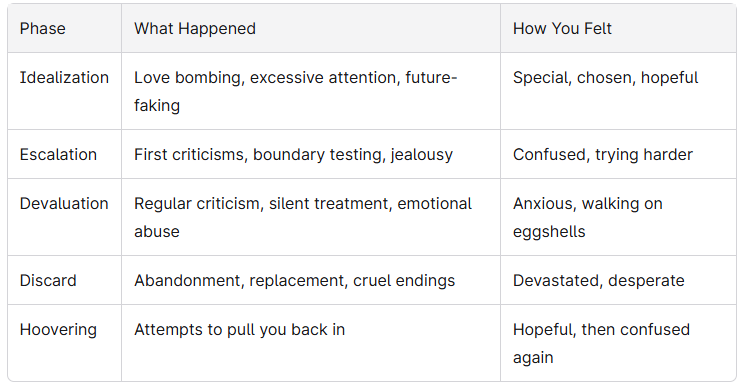
Include specific incidents and dates where possible. This becomes a resource you can return to when reality feels blurry.
Cognitive dissonance—holding two contradictory beliefs at once—is common after narcissistic abuse. You remember both the “good” moments and the abuse, and your brain struggles to reconcile them. The honest truth is that both happened, but the presence of good moments does not excuse or cancel out the abuse. Clearly labeling abusive behaviors as abuse helps resolve this internal conflict.
Reframing Self-Blame and Shame
Self-blame is one of the most persistent obstacles in narcissistic abuse healing. Most people who’ve been through this carry some version of these thoughts:
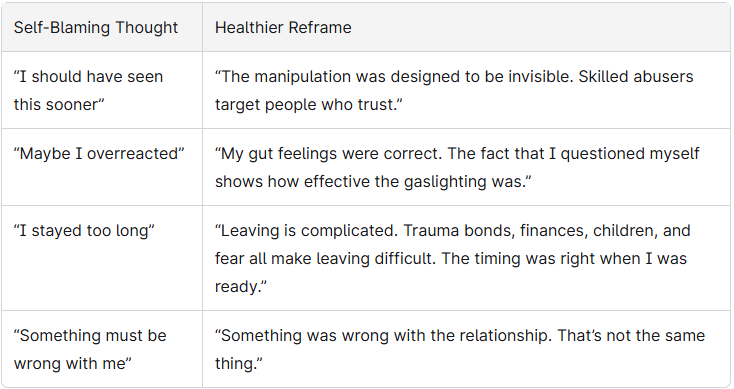
Skilled manipulators specifically target empathy, loyalty, and conflict-avoidance—qualities that are strengths in healthy relationships. You were not too trusting. You were dealing with someone who exploited trust as a weapon.
Try this exercise: Imagine a close friend describing your exact story to you. How would you respond to them? Would you blame them, or would you feel compassion and recognize what they went through? Apply that same response to yourself.
Many intelligent, high-functioning adults—including judges, lawyers, therapists, doctors, and executives—have been deceived by narcissists. Being targeted is not a sign of weakness or stupidity. Narcissistic personality disorder involves patterns of manipulation that are specifically designed to work on normal, healthy people.
Step 4: Rebuild Self-Esteem, Self-Worth, Self-Trust, and Self-Love
After narcissistic abuse, these four pillars of internal strength need to be deliberately rebuilt:
Self-esteem: How you see yourself
Self-worth: What you believe you deserve
Self-trust: Believing your own perceptions and gut feelings
Self-love: How you treat yourself
Years of criticism, minimization, and gaslighting erode all four. Recovery means actively rebuilding them through practice, not just waiting to feel better.
Research on trauma recovery programs found that structured, repeatable tasks help people regain trust in themselves. One survivor named Ana began rebuilding by making small daily decisions: she picked her own lunch, she walked down a new street, she chose what to watch in the evening. Each small step made her feel steadier.
Start with small, measurable commitments:
For your own sake, begin with actions so small they feel almost too easy:
Return one email you’ve been avoiding
Take a 10-minute walk
Make one decision without asking for anyone else’s opinion
Say no to one small request
The point is to prove to yourself that you can follow through. After years of being told you’re unreliable, incompetent, or wrong, these micro-wins rebuild the evidence that you can trust yourself.
Track daily wins:
Keep a notebook or app where you record small accomplishments every day, no matter how minor:
“Made my bed”
“Chose what to have for dinner”
“Spoke up in a meeting”
“Didn’t check their social media”
This counteracts the constant criticism you internalized and creates a new record of your capability.
Speak to yourself in plain, respectful language:
Notice how you talk to yourself internally. If you make a mistake, do you call yourself names? Would you speak to a friend that way? Practice replacing harsh self-talk with neutral or supportive statements:
Instead of “I’m so stupid,” try “That didn’t go how I wanted. I can try again.”
Instead of “I always mess everything up,” try “This was hard. I’m still learning.”
Reconnecting With Your Values and Identity
In a toxic relationship, your identity often gets subsumed into the narcissist’s needs and preferences. You may have lost touch with what you actually like, want, or believe.
List what mattered to you before the relationship:
Faith or spiritual practices
Community work or volunteering
Hobbies and creative pursuits
Career goals and professional development
Parenting style and family values
Friendships and social connections
Even if that was many years ago, those values are still part of who you are.
Write a simple personal code:
Create a list of non-negotiable standards for how you want to live:
“I do not tolerate yelling in my home.”
“I value honesty over image.”
“I maintain my own financial autonomy.”
“I trust my gut feelings even when others disagree.”
“I do not explain myself to people who have already decided not to understand.”
Take one small action per week that reflects these values:
Re-join a club or organization you used to enjoy
Update your resume
Sign up for a class
Volunteer with a cause you care about
Reconnect with an old friend
Moving on is less about “never thinking about them again” and more about building a life that aligns with who you really are.

Step 5: Build Healthy Boundaries and Safer Relationships
Boundaries are the rules you set for how people can treat you, access your time, and impact your emotional well being. They’re not punishments or ultimatums—they’re the architecture of healthy relationships.
After narcissistic abuse, boundaries may feel unfamiliar or even selfish. The narcissist likely trained you to believe that having needs was wrong and that setting limits was mean. This is false.
Examples of basic boundaries:
No yelling during disagreements
No surprise visits without checking first
No discussing legal matters outside of agreed channels
No sharing your private information without consent
No criticizing your appearance, intelligence, or character
No demanding immediate responses to messages
Early in recovery, it’s normal to swing between rigid walls (trusting no one) and no boundaries (falling back into old patterns). The goal over time is flexible, clear limits that you can adjust based on the situation and the person.
Practice boundaries in lower-stakes relationships first:
Before navigating a romantic relationship, practice with coworkers, acquaintances, and casual connections:
“I’m not available to talk right now. Can we schedule a time tomorrow?”
“That doesn’t work for me.”
“I appreciate you thinking of me, but I’m going to pass.”
These smaller moments build the muscle memory you need for bigger situations.
Recognizing Red Flags and Green Flags
After leaving a narcissistic partner, you may worry about repeating the same pattern. Learning to recognize warning signs—and healthy signs—helps you create a better future.
Red flags to watch for:
Love bombing: Excessive affection, gifts, or commitment talk very early on
Rushing commitment: Wanting to move in, get engaged, or become exclusive within weeks
Ignoring your “no”: Treating your boundaries as suggestions rather than limits
Talking badly about all exes: Everyone they’ve dated was “crazy” or “the problem”
Mocking therapy or boundaries: Dismissing emotional health as weakness
Inconsistency between words and actions
Making you feel guilty for having your own friends, money, or time
Green flags that indicate emotional stability:
Consistent behavior over months, not just impressive first dates
Respecting slow pacing without pressure or guilt trips
Taking responsibility for mistakes without excuses or blame-shifting
Comfort with you having your own friends, finances, and interests
Openness to therapy, growth, and self-reflection
Matching words with actions over time
Respecting your boundaries the first time you state them
Watch behavior across time, not just words or impressive stories. A person’s true character reveals itself in patterns, not single moments.
Discuss new relationships with a trusted, grounded friend or therapist who can help you spot patterns you might miss. When you’re still healing, your “normal meter” may be off, and outside perspective is valuable.
Step 6: Use Support and Professional Help Wisely
Seeking help is not weakness—it’s strategy. Many survivors work with therapists, coaches, legal professionals, and support groups at different stages of the recovery process.
Trauma-informed therapy modalities:
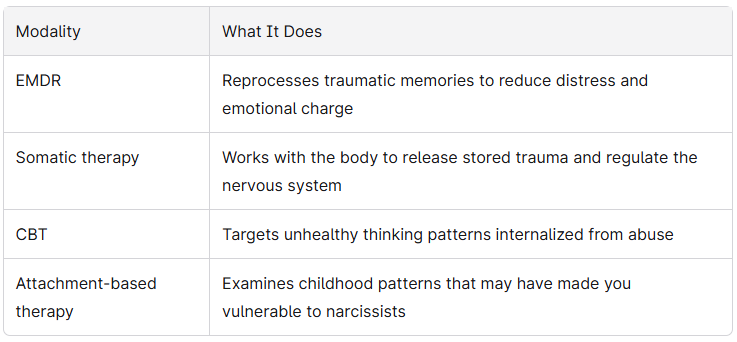
Each serves a different function. EMDR helps you process specific painful memories. CBT helps you challenge the negative beliefs the narcissist installed. Somatic work helps your body feel safe again. Attachment therapy helps you understand patterns and prevent future toxic relationships.
Vetted support groups:
Joining support groups—online or in person—where narcissistic abuse is understood provides validation and community. Look for groups that:
Focus on healing, not just venting
Do not tolerate victim-blaming
Have moderation to prevent narcissists from infiltrating
Encourage progress and forward movement
If divorce, custody, or property division is involved, consult with experienced family law or domestic violence attorneys. Narcissists often weaponize legal systems, and having knowledgeable representation protects you. This is not being dramatic—it’s being prepared.
How to Choose the Right Therapist or Support Team
Not all professionals understand narcissistic abuse. Ask specific questions in an initial consultation:
“What is your experience with narcissistic abuse or coercive control?”
“How do you approach situations where clients are being pressured to reconcile?”
“What is your stance on victim-blaming or minimizing abuse?”
Warning signs in professionals:
Minimizing your experience (“All relationships have problems”)
Rushing forgiveness before safety and accountability
Pressuring reconciliation or couples therapy while abuse is active
Suggesting you were equally responsible for the dynamic
Dismissing your concerns as exaggeration
Trust your gut. If you feel judged or dismissed after a few sessions, it’s okay—and often necessary—to find someone else.
Some survivors benefit from a “team” approach: a therapist for emotional processing, a medical doctor for sleep or anxiety issues, a lawyer for legal matters, and a small circle of safe friends for day-to-day support. You’re building a support system, not looking for one person to do everything.
How Long It Takes to Move On—and Signs You’re Actually Healing
Timelines vary significantly. Some people feel markedly different within 6–12 months of serious, focused work. Long marriages, complex custody situations, or ongoing court involvement can extend the process to several years.
Progress is not linear. The “two steps forward, one step back” pattern is normal, especially around court dates, holidays, anniversaries, or unexpected contact from the narcissist. A hard week doesn’t mean you’ve failed—it means you’re human and the process is ongoing.
Subtle signs of healing:
Less time spent obsessing about what they’re doing
Fewer urges to check their social media
Sleep becoming easier and more consistent
Moments of genuine laughter that aren’t forced
Quicker recovery from triggers (hours instead of days)
Brain fog lifting; better concentration and memory
More advanced signs of healing:
Consistently saying “no” without over-explaining or feeling guilty
Feeling bored instead of activated by drama
Noticing narcissistic tendencies and red flags early and choosing to walk away
No longer needing their validation or approval to feel okay
Building a life you actually enjoy, not just surviving
Trusting your own perception without seeking outside confirmation
Moving on is a lived experience in your body and daily choices, not a single moment of closure. You may never get an apology. You may never get acknowledgment of what they did. Healing happens anyway—it doesn’t require their participation.
Creating a Life Beyond the Abuse
At some point, the focus shifts from processing the past to building the future. This is where you intentionally design the next chapter of your life.
Ask yourself:
Where do you want to live?
How do you want to earn money?
Who do you want close to you?
What does peace look like in your daily life?
What brings you real love and genuine connection?
Concrete rebuilding moves:
Update your financial knowledge and take control of your own money
Explore new hobbies the narcissist mocked or dismissed
Take classes in something that interests you
Travel to places they refused to go
Reconnect with old photos and memories from before the relationship
Reach out to friends you lost touch with during the abuse
Redecorate your space to reflect your own taste
Some survivors eventually give back—advocacy work, mentoring others, volunteering with organizations supporting domestic violence survivors. This is meaningful but should wait until you’re more stable. You cannot pour from an empty cup.
The hard work of healing leads somewhere real: a loving relationship with yourself, healthier relationships with others, and a life that reflects your actual values rather than someone else’s demands.

A person stands confidently on a hilltop at sunrise, gazing over a vast valley, symbolizing the journey of recovery from narcissistic abuse and emotional trauma. This image represents the strength and resilience needed to break free from toxic relationships and embrace a healthier, more fulfilling life.
Your worth is not determined by what was done to you. It’s not measured by how long you stayed or how long it takes to heal from narcissistic abuse. Your worth is inherent, and you get to decide how you live from this point forward.
You do not need the narcissist’s permission to heal. You do not need their acknowledgment, their apology, or their understanding. You don’t need to explain yourself to most people who weren’t there.
Accept that it happened. Create the life you want anyway. And know that the person reading this—the one who survived, who got out, who is doing the work—that person is already further along than they realize.
The best revenge against narcissistic abuse is becoming someone who would never tolerate it again. The best life after abuse is one where you’re finally free to be yourself.
Start healing today. One decision at a time. One boundary at a time. One day at a time.
You’ve already proven you can survive the worst of it. Now prove you can thrive beyond it.