
How to Stop Being a Narcissist: 21 Real Steps to Change in 2025
Answering the Big Question Fast: Can You Actually Stop Being a Narcissist?
Yes, you can change. If you’re reading this article and genuinely asking yourself how to stop being a narcissist, that question alone separates you from the stereotype of someone completely blind to their own patterns. The honest answer is nuanced: narcissistic traits can absolutely be reduced, managed, and transformed through consistent effort. A formal diagnosis of narcissistic personality disorder NPD may not “disappear” like a cold, but the behaviors that damage your relationships, career, and well being can improve dramatically.
Let’s get the definitions straight. Narcissistic traits are patterns like needing constant admiration, struggling with empathy, reacting poorly to criticism, and putting your own needs above everyone else’s. These exist on a spectrum, and most people have at least a few. Narcissistic personality disorder is a clinical diagnosis that only a licensed mental health professional can make, based on criteria in the DSM-5 (the statistical manual used by clinicians). This article can help you recognize patterns and take action, but it cannot diagnose you.
Here’s what matters most right now: wanting to change is the first and hardest step. Research and clinical experience through 2025 consistently show that long-term therapy, genuine self reflection, and daily practice can help people manage narcissistic patterns and build healthier relationships. The brain is plastic. Behaviors are learned. What was learned can be unlearned—or at least redirected. You are not hopeless, and you are not alone.
The fact that you’re here, reading these words, means something. It means you’ve already started to recognize that something needs to shift. That recognition is not weakness. It’s the beginning of personal growth.

What Narcissism Really Is (and Isn’t)
Narcissism, at its core, is a pattern of thinking, feeling, and behaving that over-focuses on the self—on admiration, control, and being special—while under-focusing on empathy, reciprocity, and genuine connection with others. It’s not simply “being confident” or “having high self esteem.” It’s a rigid way of moving through the world that puts the self at the center of every story.
The term “narcissist” gets thrown around constantly in 2025, often to describe anyone who’s selfish, annoying, or posts too many selfies. That casual usage muddles what narcissism actually means clinically. Narcissistic personality disorder, as defined in the DSM-5-TR, is a specific mental health condition characterized by at least five of nine diagnostic criteria, including a grandiose sense of self importance, preoccupation with fantasies of success or power, belief that one is unique or special, need for excessive admiration, sense of entitlement, exploitative interpersonal behavior, lack of empathy, envy, and arrogant attitudes.
Common narcissistic traits include an inflated sense of your own abilities or achievements, expecting special treatment without earning it, difficulty hearing criticism without rage or withdrawal, talking over others, and struggling to genuinely celebrate someone else’s success. Underneath all of this often sits fragile self esteem—a secret fear that without the armor of superiority, you’re worthless.
Many people display narcissistic tendencies without meeting full criteria for the disorder. This matters because it means change is possible even for those with strong patterns. Narcissistic behaviors exist on a spectrum. You might score high on some traits and low on others. You might only display them under stress or in certain relationships. The key is recognizing where you fall and deciding what to do about it.
Personality disorders are not life sentences. They’re descriptions of patterns that can be understood, interrupted, and gradually shifted. The question isn’t whether you’re “good” or “bad.” The question is whether you’re willing to do the work.
Why You Might Be Narcissistic: Origins and Causes
Narcissistic patterns don’t appear out of nowhere. They develop from a mix of temperament, family dynamics, trauma, cultural messages, and learned coping mechanisms. Understanding where your patterns come from isn’t about making excuses. It’s about gaining the self awareness you need to stop acting them out unconsciously.
Consider the “golden child” scenario. You were born between 1990 and 2005, the only person in your family expected to achieve everything. Your parents praised you relentlessly for being smarter, more talented, and more destined for success than your siblings or peers. Every report card was a referendum on your worth. You learned that love was conditional on performance, and that being average meant being invisible. That childhood experience planted seeds of grandiosity—but also a deep terror of failure.
Or picture a different origin: growing up in a suburban household with emotionally distant or highly critical parents. Nothing you did was ever quite good enough. You were corrected constantly, mocked for mistakes, compared unfavorably to cousins or neighbors’ kids. The shame became unbearable, so you built a wall of superiority to protect yourself. If you could convince yourself you were better than everyone, maybe their criticism wouldn’t hurt so much. This is how an inflated sense of self becomes armor against low self esteem.
Then there’s the bullying scenario. Maybe you were humiliated in middle school—mocked for your weight, your clothes, your awkwardness. The pain was so intense that you swore you’d never be vulnerable again. You compensated by becoming dominant, controlling, and dismissive of others. The kid who was once a target became the one who makes sure no one can ever hurt them again.
Both excessive praise (“You’re better than everyone”) and constant criticism (“You’re never good enough”) can set the stage for narcissistic defenses. Underneath the arrogance and control, there’s almost always shame, fear of rejection, and chronic insecurity. The narcissistic personality is, in many ways, a desperate attempt to avoid ever feeling small again.
How Narcissistic Behavior Shows Up in Daily Life
Theory is useful, but patterns become real when you see them in action. Narcissistic behaviors aren’t abstract. They show up in your group chat, your bedroom, your Monday morning meeting, and your family holiday dinners.
At work, narcissistic patterns might look like dominating every conversation in a 2025 team meeting, making sure everyone knows your ideas are the best. It might mean taking credit for a colleague’s work during a presentation, then reacting with rage when your manager gives you constructive feedback. Performance reviews feel like personal attacks. You blame teammates when projects fail but hoard praise when they succeed. Over time, coworkers stop trusting you, and professional relationships become strained or superficial.
In romantic relationships, narcissistic behaviors often follow a cycle: love-bombing at the start (intense attention, grand gestures, declarations of soulmate connection), followed by devaluation (criticism, withdrawal, contempt), and then the silent treatment when your partner tries to address the problem. Jealousy flares when your partner spends time with friends. Arguments escalate because you can’t tolerate being wrong. You might rage-text at midnight, then act like nothing happened the next morning. Partners eventually feel confused, exhausted, and invisible.
Friendships suffer too. Conversations become one-sided—you talk, they listen, and when they try to share something, you redirect back to yourself. You compete with friends instead of celebrating them. When a friend gets a promotion or falls in love, you feel envy or find subtle ways to undermine their success. Eventually, many narcissists find themselves isolated, wondering why relationships keep ending.
It’s worth noting the difference between overt and covert narcissism. The overt narcissist is the loud star at parties, demanding attention and expecting admiration. The covert narcissist is quieter—the self-pitying martyr who still demands special treatment, the person who withdraws and sulks to punish others while maintaining a victim narrative. Both patterns cause harm. The covert form is often harder to recognize because it hides behind humility or helplessness.
The emotional cost of these patterns is real: loneliness, frequent breakups, job instability, family estrangement. Most people with narcissistic tendencies don’t set out to hurt others. They’re often acting out of fear and pain they don’t fully understand. But the impact on others is still damaging—and that’s why change matters.

21 Practical Steps to Stop Narcissistic Behavior
This is the core of the article: a roadmap for changing narcissistic habits through daily practice. These steps aren’t quick fixes. They require consistent effort over months and years, extending through 2025 and beyond. Real change is gradual. Relapse into old thought patterns is normal and expected.
You don’t need to do all 21 at once. Start with two or three that feel manageable. Build momentum. Add more as you gain confidence. Think of these as tools for a healthier way of living, not moral judgments about who you are.
1. Admit There’s a Problem (and Write It Down)
Denial is the engine that keeps narcissistic patterns running. The first step is to break through that denial with concrete, written acknowledgment. Pull out a notebook or open a document and write a one-page “narcissism inventory.”
Describe specific instances where your behavior hurt someone. Be precise. Write about how you dismissed your partner’s feelings during an argument in 2023. Describe the time you took credit for a coworker’s idea in early 2024. List the complaints you’ve heard repeatedly from others: “You never listen.” “You always make it about you.” “You can’t handle any criticism.”
Seeing these patterns in writing weakens the defenses that keep you from seeing yourself clearly. Try these journaling prompts:
“The last time someone told me I hurt them, I reacted by…”
“A pattern I keep repeating in relationships is…”
“If I’m honest, the trait people dislike most about me is…”
2. Learn Your Personal Triggers
Not every situation sparks narcissistic behaviors equally. You need to identify your specific triggers—the recurring situations that set off defensiveness, rage, or grandiosity.
Common triggers include being corrected in a team meeting, seeing a sibling praised on social media, waiting in a long line at the DMV, or feeling ignored at a party. For the next 14 days, keep a “trigger log.” Each time you notice a narcissistic reaction (anger, contempt, withdrawal, superiority), write down:
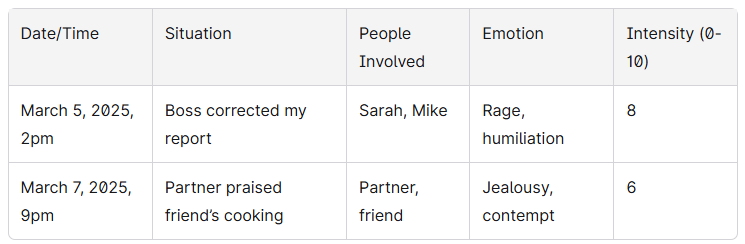
The purpose is recognition. When you know your triggers, you can catch early warning signs before behavior escalates.
3. Slow Down Before You React
Speed is the enemy of change. Narcissistic reactions are often automatic—you fire back before you’ve had a chance to think. The goal here is to install a “speed bump” between trigger and response.
When you notice a trigger, pause. Take three to five slow breaths. Count to ten before speaking or typing.
Imagine this scenario: On March 3, 2025, your boss sends an email criticizing your presentation. Your first impulse is to fire back a defensive reply explaining why they’re wrong. Instead, you close the email. You take five deep breaths. You count to ten. You wait an hour before responding. When you do reply, you ask a clarifying question instead of attacking.
This pause shifts you from automatic defense to deliberate choice. It’s simple, but it’s not easy. Practice it until it becomes habit.
4. Ask Yourself: “What Am I Really Feeling Underneath?”
Anger and superiority are often cover emotions. Underneath, there’s usually something more vulnerable: shame, fear, jealousy, embarrassment, grief. Learning to dig deeper into your emotional experience is essential.
When you feel rage or contempt rising, ask yourself: “If I couldn’t be angry or superior right now, what would I actually feel?”
Here are some common translations:
Rage after criticism → Fear of being seen as incompetent, like your father was before he got fired in 2009
Contempt toward a successful friend → Jealousy and fear that you’re falling behind
Needing to dominate a conversation → Loneliness and fear of being invisible
Naming the real feeling takes away some of its power. It also helps you respond to what’s actually happening inside you, rather than lashing out at the other party.
5. Time Yourself When You Talk
One of the clearest signs of narcissistic tendencies is conversational dominance. You talk, others listen, and you barely notice the imbalance.
For the next month, run an experiment. During at least three conversations per week, set a discreet timer on your phone. After the conversation, estimate what percentage of the time you were speaking. If it’s consistently above 60-70%, you have work to do.
Practice the “50/50 rule” in one-on-one conversations. Aim to speak roughly half the time and listen half the time. At the end of 30 days, review your results. Has the balance shifted? Do conversations feel different?
This builds awareness of dominance without shaming. It’s data, not judgment.
6. Practice Real Listening, Not Waiting to Talk
There’s a difference between hearing words and actually listening. Real listening means eye contact, nodding, reflecting back what you heard (“So you’re saying…”), and asking follow-up questions. It means being genuinely curious about the other person’s experience, not just waiting for your turn to speak.
Challenge yourself: Have one 10-minute conversation daily where you do not refer to yourself at all. Ask questions. Stay curious. Resist the strong urge to redirect to your own stories.
Try questions like:
“How did that feel for you?”
“What happened next?”
“What was the hardest part?”
“What are you hoping will happen?”
This trains your brain away from constant self-focus and toward empathy. Over time, it becomes more natural.
7. Stop Making Everything About You
Hijacking conversations is a classic narcissistic habit. Your friend mentions they’re going through a health scare, and within two minutes, you’re monologuing about your own medical issue from 2022. Your coworker shares exciting news, and you immediately one-up them.
Try this rule: For every one personal story you share, ask at least one question focused entirely on the other person.
Old pattern: Friend says, “I’m so stressed about my mom’s surgery.” You say, “Oh, that reminds me of when my dad was in the hospital. Let me tell you about that…”
New pattern: Friend says, “I’m so stressed about my mom’s surgery.” You say, “That sounds really scary. What have the doctors said? How are you holding up?”
Start catching and mentally labeling “me-talk” versus “you-talk.” The goal isn’t to never share yourself. It’s to make conversations a two-way street.
8. Accept That Perfection Is Impossible
Perfectionism and narcissism are deeply intertwined. Many narcissists need to be the best at everything—the top salesperson every quarter, the most admired person at the party, the one with the most impressive life. Anything less feels like failure. This creates an impossible standard that makes sense to you internally but damages everything around you.
List three real-life mistakes you made in the last 12 months and survived. Maybe you failed an exam in May 2024 and still moved forward. Maybe you went through a breakup and you’re still here. Maybe you made a mistake at work and didn’t get fired.
Create a personal mantra like “Good enough is still good” or “I can be valuable without being perfect.” Put it on your phone lock screen. Write it on a sticky note on your bathroom mirror. Repeat it when the perfectionism flares.
9. Learn to Take Criticism Without Exploding
For people with narcissistic traits, criticism feels like annihilation. It triggers old wounds, fear of humiliation, and a desperate need to defend the carefully constructed self-image. But learning to handle criticism without exploding is one of the most important skills you can develop.
Practice a three-step response:
Pause. Take a deep breath. Resist the urge to interrupt or defend.
Thank the person. Say something like, “Thank you for telling me that.”
Ask one clarifying question. “Can you give me an example?” or “What would have worked better?”
Here’s a script for a performance review: Your manager says your presentation lacked focus. Instead of arguing, you say, “I appreciate the feedback. Can you point me to a specific section that felt unfocused? I want to understand so I can improve.”
Start practicing with low-stakes feedback—a critique from a hobby group, a suggestion from a casual acquaintance. Build your tolerance before facing high-stakes settings.
10. Stop Blaming Everyone Else
A hallmark of narcissistic patterns is the belief that you’re always the wronged one. In your stories about breakups, job losses, and family conflicts, you’re the victim and everyone else is the villain. This protects your self-image but prevents real growth.
Try this exercise: Take one recent conflict and rewrite the story. Include one honest sentence starting with “My part in this was…”
For example: “My relationship ended because my partner was too demanding and critical. My part in this was that I dismissed their concerns for months and refused to go to couples therapy when they asked.”
Shared responsibility builds maturity and trust. Even when the other person contributed to the problem, acknowledging your role makes change possible.
11. Retire the Silent Treatment and Passive Aggression
The silent treatment is a form of control that often echoes childhood experiences—maybe a parent withdrew affection after misbehavior, leaving you alone with your fear and confusion. Now you use the same tactic on partners and friends. It feels like power, but it destroys trust.
Replace withdrawal with clear, simple statements:
Before: Going silent for three days after an argument.
After: “I’m really upset right now and need 30 minutes to calm down. I’ll come back to talk after that.”
Passive-aggressive behaviors—sarcasm, backhanded compliments, “forgetting” to do things—are equally damaging. Practice direct statements instead:
Before: “Oh, nice job on the project. I guess someone had to do it eventually.”
After: “I felt frustrated that the project took longer than expected. Can we talk about how to prevent that next time?”
12. Learn to Apologize Properly
Many narcissists have never learned to apologize in a healthy way. They might offer non-apologies (“I’m sorry you felt that way”) or turn apologies into self-flagellation that the other person has to comfort them through.
A real apology has four parts:
Name the behavior. “When I mocked you in front of your family…”
Acknowledge the impact. “…you felt humiliated and hurt.”
Take responsibility. “That was wrong of me. I shouldn’t have done that.”
Offer repair. “I’m going to work on not putting you down in public. Is there anything else I can do to make this right?”
Here’s an example: “I’m sorry for publicly making fun of you at the barbecue on July 4, 2024. I saw how embarrassed you were, and I should never have done that. I’m committed to speaking about you with respect, especially in front of others. I understand if you need time to trust me again.”
An apology is not a confession of worthlessness. It’s a sign of strength and personal growth.
13. Do Small, Quiet Acts of Kindness
Narcissistic patterns often rely on external validation—praise, admiration, recognition. You do kind things because of how they make you look, not because of how they help others. To break this pattern, practice kindness that no one sees.
For 30 days, do at least one kind act per day without posting it on social media or telling anyone. Ideas:
Help a neighbor carry groceries.
Send a supportive text to a friend going through a hard time.
Volunteer one Saturday at a local shelter.
Let someone merge in traffic without honking.
Leave a generous tip for a server.
Track these acts privately in a journal—not online. The goal is to reduce dependence on praise and build a sense of self worth that doesn’t require an audience.
14. Assume Other People Aren’t Your Enemies
Narcissistic thinking often includes paranoia: “They’re disrespecting me.” “They’re trying to embarrass me.” “They didn’t reply because they don’t care.” You assume hostile intent where none exists.
For one week, try a “benefit of the doubt” experiment. When someone does something that feels like a slight, assume neutral or positive motives first.
A late text reply → They were busy at work, not rejecting you.
A short email → They were in a rush, not being cold.
A neutral expression in a meeting → They’re tired, not judging you.
Reframe two or three recent incidents where you assumed the worst. What might a neutral explanation look like? This reduces the fear and anger that fuel narcissistic reactions.
15. Act the Opposite of Your First Impulse
This technique—sometimes called “opposite action”—is simple but powerful. When your impulse is to brag, ask a question instead. When your impulse is to attack, pause or leave the room. When your impulse is to take credit, give it to someone else.
At a 2025 work happy hour, you feel the pull to dominate the conversation with your accomplishments. Instead, you ask a colleague about their recent project and listen without interrupting. It feels uncomfortable at first. That discomfort is a sign you’re stretching.
Try this experiment once per day for two weeks. Write down what the impulse was, what you did instead, and what happened. Over time, the opposite action becomes less effortful.
16. Practice Self-Compassion Instead of Self-Hatred
Here’s a paradox many people miss: underneath narcissistic grandiosity, there’s often intense self-loathing. The arrogance is a defense against shame. When the defense cracks, many narcissists swing to the other extreme—brutal self criticism that’s just as destructive.
Self compassion is the middle path. It means speaking to yourself as you would to a close friend, especially after mistakes. It means acknowledging your flaws without drowning in shame.
Try this exercise: Write a letter to yourself dated today. Acknowledge both your flaws and your efforts to change. “I know I’ve hurt people with my behavior. I also know I’m trying to do better. I’m allowed to struggle. I’m allowed to be imperfect. Growth takes time.”
Kindness to yourself makes it safer to be kind to others. You can’t pour from an empty cup.

17. Accept and Name Your Baggage
Your narcissistic patterns didn’t come from nowhere. They developed as responses to specific experiences—a parent leaving in 2007, being mocked for your body in high school, never feeling good enough for your family.
Try creating a brief “timeline of pain.” List years and key events:
2003: Parents divorced; felt abandoned by father.
2008: Bullied in middle school for weight.
2012: Rejected by first serious romantic partner.
2019: Passed over for promotion; felt invisible.
Owning this history helps you stop unconsciously reenacting it on partners, friends, and coworkers. When you know why you react the way you do, you can choose differently. Consider bringing this timeline to therapy when you’re ready.
18. Build Mindfulness and Emotional Awareness
Mindfulness means noticing your thoughts and feelings in the present moment without immediately reacting or judging. For people with narcissistic tendencies, mindfulness can catch entitlement, anger, or superiority before these internal states turn into harmful behaviors.
Start small. Commit to a 5-minute daily practice—use a guided app, do a breathing exercise, or take a mindful walk after work. A good time to start is January 2025: make it a New Year’s practice.
During the practice, notice when your mind wanders to thoughts of superiority, resentment, or victimhood. Don’t judge. Just notice. The noticing itself is the practice.
19. Set Boundaries With Yourself, Not Just Others
We often talk about setting healthy boundaries with other people. But self-boundaries—limits you place on your own behavior—are equally important.
Examples of self-boundaries:
No checking ex-partner’s social media after midnight.
No yelling during arguments.
No interrupting more than once per meeting.
No firing off angry texts before waiting 15 minutes.
Choose two or three specific, measurable self-boundaries to follow for the next 30 days. Do a weekly self-check-in: Did I respect my boundaries this week? Where did I slip?
Self-limits increase freedom and self-respect. They’re not restrictions—they’re a way of being the person you want to be.
20. Let Go of the “Benefits” of Being Narcissistic
Narcissistic behaviors come with perceived payoffs: attention, power, fear from others, short-term wins at work or in dating. If there were no benefits, you wouldn’t keep doing it.
Make two lists:
What narcissistic behaviors have gotten me:
Quick promotions between 2020 and 2022
Attention at parties
Partners who initially seemed impressed
What these patterns have cost me:
Broken trust with three close friends
A marriage that ended in 2023
Strained relationship with my sister
Two jobs I left after conflicts with coworkers
When the long-term costs feel more real than the short-term benefits, change becomes possible. The goal is to tip the inner balance.
21. Commit to Ongoing Therapy and Support
Deep narcissistic patterns rarely change without long-term, consistent therapy. Self-help is valuable, but a trained professional can see blind spots you can’t, provide a safe space for vulnerability, and guide you through the underlying issues that self-help articles can’t reach.
Evidence-based approaches that help include:
Cognitive Behavioral Therapy (CBT): Challenges distorted thought patterns and changes behaviors.
Dialectical Behavior Therapy (DBT): Builds skills in emotion regulation, distress tolerance, and interpersonal effectiveness.
Psychodynamic therapy: Explores unconscious conflicts and patterns from childhood experiences.
Schema Therapy: Addresses maladaptive patterns rooted in early life.
Look for a licensed therapist experienced with personality issues and relational trauma. Since 2020, telehealth options have expanded significantly, making professional help more accessible in 2025. Group therapy can also accelerate change by providing safe feedback from others in similar situations.
Asking for help is a strength and a turning point. It’s not a defeat.
Therapy, Diagnosis, and When to Seek Professional Help
Only licensed mental health professionals can diagnose narcissistic personality disorder. Self-diagnosing from social media or online quizzes is unreliable and often leads people to either overidentify or dismiss real problems. If you suspect you have NPD or significant narcissistic traits, seek a formal diagnosis from a qualified clinician.
Signs it’s time to seek treatment:
Multiple partners or friends have called you narcissistic or said you lack empathy.
You’ve had repeated job losses following conflicts with supervisors or colleagues.
Family members are estranged—maybe by late 2024, you’re no longer invited to holidays.
You feel intense shame after outbursts but can’t seem to stop them.
Relationships keep ending the same way.
When you go to your first therapy session, bring specific examples and timelines. Dates of breakups, job changes, major conflicts—these details help your therapist understand your patterns. Be honest about why you’re there, even if it feels uncomfortable.
Many people first seek therapy for anxiety, depression, or addiction, and only later realize that narcissistic patterns are part of the problem. That’s okay. Mental health issues often overlap, and a good therapist can help you see the full picture. Research shows that up to 50% of people with NPD also experience depression, and 21% struggle with substance use.
Treatment is not a quick fix. Studies suggest that committed patients can see 20% or more symptom reduction, but this often takes a year or longer. Dropout rates are high—up to 63% in the first year—because confronting your patterns is painful. But those who stay the course report improved relationships, career stability, and genuine self acceptance.
Can You Really Change Narcissistic Patterns? A Realistic Outlook
Let’s be direct: narcissistic personality disorder, as a deep character structure, may not “vanish.” But day-to-day behavior, empathy, and relationship quality can improve significantly. Research shows that psychotherapy for personality disorders has a strong effect (effect size 0.8 in recent meta-analyses), particularly when individuals are motivated and consistent.
Change is gradual. Measure your progress over months and years, not days. Track milestones from spring 2025 to spring 2026: fewer blow-ups, more genuine apologies, deeper friendships, more stable work relationships. Some symptoms may attenuate naturally with age and maturity as you gain perspective through life experience.
The goal isn’t to become “small” or “unimportant.” The goal is to become more fully human—capable of both strength and genuine connection. You can still be ambitious, confident, and successful. The difference is that you’ll build those things on a foundation of authenticity rather than fear.

A person sits at a quiet desk, writing thoughtfully in a journal, reflecting on their feelings and experiences. This scene highlights the importance of self-reflection and personal growth, which can be essential for individuals dealing with mental health issues like narcissistic personality disorder and its associated traits.
If you’ve read this far, you’ve already taken a step that most people with narcissistic patterns never take. That makes sense—you’re ready to do something different. Don’t let this moment pass.
Take one action today. Write the first page of your narcissism inventory. Start your trigger log. Book a therapy consultation for this week. Send a genuine apology you’ve been avoiding. The person who finishes reading this article is already different from the one who started.
Change is possible. It’s not easy, and it’s not fast. But it’s real. And you can start right now.