
How to Stop Emotional Manipulation (Step-by-Step Guide)
Introduction: Take Back Control From Emotional Manipulators
Emotional manipulation happens in places you’d never expect: the partner who makes you apologize after they hurt you, the parent whose “guilt trips” ruin every holiday, the boss who denies promises they made last month, the friend who freezes you out until you “fix” whatever upset them. These patterns often go unnoticed for months or years because they don’t look like obvious abuse. They look like normal conflict—until you notice you’re always the one feeling confused, ashamed, or wrong.
Here’s the reality: you can start protecting yourself today, even if the manipulator never changes. You don’t need their cooperation or their permission.
Emotional manipulation involves patterns of behavior designed to distort your reality, make you feel guilty, or pressure you into choices that don’t feel right. The manipulator may be doing this consciously or they may have learned it from their own upbringing. Either way, the impact on your mental health and self esteem is the same.
Common red-flag feelings include walking on eggshells before seeing them, constant guilt without clear wrongdoing, second-guessing your own judgment, or feeling “crazy” after arguments you started with a valid concern.
This article will show you concrete signs of emotional manipulation and give you clear, practical steps to stop it—starting with what you can do in your next conversation. The approach here is grounded in evidence-based thinking, personal responsibility, and the belief that honest relationships require clarity, not confusion.

What Is Emotional Manipulation? (And What It Isn’t)
Emotional manipulation means using fear, guilt, confusion, or obligation to control someone’s decisions, feelings, or version of reality. It’s not a single argument or a moment of frustration. It’s a pattern where one person consistently benefits while the other feels worse, more confused, and more controlled.
The difference between normal conflict and manipulative behavior is straightforward:
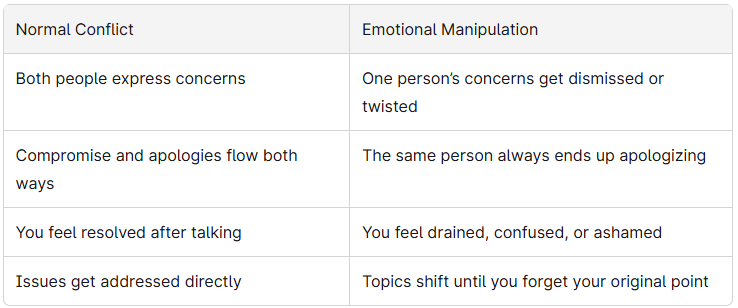
Consider these real-world scenarios:
Workplace: Your boss says, “You’re imagining I promised that raise; you must have misheard.” You have the email, but now you’re doubting yourself.
Family: Your parent sighs, “After all I’ve sacrificed, you can’t skip one trip for the holidays?” You end up canceling plans you’d looked forward to for months.
Romantic relationship: You bring up their lateness and somehow the conversation ends with you apologizing for “overreacting.”
Emotional manipulation can be intentional or learned unconsciously from family dynamics. But the impact remains harmful regardless of intent. The key to recognizing manipulation is identifying repetitive patterns, not isolated mistakes.
Early Signs You’re Being Emotionally Manipulated
Your emotions and body are often your earliest warning system. Before you can name what’s happening, you can feel that something is wrong.
Internal signs to watch for:
Chronic self doubt after conversations, even when you entered feeling confident
Guilt or shame that appears without a clear reason
Feeling responsible for another adult’s moods
A sense of dread before seeing, calling, or texting them
Feeling confused about what actually happened
Behavioral signs:
Compulsively apologizing, even when you didn’t do anything wrong
Deleting texts or hiding conversations to avoid “evidence” of your own words
Rewriting events in your head to match their version
Canceling plans with others to keep them calm
Walking on eggshells to avoid triggering their anger
After-argument feelings:
“I don’t even remember what we were fighting about”
“I started out upset with them, but somehow I ended up apologizing”
“I feel drained, not relieved, after we talk”
“I keep second-guessing whether I was being fair”
Quick self-check: Think about your last three tense conversations with this person. Did they end with you feeling confused, guilty, or ashamed—even though you raised a legitimate concern? If yes, you’re likely dealing with manipulation, not normal conflict.
Common Emotional Manipulation Tactics (Know What You’re Up Against)
Emotionally manipulative people use a predictable set of manipulation tactics. You don’t need to memorize jargon—you need to notice patterns that leave you feeling worse and more controlled.
Gaslighting
They deny events you clearly remember. Example: You have a text from March where they agreed to help you move. When you bring it up, they say, “I never said that. You’re over-tired and making things up.”
What it does to you: Makes you question your memory and defer to their version of reality, creating deeper self doubt.
Guilt tripping
They leverage obligation. Example: “After everything I’ve done for you, this is how you repay me?”
What it does to you: Makes you feel selfish for having normal limits, pressuring you into compliance.
Playing the victim
They reframe your complaint into their suffering. Example: You say they forgot your birthday. They respond, “Why is everyone always against me? I can’t do anything right.”
What it does to you: Deflects accountability and shifts the conversation’s focus to comforting them.
Love bombing
Early in relationships, they flood you with excessive affection—constant texts, lavish gifts, declarations of “soulmates” within weeks. Then they withdraw suddenly when you set a boundary.
What it does to you: Creates emotional dependency and makes you chase their approval.
Silent treatment
They deliberately withhold contact or affection—ignoring calls for days, sleeping separately—to punish you.
What it does to you: Weaponizes your fear of abandonment, forcing you to “fix” a situation you didn’t break.
Triangulation
They invoke third parties: “My sister thinks you’re overreacting too.”
What it does to you: Isolates you and makes you doubt yourself when “everyone” apparently agrees with them.
Passive aggression and moving goalposts
Passive aggressive behavior veils hostility in sarcasm or “jokes.” Moving goalposts means they change expectations after you’ve met the original agreement: “Great, you did X. Now you need to do Y and Z.”
What it does to you: Keeps you perpetually off-balance, never able to succeed.

Step 1: Stop the Internal Manipulation – Trust Your Own Reality
The first way to stop external manipulation is to stop undermining yourself internally. A manipulative person’s power depends on your self doubt. When you rebuild trust in your own judgment, their tactics lose effectiveness.
Name what’s happening in your head:
Tell yourself: “This conversation is making me doubt my memory and feel ashamed. That’s a sign of manipulation, not proof I’m wrong.”
Use reality-anchoring statements:
“I remember reading that text on June 12”
“I clearly said no to that request yesterday”
“My feelings are valid even if they disagree”
Keep a dated log:
On your phone or in a notebook, write down:
What was said
How they responded
How you felt immediately after
This log is for your clarity, not to “prove” anything to them. Over time, patterns become undeniable.
Grounding techniques during or after manipulative encounters:
Slow breathing: inhale 4 seconds, hold 4, exhale 6
Feel your feet on the floor
Name 5 things you can see in the room
These techniques interrupt the emotional hijack that manipulation creates, helping you think clearly.
Step 2: Learn to Name the Behavior (At Least to Yourself)
Labeling what’s happening reduces confusion and shame. When you can identify a tactic, you stop seeing it as your personal failing and start seeing it as their strategy.
Mental labels to use:
“That was gaslighting”
“That was guilt tripping”
“That was a threat of withdrawal”
“They’re not answering my question; they’re changing the subject”
“They’re using my fear of conflict to exert power”
You don’t have to say these labels out loud. The power comes from your own clarity, not from confronting them.
When to name it aloud:
If you feel safe and the person has shown capacity for reasonable dialogue, you might say: “I notice we keep shifting topics. I’d like to stay focused on what happened Sunday.”
When NOT to name it aloud:
If there’s any history of rage, threats, stalking, or physical aggression, do not confront directly. Safety planning and seeking professional support should come before any direct confrontation. Naming manipulative tactics to someone prone to violence can escalate danger.
Step 3: Set Clear Boundaries—and Actually Enforce Them
Healthy boundaries are not negotiations, lectures, or repeated warnings. They are clear statements of what you will and won’t do, followed by consistent action.
The basic formula:
“If X happens, I will do Y.”
Focus on your own behavior, not trying to control theirs.
Concrete examples:
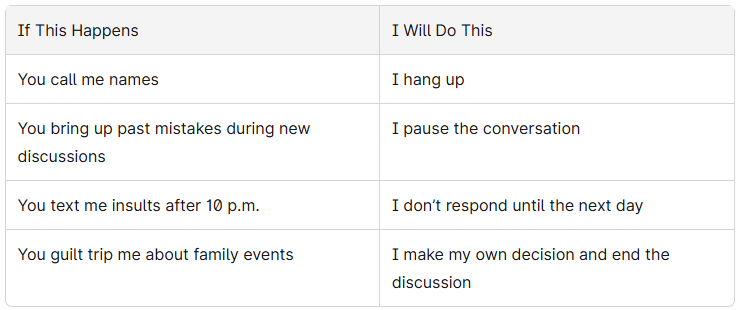
The power of a boundary is in following through. No repeated warnings, no bargaining, no pleading. You stated your limit. Now you maintain boundaries through action.
Common fears:
“They’ll call me selfish, cold, or dramatic”
“I might lose the relationship”
“My family will take their side”
These fears are valid. And here’s what’s also true: people who benefit from your lack of boundaries will always complain when you set them. That complaint is not evidence you’re doing something wrong.
Start with one or two specific, realistic boundaries in low-stakes situations. Build your confidence before tackling higher-stakes ones.
Step 4: Change How You Communicate (Without Fueling the Manipulation)
Developing emotional intelligence in difficult relationships means learning communication skills that reduce the manipulator’s leverage.
The “I feel / I need / I will” format:
“I feel disrespected when I’m insulted.”
“I need us to talk without name-calling.”
“If it continues, I will end the conversation.”
This structure keeps you factual, brief, and focused on your own needs rather than attacking their character.
The gray rock technique:
For repeat manipulators, give short, neutral responses. Don’t share emotional details. Don’t react to baiting.
Example text exchange:
Them: “You’re so sensitive. Everyone agrees you overreact.”
You: “Okay.”
Them: “That’s all you have to say?”
You: “Noted.”
Gray rock starves the manipulation of the emotional reaction it needs to thrive.
Stay on the original issue:
When they deflect or play the victim, respond: “I hear you’re upset. Right now, I’m talking about what happened on Sunday afternoon.”
Limit explanations:
Manipulative people twist extra details into ammunition. Say less. “No” is a complete sentence.
Exit when needed:
If you feel dizzy, confused, or panicked: “I need a break. We can talk later.” Then leave. No negotiation required.
Script key sentences in advance:
Before planned conversations, write down 2-3 statements you want to make. Having them ready prevents improvising under stress.
Step 5: Protect Your Support System and Outside Perspective
Isolation is one of the most powerful tools of emotional manipulators. Reconnecting with others directly weakens their control over your emotional well being.
Confide with specifics:
Tell at least one trustworthy person—trusted friends, a family member, mentor, or therapist—exactly what’s happening. Not “we fight a lot” but “they denied sending an email despite proof, and I ended up apologizing.”
Outside feedback corrects distortion:
When you’ve been manipulated, you start believing things like “Maybe I am too sensitive” or “Everyone would react like them.” A strong support system helps you see reality clearly.
Rebuild normal routines:
Maintain hobbies
Exercise regularly
Attend social events
Don’t let the manipulative relationship become the center of your world.
Safety note:
In some situations (controlling partners or family members), you may need to be discreet. Use safe communication channels. If finances, housing, or children are involved, seek support from legal advocates, domestic violence resources, or a mental health professional.
Step 6: Decide How Far You’re Willing to Go (Including Walking Away)
After establishing healthy boundaries and changing your communication, assess the results.
Questions to ask yourself:
Has their behavior improved, stayed the same, or worsened?
Do they show sustained change, or just temporary apologies followed by the same patterns?
Am I spending more energy managing this relationship than any other part of my life?
Pay attention to actions, not apologies. Repeated “I’ll change” without sustained change manipulative behaviors is itself manipulation.
Possible decisions:
Reducing contact frequency
Limiting topics you’ll discuss
Restructuring living arrangements
Ending the relationship entirely
Planning matters:
Ending or scaling back a manipulative relationship is serious. Consider:
Financial disentanglement
Housing arrangements
Shared accounts
Childcare
Physical safety
Manipulation often escalates when the target starts to break free. Think and plan ahead rather than announcing impulsively.
Consult professionals—therapists, attorneys, domestic violence advocates—when there’s any history of threats or aggression.

When Emotional Manipulation Crosses Into Abuse
Some relationships move beyond “difficult” into territory that is emotionally, psychologically, or physically abusive.
Red flags that signal abuse:
Threats of self-harm if you leave
Threats to harm you, your children, or your pets
Monitoring your phone, location, or social media
Blocking access to money or financial sabotage
Sabotaging your work or school
Physically intimidating behavior: punching walls, blocking doors, looming
Persistent, severe gaslighting combined with isolation and control is a hallmark of coercive control—a recognized form of emotional abuse.
If these signs are present:
Safety and legal options take priority over “talking it out.” Contact local domestic violence hotlines, crisis centers, or emergency services (911 in the United States) if you’re in immediate danger.
Don’t wait for “proof” or a worst-case incident. Patterns and fear are enough reasons to seek professional help.
How Therapy and Professional Support Can Help You Stop Being Manipulated
Not everyone needs therapy to set boundaries. But many people benefit from structured, confidential professional support.
What a skilled therapist can help with:
Identify manipulation patterns you’ve normalized
Build assertiveness and communication skills
Process guilt, trauma bonds, or childhood conditioning
Develop a safety plan if needed
Understand why you’ve tolerated manipulation and develop new patterns
Couples or family therapy considerations:
Only appropriate when it’s safe and the other person shows genuine, sustained willingness to change your behavior patterns together—not just to “prove” you’re the problem.
Individual therapy benefits:
Helps you understand root causes like low self esteem, fear of abandonment, or early family dynamics that made you vulnerable to emotionally manipulative people.
Additional support:
For high-conflict separations involving shared finances, property, or children, legal or mediation support may be essential. Seeking professional guidance isn’t weakness—it’s strategic.
Quick Response Scripts to Use in the Moment
When caught off guard, having pre-planned sentences helps you respond without losing your ground.
For gaslighting:
“I remember it differently, and I trust my memory.”
“We won’t resolve this by debating my reality.”
For guilt tripping:
“I understand you’re disappointed, and I’m still not able to do that.”
“Feeling guilty doesn’t mean I’m doing something wrong.”
For playing the victim:
“I’m sorry you feel hurt. We still need to talk about what happened last night.”
“Both of us have feelings here; I want to address my concern too.”
For silent treatment:
“I’m ready to talk when you are, but I won’t chase you for a conversation.”
“If you don’t want to discuss this by tomorrow evening, I’ll make informed decisions on my own.”
Generic exit script:
“I’m not willing to continue this conversation while I’m being insulted. I’m stepping away now.”
Modify language to fit your personality. What matters is the boundary and calm tone, not perfect wording.
Rebuilding After Emotional Manipulation: Long-Term Healing
Life after a manipulative relationship requires rebuilding what was eroded: your self esteem, your trust in your own judgment, and your sense of what healthy relationships look like.
Rebuild self-respect through routines:
Regular sleep, exercise, and meals
Hobbies you enjoyed before the relationship consumed everything
Self care practices that feel genuinely nourishing
Journal about early red flags:
What did you ignore or minimize at the beginning? Understanding this helps you recognize warning signs faster in future close relationships.
Relearn trust in yourself:
Start making small decisions without seeking approval. Then build to larger ones. Each independent choice strengthens your personal growth.
Practice self-compassion:
Notice critical inner voices that sound like the manipulator’s desires projected onto you. Replace them with kinder, more accurate messages about your worth.
Understand healing timelines:
Feeling numb, angry, or confused for months after leaving is normal. It’s not proof you made the wrong choice or that seeking support was premature.
Track progress with concrete markers:
Fewer panic responses to unexpected texts
More days spent feeling peaceful
Increased ability to say no without hours of guilt
Better stress management during difficult conversations
Building self esteem after manipulation takes time. Progress isn’t linear, but it is possible.
Conclusion: You Can Choose Clarity Over Confusion
Emotional manipulation thrives on confusion, guilt, and self doubt. But small, consistent steps—trusting your perception, setting clear boundaries, seeking support from trusted friends or a mental health professional—can dismantle its power.
You don’t need the manipulator’s permission to change how you respond. You don’t need them to admit they were wrong. You only need to take responsibility for your own behavior and your own well being.
Choose one practical action from this article to implement in the next 24-48 hours:
Start a dated log of conversations
Script one boundary statement
Schedule a therapy consultation
Tell one trusted person what’s happening
You are responsible for your decisions, not for someone else’s reactions. You have the right to relationships grounded in honesty, respect, and healthy relationship dynamics. Developing emotional intelligence around manipulation helps you make better choices in every area of life.
The path forward requires clarity, not confusion. Start today.