
Is Being a Narcissist Bad?
The short answer is no—being a narcissist is not automatically bad. But the longer answer matters far more for anyone trying to understand their own behavior or protect themselves from someone else’s.
Narcissistic traits exist in varying degrees across the population. Confidence, ambition, and a healthy sense of self importance are not problems. They help people succeed, advocate for themselves, and navigate competitive environments. The trouble starts when these traits become rigid, extreme, and harmful to others over time. When someone meets the clinical criteria for narcissistic personality disorder NPD, the impact on relationships, work, and mental health can be severe—not just for the person with the disorder, but for everyone around them.
NPD is a mental health condition, not a moral verdict. But the behaviors that come with it—chronic blame-shifting, lack of empathy, exploitation of others—can feel deeply harmful, sometimes crossing into narcissistic abuse. This article takes a legal-psychology-informed perspective, focusing on fairness, accountability, and real-world impact on families, courts, and relationships.
Key points to understand:
Having some narcissistic traits is common and often useful
Narcissistic personality disorder requires clinical diagnosis using DSM-5-TR criteria
NPD is a disorder, not a character flaw, but people remain responsible for their actions
The “badness” of narcissism depends on specific behaviors and their impact on others
Protection, boundaries, and accurate information matter more than labels
What Do We Mean by “Narcissist” vs. Narcissistic Personality Disorder?
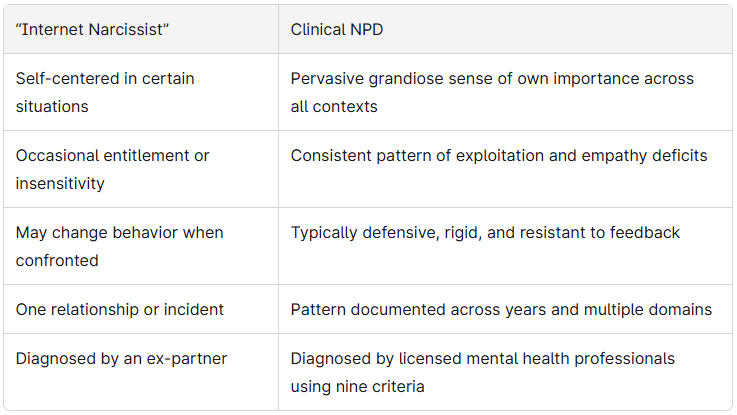
The word “narcissist” gets thrown around constantly—on social media, in dating conversations, and at work. Usually, it describes someone who seems self-centered, entitled, or excessively vain. But there’s a significant gap between calling someone a narcissist and the clinical diagnosis of narcissistic personality disorder.
NPD, as defined by the American Psychiatric Association in the Diagnostic and Statistical Manual (DSM-5-TR, updated in 2022), is a pervasive pattern of grandiosity, excessive need for admiration, and lack of empathy. It must begin by early adulthood, appear across multiple contexts, and meet at least five of nine criteria. A mental health provider diagnoses NPD through structured interviews, behavioral history, and observation over time—not from a single argument or an annoying social media post.
Most narcissistic people you encounter don’t have NPD. Many simply show narcissistic traits in specific settings or during stressful periods.
Healthy Narcissism vs. Harmful Narcissism
Not all narcissism is pathological narcissism. Psychologists recognize “healthy narcissism” as normal self esteem, ambition, and pride that allows people to function well without chronically harming others. The difference lies in flexibility, empathy, and accountability.
Healthy narcissism shows up when a teenager takes pride in good grades without belittling classmates. It appears when a lawyer confidently argues a case in court while still listening to colleagues. It looks like an entrepreneur in 2025 pitching investors with conviction while accepting partner feedback. These people can feel good about themselves without needing constant praise or special treatment from everyone around them.
Harmful narcissism is different. It involves repeated entitlement, inability to accept responsibility, and consistent exploitation of partners, children, colleagues, or clients over months and years. The sense of self becomes dependent on being superior, and other people exist primarily to provide favorable treatment or admiration.
Healthy vs. Harmful Contrasts:
Healthy: Confidence with empathy | Harmful: Superiority with contempt
Healthy: Ambition that includes collaboration | Harmful: Success at others’ expense
Healthy: Resilience to criticism balanced by self-reflection | Harmful: Even rage at the slightest criticism
Healthy: Pride in achievements with recognition of others | Harmful: Taking credit while blaming others for failures
Healthy: Boundaries that protect without exploiting | Harmful: Manipulation disguised as boundaries
Some narcissistic traits genuinely help in competitive environments—courtrooms, high-level negotiations, politics. But they become bad when empathy, ethics, and accountability disappear.
How Can Being a Narcissist Hurt Other People?
The “badness” of narcissism is mostly about impact. Persistent narcissistic behavior affects partners, children, coworkers, and communities in documented, measurable ways.
In romantic relationships, patterns often follow a cycle: intense love-bombing that creates emotional dependency, followed by devaluation where the partner can never do anything right, then discard when the narcissistic person moves on. This emotional abuse leaves lasting damage. In workplaces, narcissistic bosses steal credit, scapegoat employees, and create environments where turnover runs 20-30% higher than average. In family settings, a parent who always has to be right instills lifelong self-doubt in children.
Research through the 2010s and 2020s documents consistent patterns: lack of emotional empathy, chronic blame-shifting, gaslighting, boundary violations, and cycles of idealization-devaluation-discard. Victims experience two to three times higher rates of clinical depression. Many develop anxiety, complex trauma symptoms, and damaged sense of self worth that takes years to rebuild.
In legal contexts—custody battles, financial disputes, harassment claims—narcissistic traits escalate conflict. People with NPD may use power plays, file strategic motions to exhaust the other party, make false allegations, or use children as weapons. This prolongs litigation, increases costs, and inflicts emotional damage on everyone involved.
Specific harms to illustrate:
Chronic invalidation where one person’s emotions are always wrong or exaggerated
Financial exploitation through entitlement to shared resources or hidden spending
Emotional whiplash from intermittent reinforcement—unpredictable cycles of kindness and cruelty
Gaslighting that makes partners question their own memory and perception
Retaliatory behavior after any perceived slights or challenges to authority
Using children to send messages, gather information, or punish an ex-partner
Community damage through divisive arrogance and reputation attacks
Are Narcissists “Bad People,” or Is It More Complicated?
Labeling someone a “bad person” feels satisfying but oversimplifies a complex picture of personality disorders, upbringing, trauma, and choices.
NPD is a recognized mental disorder, not a moral identity. Neurobiology plays a role—research shows alterations in prefrontal cortex function affecting empathy. Genetics contribute 40-60% of variance. Early experiences matter too: childhood emotional neglect, inconsistent praise that rewarded performance over emotional attunement, or environments that punished vulnerability. Understanding these other factors doesn’t excuse adult harm, but it does complicate simple moral labels.
People with NPD are still responsible for their actions. Once harm is pointed out, continued harmful behavior is a choice. The ethical approach separates person from behavior: avoid calling anyone inherently bad, but describe specific behaviors that are abusive, manipulative, or dangerous.
The online trend of calling ex-partners or difficult relatives “narcs” often lacks clinical rigor. Someone can be selfish, immature, or difficult without meeting diagnostic criteria. Accuracy and fairness matter—rushing to label people damages credibility and can even become its own form of manipulation.
Balanced examples:
A demanding boss who pushes hard but gives credit fairly—difficult, not abusive
A parent who needs to be right but responds to firm boundaries—high-conflict, not dangerous
A partner who stonewalls during arguments but shows genuine remorse afterward—struggling, not exploitative
A malignant narcissist who combines grandiosity with cruelty, aggression, and paranoia—potentially dangerous
An ex who made you feel bad during the relationship—possibly narcissistic, possibly just incompatible
Can You Have a Relationship with a Narcissist Without It Being Bad for You?
Many people cannot easily leave a narcissistic partner, parent, boss, or co-parent. Divorce decrees don’t end co-parenting. Quitting a job isn’t always financially possible. Family ties don’t disappear. So the practical question becomes: how do you protect yourself?
Outcomes depend on several factors: severity of traits, willingness to work on bad behavior, safety level, and your own support network. A relationship with someone who has mild narcissistic traits and genuine motivation to change looks very different from one with someone showing covert narcissism who manipulates through victimhood, or a malignant narcissist who becomes dangerous when challenged.
High-level strategies:
Set clear boundaries and enforce them consistently without lengthy explanations
Recognize love-bombing and rapid intensity as early red flags, not romance
Practice gray rocking—minimal emotional response to provocations—in unavoidable contact
In co-parenting, communicate in writing only, stick to facts, avoid emotional arguments that can be twisted
Build independent support systems: friends, family, therapists, support groups who understand the dynamics
Document incidents in case legal protection becomes necessary
Accept that some relationships are not fixable and focus on managing rather than healing them
In some situations—domestic violence, escalating threats, stalking—the relationship is not just “bad” but unsafe. When physical safety is at risk, professional help from law enforcement, attorneys, or domestic violence resources takes priority over relationship management. Suicidal thoughts or severe depression in response to ongoing abuse require immediate mental health intervention.

Is Narcissism Ever Useful or “Good” in Modern Life?
Some narcissistic traits are genuinely adaptive in competitive environments. Politics, high-stakes litigation, corporate negotiations, and high-profile media careers often reward confidence, resilience against criticism, and comfort with visibility. A lawyer who can’t handle being attacked in cross-examination won’t last. An entrepreneur who crumbles at investor skepticism won’t raise capital.
The distinction lies between adaptive narcissism and maladaptive narcissism. Adaptive narcissism includes self love that enables bold risk-taking, confidence that withstands setbacks, and self-promotion that opens doors. Maladaptive narcissism involves ruthlessness, chronic exploitation, dishonesty, and treating others as tools rather than people.
Public figures in the 2010s and 2020s demonstrate both patterns. Some appear intensely self-promotional but remain subject to public accountability, oversight, and legal constraints. Others show unchecked narcissism that eventually backfires—leading to scandals, broken trust, lawsuits, or professional isolation. Research suggests unchecked narcissism correlates with 40% higher long-term failure rates due to trust erosion.
When mild traits can help:
Comfort with public speaking and visibility in leadership roles
Resilience that allows recovery from criticism or setbacks
Confidence in negotiations without backing down prematurely
Ability to self-promote in competitive job markets or entrepreneurship
Risk tolerance that enables innovation and bold decision-making
The key is balance. These traits become harmful when empathy disappears, ethics bend, and accountability to others vanishes.
How Is Narcissistic Personality Disorder Diagnosed and Treated?
Only licensed mental health professionals—typically psychiatrists or clinical psychologists—can diagnose NPD. Self-diagnosis from online quizzes or social media posts doesn’t count, and neither does your confident assessment of your ex.
Diagnosis requires meeting at least five of the nine criteria in the DSM-5-TR, present across time and situations, starting by early adulthood, and causing significant distress or impairment. These criteria include grandiose sense of self-importance, fantasies of unlimited success, belief in being special, excessive need for admiration, sense of entitlement, exploitative behavior, lack of empathy, envy, and arrogant behaviors.
NPD often overlaps with other mental health conditions: depression (about 50% comorbidity), anxiety (40%), substance use (30%), bipolar disorder, or other personality disorders like antisocial personality disorder. This complicates both diagnosis and treatment, requiring a mental health provider who can assess the full picture.
Treatment usually centers on long-term psychotherapy. Options include mentalization-based therapy (building empathy), schema therapy (restructuring maladaptive patterns), or psychodynamic approaches (understanding defenses). Medications may help with comorbid conditions but don’t specifically treat NPD.
How therapy can help people with NPD:
Increasing self-awareness about impact on others
Softening defensive reactions to feedback or perceived slights
Building genuine empathy rather than performed concern
Learning healthier relationship patterns
Managing shame and vulnerability that often underlie grandiosity
Developing tolerance for imperfection and criticism
Reducing reliance on constant praise and admiration
Treatment is challenging. Many people with NPD feel attacked by feedback and only seek treatment after a crisis—divorce, job loss, legal consequences. Dropout rates run 50-70%. But motivated individuals can make meaningful progress with sustained effort.
What If You Recognize Narcissistic Traits in Yourself?
Many people see some narcissistic traits in themselves when reading about NPD. This doesn’t automatically mean you have the disorder. Self absorption during stressful periods, defensiveness when criticized, or needing reassurance from a partner are common human experiences.
The key questions involve patterns and flexibility. How often do these behaviors show up? Who gets hurt? Can you change when you try? If you feel guilty or uncomfortable after realizing you’ve dismissed someone’s emotions or dominated a conversation, that discomfort itself signals empathy—something largely absent in severe NPD.
If you’re worried about being “a bad person,” this concern points away from rigid, inflexible NPD and toward an opportunity for growth. The difference matters.
Action-focused suggestions:
Journal about specific incidents: what happened, how others reacted, how you feel now
Ask trusted people for honest feedback about patterns they’ve noticed
Notice when you take things personally that aren’t about you
Practice listening without planning your response or interrupting
Spend time considering others’ perspectives before reacting
Seek a qualified therapist for proper assessment rather than relying on online quizzes
Focus on behavior change rather than identity labels
Professional evaluation provides clarity. A mental health provider can distinguish between narcissistic traits, other mental health conditions, and actual NPD requiring treatment.
When Is Narcissism Not Just Bad, but Dangerous?
Malignant narcissism represents the extreme end where narcissistic traits merge with cruelty, aggression, or antisocial personality disorder features. This goes beyond “difficult” into genuinely unsafe.
These patterns require different responses than ordinary relationship conflicts. When someone combines grandiosity with paranoia, vindictiveness, and willingness to harm others, moral debates about mental disorders become secondary to immediate safety.
Red-flag behaviors that indicate danger:
Credible threats of violence or retaliation
Stalking or surveillance after a relationship ends
Physical violence or escalating intimidation
Financial sabotage: destroying credit, hiding assets, draining accounts
Using the court system as a weapon: filing false allegations, manipulating custody processes
Weaponizing children against the other parent
Revenge campaigns: reputation attacks, contacting employers, harassment of new partners
Real-world cases show these patterns in repeated restraining orders, harassment campaigns after breakups, or strategic lies under oath to win custody battles. The goal becomes destruction rather than resolution.
In these situations, prioritize safety planning and legal protection. Contact local law enforcement, seek orders of protection, work with attorneys experienced in high-conflict cases, and reach out to domestic violence resources. Stay calm in documentation but act decisively in protection.
How to Protect Yourself If You’re Dealing with a Narcissist
You cannot “fix” a narcissist. Only about 20-30% engage meaningfully with therapy, and that requires their own motivation, not your efforts. What you can control is how you respond and how much access they have to your time, emotions, and resources.
Understanding the narcissist in your life might feel important, but it can become a trap. Endless research about their childhood or psychological profile doesn’t protect you. Focus instead on understanding your own limits, rights, and options. This aligns with reclaiming your voice and well being rather than getting lost in their disorder.
Protective principles:
Document incidents in writing with dates, specifics, and any witnesses
Limit personal disclosure—information becomes ammunition
Set personal boundaries clearly and enforce them without lengthy justification
Keep expectations realistic: consistency and empathy are unlikely
Build support systems independent of the narcissistic person’s sphere
In legal conflicts, communicate in writing only and stick to facts
Seek support from therapists, support groups, or trusted friends who understand the dynamics
Practice self care to maintain your own mental health and sense of self
Consult attorneys when behavior crosses into harassment, financial abuse, or safety threats
Setting healthy boundaries isn’t selfish—it’s necessary. The goal is protecting healthy relationships and your own functioning, not winning arguments or getting acknowledgment.

So, Is Being a Narcissist Bad?
Being a narcissist is not inherently bad. Narcissistic traits exist on a spectrum. Mild traits can be neutral or even helpful—confidence, ambition, resilience. But persistent, extreme narcissism and narcissistic personality disorder are often deeply harmful to relationships, workplaces, and families.
The question isn’t whether narcissists are “bad people.” It’s whether specific behaviors cause harm and what you’re willing to accept. NPD is a mental health condition, not a moral category. But people with NPD remain responsible for their actions, especially once harm becomes clear. Those affected have a right to safety, healthy boundaries, and support.
Move away from blanket labels. “All narcissists are evil” is no more accurate than “narcissists are just misunderstood.” Instead, evaluate specific behaviors, their impact, and the risk they pose in your particular situation. Some people recognize traits and work to change. Others never will. Your job isn’t to diagnose them—it’s to protect yourself and make informed decisions.
If narcissistic behavior has harmed you, seek accurate information, psychological support, and when needed, legal guidance rooted in evidence and fairness. Change is possible for some individuals. Protection is essential for others. Clear thinking serves you better than internet outrage.