
Narcissistic Parents: How to Deal (Practical Steps to Protect Yourself)
Quick answers: what to do right now if you have a narcissistic parent
If you’re reading this, you’ve probably spent years wondering if you’re the problem. You’re not. What follows are concrete steps you can take starting today—not vague advice about “understanding” your parent, but real actions to protect your mental health and reclaim your life.
Do these things this week:
Write down 3 recent situations where you felt manipulated, confused, or “crazy”—this is evidence, not a judgment on you
Identify one person you can safely talk to about what’s happening (a trusted friend, partner, therapist, or support group member)
If you feel unsafe today, limit contact—you don’t need permission to protect yourself
Stop arguing to “prove” your side or convince your parent they’re wrong
Start a brief written record of incidents (date, what was said, how you responded)
Remind yourself: you do not have to win arguments or make your parent admit they are narcissistic
Your job is not to fix them—it’s to protect your own well being
Here’s something that took me years on the bench to fully understand: you will never win an argument with someone whose entire identity depends on being right. That’s not pessimism—that’s strategy. When you stop trying to convince them and start focusing on what you can control, everything shifts.
The sections that follow will cover setting firm boundaries, dealing with aging or victim-style narcissistic parents, protecting your own children, and long-term healing. Whether you’re 35 or 65, still financially dependent or living across the country, there’s a path forward.
What is a narcissistic parent (without getting lost in labels)?
Let’s be clear about something: this isn’t about diagnosing your parent with narcissistic personality disorder. Many damaging parents are never formally diagnosed, and frankly, you don’t need a clinical label to set boundaries with someone who hurts you.
What matters is behavior and impact—specifically, a pattern where the parent’s excessive need for admiration, control, and being “right” consistently outweighs your need for safety, truth, and care.
The clinical definition of narcissistic personality disorder, according to the DSM-5, involves an unreasonably high sense of one’s own importance, a deep need for excessive admiration, and a profound lack of empathy. But narcissistic traits exist on a spectrum. Your parent might have narcissistic tendencies without meeting the full diagnostic criteria—and the damage can be just as real.
Narcissistic parenting typically looks like this: the parent sees their children as extensions of themselves rather than as independent people with their own rights, feelings, and identity. Your achievements exist to boost their ego. Your failures embarrass them. Your boundaries threaten them.
These dynamics can exist in mothers, fathers, step-parents, and grandparents. They’re often amplified by stressors like divorce, financial trouble, or aging. A narcissistic mother might use emotional manipulation to keep you close; a father might rely on authoritarian control. Both exhibit behaviors that prioritize their needs over yours.
Understanding this isn’t about blame—it’s about clarity. When you can name what’s happening, you can stop doubting yourself.
Common signs you’re dealing with a narcissistic parent
No parent will show every sign on this list. What matters is consistent patterns over years—not the occasional bad day or stressed reaction, but a predictable script that plays out again and again.

Constant criticism is often the baseline. Nothing you do is quite good enough. Your career choice, your partner, your parenting, your body—all fair game for negative comments delivered as “helpful advice” or “just being honest.” The message underneath is always the same: you need their approval to be acceptable.
Public shaming serves a specific purpose in narcissistic behavior: it maintains control by humiliating you in front of others. This might happen at graduations, weddings, holiday gatherings, or casual dinners with extended family. The narcissistic parent needs to be the center of attention, even when the event is about someone else—especially when the event is about someone else.
When confronted about their behavior, narcissistic parents become the victim. Suddenly, you’re the ungrateful child attacking your poor, sacrificing parent. They may cry, rage, give the silent treatment, or recruit other family members to pressure you back into line. This victim narcissism is particularly confusing because it flips reality: the person causing harm presents themselves as the one being harmed.
Gaslighting is perhaps the most disorienting tactic. Your parent denies past events (“I never said that”), minimizes the impact of their actions (“You’re too sensitive”), or rewrites history entirely. After enough years of this, adult children often genuinely struggle to trust their own perceptions.
Favoritism and triangulation between siblings create lasting damage. The “golden child” receives conditional love and praise while the “scapegoat” carries the family’s projected failures. At family gatherings, parents might share information selectively, telling each person a different version of events to create drama and maintain control over family dynamics.
Poor boundaries are standard. Opening your mail. Commenting on your body or finances. Demanding access to your private relationships as if they have an automatic right to know. Showing up unannounced. Making phone calls at all hours expecting immediate response.
If you’ve spent decades wondering whether you’re the problem—especially because your parent appears charming and reasonable to outsiders—that confusion itself is evidence. Narcissistic parents are often skilled at managing their public image while reserving their cruelest behavior for closed doors.
How narcissistic parents affect children into adulthood
The survival strategies you developed as a child don’t disappear when you turn 18 or move out. They follow you into adult life, shaping relationships, work, and how you feel about yourself in ways that can take years to untangle.
People-pleasing isn’t a personality trait—it’s an adaptation. When love was conditional on meeting your parent’s needs, you learned to read moods, anticipate demands, and twist yourself into whatever shape kept the peace. Chronic guilt about prioritizing your own needs, difficulty setting boundaries, and the persistent feeling that you must earn love through performance—these aren’t character flaws. They’re logical responses to an illogical environment.
Low self esteem is one of the most common legacies of narcissistic abuse. Years of belittling, humiliation, and being told your perceptions are wrong create an internalized critical voice—what some therapists call the “traitor within”—that repeats your parent’s judgments whenever you try to rest, succeed, or say no.
Emotional regulation becomes challenging when you were never taught it. If your parent was allowed to explode emotionally while you were forbidden from expressing feelings, you may struggle with anxiety, depression, or an inability to identify what you’re actually feeling. The research supports this: children of narcissistic parents show elevated risks of mental health conditions including anxiety disorders, depression, PTSD, and even personality disorders.
Relationally, the patterns persist. You might choose partners who are controlling or emotionally unavailable because that dynamic feels familiar. Or you over-function in every relationship—at work, with friends, with your spouse—because caretaking is your default mode. Fear of abandonment if you stop performing keeps you locked in exhausting cycles.
These effects collide with practical realities in adulthood. You may feel obligated to become power of attorney for a parent who was never truly caring. You might be expected to manage their medical decisions, their finances, their emotional crises—all while your own life, marriage, and children take a backseat.
Understanding these patterns isn’t about self-blame. It’s about finally having an explanation for why stepping out of old roles feels so impossibly hard.
Manipulation tactics narcissistic parents commonly use
Naming the tactics is the first step toward refusing to play your assigned role. When you can see the manipulation clearly, you gain the ability to respond strategically instead of reactively.
Gaslighting makes you question your own reality. “That never happened.” “You’re imagining things.” “You’ve always been dramatic.” After years of this, many adult children of narcissistic parents genuinely don’t know what’s true anymore.
Guilt trips leverage your love against you. “After everything I’ve done for you.” “I guess I’m just a terrible mother then.” “Fine, I’ll just sit here alone.” The message: your needs are selfish, and meeting them makes you a bad person.
Obligation narratives treat the parent-child relationship as a debt. “I’m your mother—you owe me.” “I sacrificed everything for you.” The implication is that you can never repay what you owe, so you must keep giving indefinitely.
The silent treatment punishes you for having boundaries or opinions. It can last hours, days, or weeks, and you’re expected to apologize even when you did nothing wrong.
Triangulation pits family members against each other. Your narcissistic parent might tell your younger brother one story and you another, creating conflict where none existed. They might recruit other relatives to pressure you. This keeps everyone off-balance and focused on the parent’s narrative rather than forming independent relationships.
Financial manipulation is particularly effective with adult children. Offers of help with rent, childcare, or medical bills come with strings attached. Accept the money, accept the control. “Emergencies” that require your time and resources appear at suspiciously convenient moments—right before your vacation, your child’s birthday, or any event where you might be unavailable.
Drama creation follows a predictable calendar. Arguments escalate before holidays. Health crises emerge when attention shifts away. Wills and estate planning become tools for favoritism and control. These aren’t coincidences—they’re strategies to maintain control and ensure the parent remains the center of everyone’s focus.
Victim narcissism deserves special attention. Some narcissistic parents constantly present themselves as helpless, financially ruined, chronically wronged, or extremely jealous of others’ success. This keeps adult children feeling indebted and responsible for rescuing them—over and over, indefinitely.
Understanding these tactics is liberating. You’re not crazy, oversensitive, or ungrateful. You’ve been responding normally to manipulative behavior.
How to deal with a narcissistic parent: step-by-step strategies
Here’s the hard truth: you probably cannot make your parent change. People with entrenched narcissistic patterns rarely seek help because they don’t believe anything is wrong with them. They may react to confrontation with denial, rage, or retaliation.
But you can radically change how much power their behavior has over your daily life. That’s not resignation—that’s reclaiming your own life.
Your approach will differ depending on your circumstances. If you’re still living with your parent or financially dependent, your options are more constrained than if you’re an independent adult in another city. Both situations require strategy; they just require different strategies.
Start with internal work. Accept that you may never receive the apology, validation, or “normal parent” you deserved. This grief is real and needs to be acknowledged. The parent you needed didn’t show up, and no amount of perfect behavior on your part will change that. Mourning this loss is part of the healing process.
Shift from persuading to protecting. Stop trying to make your parent understand, admit fault, or change. Every hour you spend explaining, arguing, or presenting evidence is an hour lost. Instead, focus on what you will and won’t accept.
Here’s a simple example. Instead of: “You always criticize my parenting and it’s hurtful because I’m doing my best and you should be more supportive…” Try: “I’m not discussing my parenting with you. How about those Cardinals?” If they persist: “I told you I’m not discussing this. I’m going to hang up now. Talk to you next week.”
Define your non-negotiables in writing. What will you no longer tolerate? Yelling? Name calling? Racist remarks around your children? Criticism of your spouse? Write them down. These aren’t negotiations—they’re your limits.
For some people, low contact becomes the healthiest option—reducing interactions to brief, structured encounters with clear time limits. For others, going no contact is necessary for survival. And for some, maintaining limited contact with strong boundaries works best. There’s no universal right answer, only what’s right for your situation.
Setting and enforcing boundaries that actually work
Boundaries are not about changing your parent. They’re about deciding what you will do when a line is crossed.
This distinction matters because narcissistic parents often interpret boundaries as attacks to be defeated. Expect pushback. Expect guilt trips. Expect the behavior to escalate before it settles—if it settles at all. Your job isn’t to make them accept the boundary; it’s to enforce it consistently.
Concrete boundary examples:
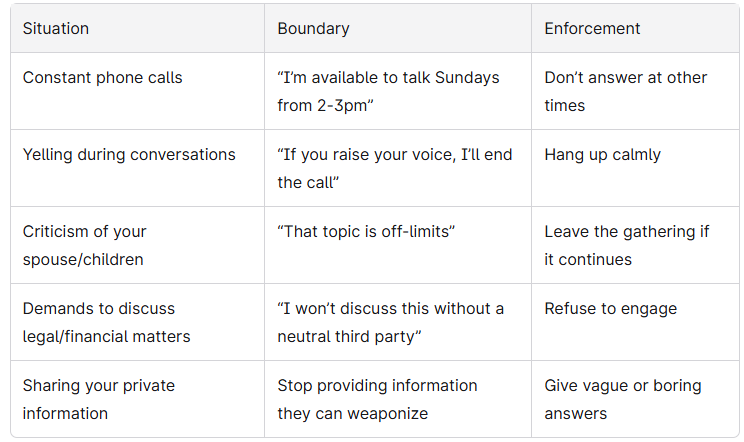
Keep your statements brief and clear. Long explanations invite debate. “I’ve decided not to discuss my marriage with you” is complete. You don’t need to justify it.
Protecting your own children requires specific boundaries. Limit unsupervised time with narcissistic grandparents who undermine your rules, criticize your children, or try to create secrets. Cut off conversations where grandparents compare grandchildren or play favorites. Your children’s safety and self esteem come first.
Document patterns. Keep notes on dates, what was said, and how you responded. This isn’t paranoid—it’s practical. Documentation becomes essential if legal or medical decisions later become contested among siblings, or if you need to demonstrate a pattern to a therapist, lawyer, or family member who doubts you.
Resisting gaslighting and protecting your reality
If you’ve spent years being told your perceptions are wrong, your memory is faulty, and you’re “too sensitive,” rebuilding trust in yourself takes time. You’re not crazy—you’ve been systematically trained to doubt your own experience.
Practical tools for protecting your reality:
Keep a private journal of interactions. Write down what happened immediately after encounters, while details are fresh
Save texts and emails. Create a folder you can reference when you start doubting yourself
Compare current events to long-standing patterns. Ask yourself: “Have I seen this exact dynamic before?”
Develop mental scripts you can repeat internally during conversations: “They rewrite history to protect their image. I don’t have to accept their version as truth.” “This is the gaslighting pattern. My memory is accurate.”
When your parent denies obvious facts, state your position once and disengage. “That’s not how I remember it” is sufficient. You don’t need to prove anything. Circular arguments where you present evidence and they deny it endlessly are designed to exhaust you into submission.
Limit alcohol or other disinhibitors at family events when possible. These can make emotional manipulation more volatile and impair your ability to maintain boundaries.
A mental health professional can specifically help rebuild self-trust through approaches like cognitive behavioral therapy, EMDR, or Internal Family Systems therapy. If you have a long history of minimizing your own perceptions, professional support accelerates healing.
When compassion meets self-protection
You can have compassion for your parent’s wounds while refusing to accept ongoing abuse. These aren’t contradictory positions—they’re the foundation of a more healthy relationship with yourself.
Your parent may have had a difficult childhood. They may have their own unaddressed trauma, mental illness, or fears about aging. And they are still responsible for how they treat you now. Both things are true.
Compassion at a distance is possible. You can care that your parent is struggling without rushing to fix or rescue them every time they create a crisis. You can acknowledge their pain without setting yourself on fire to keep them warm.
Compassionate but firm responses:
“I’m sorry you’re lonely, but I can’t come over tonight. I’ll call you on Sunday as planned.”
“That sounds really hard. What does your doctor suggest?”
“I understand you’re upset, and I’m not going to discuss this further.”
Watch for the pull back into old roles. The “family hero” who keeps the peace at any cost. The emotional support system for a parent who never supported you. The person whose spouse, children, and own needs always come last because the narcissistic parent’s demands feel more urgent.
Your dignity and safety come first. Real compassion includes protecting the next generation from repeating the same damage. That’s not selfishness—that’s personal growth.
Special case: dealing with aging or “victim” narcissistic parents
Narcissistic traits often intensify with age. Illness, loss of independence, shrinking social circles, and fear of death can amplify the patterns you’ve dealt with for decades. Adult children frequently find themselves trapped between guilt and exhaustion, cultural expectations and self-preservation.
Victim narcissism in older parents looks like constant complaints about doctors, neighbors, other family members, and you. Everything wrong in their life is someone else’s fault. They may exaggerate frailty to demand attention, yet reject reasonable help that doesn’t center their preferences. A nursing home is unacceptable. A home health aide is insulting. Your suggestions are stupid. But you should still fix everything.

Safety vs. autonomy requires practical thinking:
Set “guardrails” appropriate to actual risk: medical alert systems, home modifications, required professional care
Involve adult protective services if there’s serious risk they’re refusing to address
Consult neutral professionals (lawyers, geriatric care managers, mediators) when family conflicts escalate
Don’t make decisions based solely on guilt—make decisions based on realistic assessment
Cultural and religious expectations often get weaponized. “Honor your parents.” “Family never walks away.” “You’ll regret this when I’m gone.” These phrases are designed to pull you back into unhealthy caretaking roles that sacrifice your own family, career, and well being for someone who never prioritized yours.
Strategies for reducing drama with aging narcissistic parents:
Keep communication brief and logistical rather than emotional
Use “gray rock” methods: neutral, boring responses that give nothing for them to work with
Avoid debating their narratives—you won’t change their mind
Establish written care agreements among siblings with clear limits on money, time, and housing
Document everything, especially financial transactions and care decisions
Stepping back, using respite care, hiring professional support, or even choosing estrangement in extreme cases can be legitimate acts of self-preservation. Reducing contact to protect your own life is not evidence that you’re ungrateful or cruel. Sometimes it’s the only path to spend time healing from decades of narcissistic abuse.
Protecting your own family and breaking the cycle
If you’re now a parent yourself, you carry the weight of what was done to you alongside the determination not to repeat it. Breaking the cycle is the hardest and most important work you’ll ever do.
Start by learning what you never experienced. Read about healthy attachment. Understand child development. Learn what secure, consistent parenting actually looks like so you can offer your own children the warmth, boundaries, and unconditional acceptance you deserved but didn’t receive.

Specific protective steps for your children:
Don’t leave children alone with a narcissistic grandparent who undermines your rules, criticizes, or attempts to create secrets
End visits when grandparents make negative comments about your child’s appearance, abilities, or worth
Monitor for triangulation: grandparents playing favorites or pitting siblings against each other
Trust your instincts when something feels wrong
How do you explain limited contact to children? Age-appropriate honesty works better than pretending everything is fine or vilifying the grandparent.
“Grandma sometimes says things that hurt people’s feelings, so we see her less to keep everyone safe.”
“Some grownups never learned how to be kind when they’re upset. We love Grandpa, and we also need to protect ourselves from unkind words.”
Model what you wish you’d seen. Apologize when you’re wrong. Validate your children’s feelings even when inconvenient. Show them that love isn’t withdrawn when they disagree, say no, or have needs of their own.
You will make mistakes—every parent does. The difference is that you’ll repair them. You’ll say “I’m sorry, I was wrong” and mean it. You’ll demonstrate that healthy relationships include rupture and repair, not silent treatment and punishment.
Breaking the cycle is a long process. You may catch yourself repeating old patterns and feel devastated. That’s normal. Each time you choose a healthy response instead of the automatic one, you’re changing the story for the next generation.
Building support and beginning long-term healing
Many people dealing with narcissistic parents feel profoundly isolated. From the outside, your family might look fine—maybe even admirable. The perfect family image your parent cultivated makes it hard for others to understand what happens behind closed doors.
This isolation is part of the trap. Breaking it is essential for healing.
Build a support network:
Trusted friends who believe you and don’t minimize your experience
A partner who understands your history and respects your boundaries
Support groups focused on narcissistic abuse or adult children of difficult parents (both in-person and online therapy options exist)
Faith communities or other organizations where you feel genuinely seen
A therapist or mental health professional experienced with family trauma
Therapy specifically helps with complex family trauma. Approaches like EMDR (Eye Movement Desensitization and Reprocessing), CBT (Cognitive Behavioral Therapy), DBT (Dialectic Behavior Therapy), and Internal Family Systems therapy address the deep patterns that formed over decades. Many therapists now work via secure online platforms, making professional help more accessible.
Self-care means more than bubble baths:
Regular sleep—not staying up scrolling because you’re too anxious to rest
Medical checkups you’ve been postponing
Physical movement that feels good, not punishing
Time away from constant crisis mode
Saying no without elaborate justification
Give yourself permission to grieve the parent you never had. This might include journaling, writing letters you never send, or rituals that symbolize letting go of impossible expectations. The grief is real. The childhood you deserved was stolen. Acknowledging that isn’t weakness—it’s the beginning of reclaiming your sense of self.
Rethinking narcissism in your family history means recognizing that you were never the problem. The parental narcissism, the lack of empathy, the conditional love—none of that was your fault, and none of it was something you could have fixed by being better, smarter, or more compliant.
Healing isn’t about pretending the past was fine. It’s about reclaiming your voice, your dignity, and your right to build relationships and a home that are sane, respectful, and safe. You’ve already survived the hardest part. What comes next is learning to thrive.
Start today:
Identify one trusted person you can talk to this week
Write down three situations where you felt manipulated—this is your evidence, your validation
Consider reaching out to a mental health professional or support group
You are not obligated to set yourself on fire to keep anyone else warm. Not even your parent. Especially not your parent. The practical advice in this guide is just the beginning—your own life, your other relationships, your well being are worth protecting. And you are more than capable of doing exactly that.