
Self Care After Narcissistic Abuse
Narcissistic abuse leaves lasting emotional, psychological, and physical impacts that continue long after the relationship ends. The manipulation, gaslighting, and constant devaluation don’t simply disappear when you walk away—they echo through your nervous system, your thought patterns, and your sense of self for months or even years afterward.
If you’re reading this, you likely know the experience intimately: the chronic self-doubt that makes you question your own memories, the guilt that convinces you everything was somehow your fault, the hypervigilance that keeps you scanning for danger even in safe spaces. You may be dealing with nervous system burnout that manifests as exhaustion, insomnia, or an inability to focus on anything for more than a few minutes.
This article focuses specifically on concrete self-care practices you can begin today to stabilize, heal, and rebuild your life. These aren’t abstract concepts—they’re actionable steps grounded in trauma-informed approaches that many survivors have used to reclaim their well-being.
You’re Not Broken
Before we go further, let this sink in: the abuse was not your fault. The confusion you feel right now is a normal response to an abnormal situation. Narcissistic abuse is designed to make you feel crazy, inadequate, and responsible for the abuser’s behavior. Feeling disoriented and exhausted isn’t a character flaw—it’s evidence of what you survived.
Acknowledge What Happened: Naming the Abuse as a First Act of Self-Care
Self-care after narcissistic abuse starts with truth. It begins with recognizing the relationship for what it actually was—emotional abuse, manipulation, control—rather than what the narcissist told you it was. This isn’t about dwelling in victimhood. It’s about respecting yourself enough to stop carrying undeserved responsibility.
Common Tactics You May Have Experienced
A narcissistic abuser typically employs a predictable set of manipulation tactics. Gaslighting makes you question your perception of reality (“That never happened—you’re imagining things”). Blame-shifting ensures that every conflict somehow becomes your fault. The silent treatment punishes you for perceived slights while keeping you anxious and desperate to reconnect. Love-bombing followed by devaluation creates an addictive cycle where intense affection is abruptly replaced by criticism and contempt.
Perhaps your narcissistic partner rewrote arguments from years past, insisting conversations never happened or that you “said things you never said.” Maybe you left interactions feeling confused, apologizing for things you couldn’t quite remember doing wrong. These experiences are hallmarks of a narcissistic relationship, not evidence that something is wrong with your memory.
Why You May Still Minimize What Happened
If you find yourself thinking “It wasn’t that bad” or “Every couple fights,” you’re not alone. Denial and minimization are survival responses, not character flaws. Your brain learned to downplay the abuse to cope with an impossible situation. Acknowledging the full reality of what happened can feel overwhelming, which is why it often happens gradually.
Naming the abuse isn’t about assigning labels to hurt someone else—it’s about giving yourself permission to stop defending the indefensible. When you can clearly see the narcissistic abuse cycle for what it was, you can begin to understand why you feel the way you do, and more importantly, you can start healing from narcissistic abuse with clarity rather than confusion.

Stabilize Your Nervous System: Immediate Self-Care for a Body in Survival Mode
Living with a narcissist keeps your body in chronic fight-flight-freeze mode. Your nervous system learns to stay on high alert, scanning for the next explosion, the next criticism, the next silent withdrawal. Even months after leaving an abusive relationship, you may experience insomnia, panic attacks, brain fog, chronic fatigue, and exhaustion that sleep doesn’t resolve.
This isn’t weakness—it’s biology. Your body is still responding to a threat that no longer exists. The good news is that your nervous system can be retrained through consistent, gentle practices.
Breath: Your First Tool
Deep breathing is one of the most accessible ways to signal safety to your body. When you exhale slowly, you activate your parasympathetic nervous system, which counteracts the stress response.
Try this simple practice: Before responding to any text or email that creates anxiety, take three slow exhalations. Make each exhale longer than the inhale—breathe in for 4 counts, out for 6 or 8. This small pause interrupts the automatic reactivity that narcissistic abuse programmed into you.
Sensory Grounding
When you feel triggered or dissociated, grounding brings you back to the present moment. A simple technique: place your feet flat on the floor and name 5 objects you can see in the room. Then notice 4 things you can touch, 3 you can hear, 2 you can smell, and 1 you can taste.
This exercise works because trauma often pulls you into the past (replaying painful memories) or the future (anticipating danger). Grounding anchors you in the present, where—in this moment—you are safe.
Movement: Start Small
You don’t need intense workouts to help your body heal. In fact, high stress from overexercising can backfire when your system is already depleted. Instead, try low-intensity movement: a 10-minute walk around the block, gentle stretching upon waking, or trauma-sensitive yoga videos designed for survivors.
Movement helps discharge the tension stored in your body from months or years of walking on eggshells. Even small amounts, done consistently, make a difference.
Nervous System Hygiene
Think of this as protecting your recovery environment. Practical steps include:
Limiting exposure to chaotic conversations or high-conflict people
Reducing caffeine after 3 p.m. to support sleep
Avoiding late-night scrolling about the narcissist or reading their social media
Creating a calming bedtime routine to signal safety to your body
Consider keeping a simple log where you track your practice (breathing, movement, grounding), the date, and how your body felt before and after. Over weeks, this builds self-trust as you notice small improvements—proof that your efforts are working.
Set and Maintain Boundaries as Self-Care
Boundaries after narcissistic abuse aren’t punishment for the narcissist—they’re emotional and physical safety measures for you. Setting boundaries is one of the most powerful forms of self-care because it protects the healing space you’re trying to create.
This is extremely difficult when trauma bonds and guilt are strong. You may still feel pulled toward the person who hurt you, or convinced that maintaining contact is somehow your responsibility. Recognizing this pattern is itself a crucial step in your healing process.
No Contact (When It’s Safe)
When possible, complete no-contact with the narcissistic abuser is the most protective option. This means blocking phone numbers, email addresses, and social media accounts. It means not checking their profiles, not asking mutual friends about them, and not responding to attempts at reconnection.
No-contact allows your nervous system to reset without constant re-triggering. It gives you space to hear your own voice again, separate from the narcissist’s constant input about who you are and what you deserve.
Structured Contact
When no-contact isn’t possible due to shared custody arrangements, legal matters, or joint property, structured contact minimizes harm. This might look like:
Communicating only via email or a court-approved co-parenting app
Using a businesslike tone with no emotional engagement
Waiting 24-48 hours before responding to non-urgent messages
Not responding to messages after 8 p.m.
Refusing to engage when there is shouting or name-calling
These structures reduce the narcissist’s ability to provoke emotional reactions and give you control over the interaction.
Boundary Scripts
Decision fatigue is real when you’re healing from relationship trauma. Writing boundary scripts in advance reduces anxiety during difficult moments. For example:
“I won’t discuss this while you’re yelling. We can continue when we’re both calm.”
“That’s not something I’m willing to talk about. Let’s stick to the children’s schedule.”
“I’ve made my decision. I’m not going to debate it.”
Having these phrases ready means you don’t have to think on your feet when you’re feeling triggered.
When No-Contact Isn’t Possible
Sometimes complete separation isn’t an option. Shared custody orders, joint business ownership, or family obligations may require ongoing interaction with someone who has narcissistic traits or narcissistic personality disorder.
The Gray Rock Method
Gray rock is a self-care tool that makes you uninteresting to the narcissist. You become as boring and non-reactive as a gray rock. This means:
Keeping responses minimal and neutral
Sticking strictly to logistics (“The pickup time is 5 p.m.”)
Avoiding personal disclosure or emotional expression
Not taking the bait when they try to provoke you
The narcissist feeds on emotional reactions—both positive and negative. When you stop providing that fuel, interactions often become less volatile over time.
Using Written Communication
Email and co-parenting apps create a written record, which is valuable if legal issues arise. They also reduce real-time emotional volatility because you have time to compose thoughtful responses rather than reacting in the moment.
Recovery Time After Required Contact
Build recovery into your schedule. After custody hand-offs or necessary meetings, plan 15-30 minutes of intentional self-care: a short walk, journaling, calling a trusted friend, or simply sitting quietly with a cup of tea. This isn’t indulgent—it’s essential maintenance for your mental health.
Practice Self-Compassion and Repair Your Inner Voice
One of the most insidious effects of narcissistic abuse is how it installs the narcissist’s critical voice inside your head. Long after the relationship ends, you may hear their words every time you make a mistake: “You’re so stupid.” “You always ruin everything.” “No one else would put up with you.”
This harsh inner critic isn’t your true voice—it’s an internalization of the abuser’s constant criticism. Self-compassion is the practice of gradually replacing that voice with one that treats you as you would treat a close friend.
A Simple Written Exercise
Take a few minutes to write down three common self-blaming thoughts that run through your mind. These might include:
“I’m too sensitive.”
“Everything was all your fault—I mean, my fault.”
“I should have left sooner.”
Beneath each one, write a compassionate, reality-based response:
“My sensitivity helped me survive. It’s a strength, not a flaw.”
“I was responding to manipulation designed to confuse me. The abuse was never my fault.”
“I left when I was able to. That took courage.”
This exercise begins rewiring the neural pathways that narcissistic abuse created. Over time, the compassionate responses become more automatic.
Mantras for Abuse Recovery
Short, believable statements can interrupt self-critical spirals. Try phrases like:
“What happened to me was real.”
“Needing respect is not asking too much.”
“I am learning, and I’m allowed to make mistakes.”
“I deserve love and kindness—including from myself.”
The key is choosing mantras that feel true, not aspirational platitudes that your brain rejects. Integrate them into existing routines: repeat them during your commute, on a lunch break, or before sleep.

A person sits peacefully in a natural setting, eyes closed, engaging in mindfulness to promote emotional well-being and self-care after experiencing narcissistic abuse. This serene moment emphasizes the importance of self-compassion and healing from emotional trauma in the journey towards recovery.
Rebuild Daily Life: Practical Self-Care Routines After Narcissistic Abuse
After leaving a long-term narcissistic relationship, daily life often feels simultaneously empty and chaotic. The routines you had—even unhealthy ones built around managing the narcissist’s moods—are gone. Creating new structure becomes a form of self-care in itself.
The Power of a Gentle Routine
A realistic daily routine doesn’t need to be elaborate. Focus on basics that support your emotional well-being and physical health:
Start with regular meals. Narcissistic abuse often disrupts eating patterns—you may have skipped meals to avoid conflict or eaten erratically due to anxiety. Returning to consistent mealtimes signals stability to your body.
Prioritize a consistent sleep schedule. Go to bed and wake up at roughly the same time, even on weekends. Sleep is when your brain processes traumatic experiences and consolidates healing.
Include light movement. Even a 10-minute walk counts. Movement releases tension and improves mood without requiring intense effort.
Add one small joy. This might be 15 minutes of reading, a cup of tea on the balcony, listening to music you love, or watching one episode of a comforting show. You deserve moments of pleasure—they’re not frivolous.
Scheduling Self-Care
Use a planner or phone calendar to block off self-care time as seriously as work meetings. This might include “no contact-checking” periods where you commit to not looking at the narcissist’s social media or obsessively reviewing old messages.
Micro-Habits That Rebuild Agency
Small actions rebuild your sense of control and self-trust. Consider:
Making your bed each morning as a first act of self-respect
Opening curtains for natural light, which supports mood regulation
Preparing a simple, nourishing breakfast instead of skipping the meal
Spending 5 minutes tidying one small area of your living space
Choose 1-2 self-care actions to practice consistently over 30 days rather than overhauling your entire life at once. Consistency matters more than intensity in narcissistic abuse recovery.
Nurturing Your Body Without Shame
Survivors often disconnect from their bodies during and after narcissistic abuse. Constant criticism about appearance, sexual coercion, or chronic stress teaches you to ignore physical sensations and needs. Reconnecting happens gently, without pressure.
Start with basic care: drinking enough water throughout the day, gentle stretching when you wake up, booking a medical checkup you’ve been postponing, or taking an unhurried shower instead of rushing through hygiene.
Movement and rest are both valid self-care. If your body signals fatigue, rest is the appropriate response—not pushing through to meet expectations that came from the abuser. Healing from narcissistic abuse takes time, and your body needs resources to do that work.
If you’re drawn to structured movement, consider trauma-informed options like beginner yoga classes that emphasize choice and self-pacing rather than performance. Walking in nature combines gentle exercise with the calming effects of natural environments.
Reconnect Safely: Social Support as Self-Care
A narcissistic partner often isolates survivors from friends, family member connections, and community. They may have criticized your relationships, created conflict with your loved ones, or monopolized your time until other connections withered. Re-connecting can feel both essential and terrifying.
Starting Small
You don’t need to rebuild your entire social life at once. Begin with one honest message to a trusted friend. Attend one local support group meeting. Join one online community moderated by trauma-informed facilitators.
Be selective about confidants. Seek out people who believe you, respect your boundaries, and don’t minimize what happened. Not everyone will understand narcissistic abuse, and that’s okay—you only need a few people who do.
Conversation Openers
If you’re unsure how to re-engage, try something like:
“I’ve been through a really confusing relationship, and I’m trying to lean on safe people again. Can I share a bit?”
“I’m working through some difficult experiences and could use support. Are you open to listening?”
These openers give the other person a chance to consent while signaling that you need genuine support, not advice or debate.
Building a Support Map
Create a simple list of 3-5 contacts you can reach out to during crisis moments or when tempted to contact the narcissist:
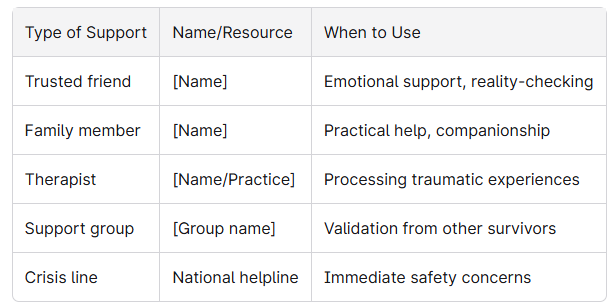
Having this map visible—on your phone or refrigerator—reduces the cognitive load of figuring out who to call when you’re struggling.
Professional Help as Self-Care
Working with a mental health professional trained in trauma recovery is one of the most powerful forms of self-care available. Options include:
In person therapy with a licensed therapist specializing in domestic violence or relationship trauma
Online therapy platforms offering trauma-informed care
Talk therapy approaches like Cognitive-Behavioral Therapy (CBT) that address distorted thought patterns
Eye movement desensitization and reprocessing (EMDR) to process painful memories
Somatic therapy to address trauma stored in the body
Dialectical Behavior Therapy (DBT) for building emotion regulation skills
Many survivors also find relief through support group settings where sharing experiences with others who understand the narcissistic abuse cycle provides validation that normalizes their experiences.

Protecting Yourself from Further Harm
Not everyone in your life will be a safe support. Some mutual friends or family members may have been charmed by the narcissist and may dismiss or question your experience. This is particularly painful with people who witnessed the romantic relationship and took the abuser’s side.
Set clear limits with invalidating people. You might say: “I’m not comfortable discussing whether it was ‘that bad.’ I need support, not debate.”
Consider taking breaks from social media accounts that keep the narcissist in your feed. Mute or unfollow contacts who frequently post about them. You don’t need to announce these decisions or explain yourself.
Choosing distance from people who undermine your reality is an act of self-care, not pettiness. Your emotional energy is a finite resource during recovery, and protecting it is essential.
Reclaim Your Identity, Purpose, and Future
Narcissistic abuse often rewrites the survivor’s internal story. The narcissist convinced you that you were unlovable, incompetent, broken, or “lucky” to have them. These messages may have eroded your self esteem until you barely recognized yourself.
Reclaiming your identity is long-term self-care. It shifts your focus from the narcissist to your own story and future—where it belongs.
Remembering Who You Are
Before the relationship, you had interests, dreams, values, and a sense of yourself. The narcissist may have mocked these things, dismissed them as unimportant, or gradually crowded them out of your life.
Gentle exploration helps you reconnect with that person. Ask yourself:
Which hobbies did I give up during the relationship?
What did I once daydream about doing with my life?
When have I felt most like myself?
What values matter to me that the narcissist dismissed or violated?
You don’t need answers immediately. Simply asking the questions opens space for your own voice to emerge again.
Taking One Brave Step Forward
Identity reclamation happens through action, not just reflection. Consider small, concrete steps toward old or new interests:
Signing up for a local art class or community workshop
Volunteering one Saturday a month for a cause you care about
Restarting a university course or professional development you abandoned
Planning a solo weekend trip to a place you’ve always wanted to visit
Reconnecting with a hobby the narcissist criticized or forbade
These steps rebuild your sense of self worth and demonstrate—through evidence—that your interests and desires matter. As one survivor described, tracking positive outcomes from your own decisions rebuilds self trust through tangible proof of your agency.
Moving Toward Fulfilling Relationships
As you heal, you develop greater self awareness about relationship patterns and warning signs. This positions you to build fulfilling relationships in the future—romantic and otherwise—with people who respect your boundaries and value who you actually are.
The goal isn’t to become suspicious of everyone. It’s to trust yourself to recognize both red flags and green ones, and to choose connections that enhance rather than diminish your well being.
Measuring Progress in Your Healing
Recovery from narcissistic abuse is non-linear. You will have setbacks, triggers, and days that feel like “back to square one.” This doesn’t mean you’re failing—it means healing is complicated, and that’s normal.
Signs of Progress
Look for these indicators that your healing journey is moving forward:
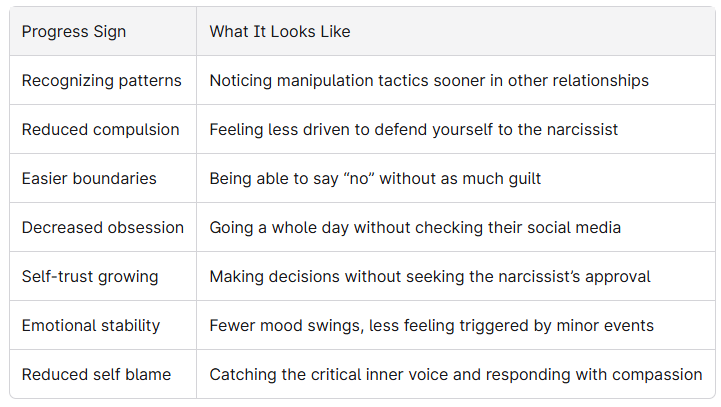
Tracking Your Journey
Consider keeping a simple journal or monthly reflection. At the end of each month, record:
Small wins (boundary you held, self-care practice you maintained)
Difficult emotions you navigated without spiraling
Moments of self-respect or self-compassion
Insights about patterns or progress
This creates a record you can look back on when you’re having a hard day and need evidence that healing is happening.
A Hopeful Truth
Every act of self-care—no matter how small—is part of reprogramming your nervous system and rebuilding self trust. The breath you took before responding to that text, the boundary you held despite guilt, the morning you made breakfast instead of skipping it—these actions accumulate.
Your brain has neuroplasticity. This means the neural pathways altered by trauma can be rewired through repeated positive experiences and structured self-care practices. Science supports what many survivors already sense: healing is possible.
You are already on the path by choosing to focus on your own care rather than the narcissist’s behavior. That choice—to turn your attention toward yourself rather than toward managing someone who harmed you—is revolutionary.
The healing process takes time. There will be difficult emotions, days when imposter syndrome tells you that you’re making it all up, moments when the dangerous idea of returning creeps in. But you have survived something that was extremely difficult, and you are building something new.
You deserve love. You deserve respect. You deserve a life where your own needs matter.
Start with one practice today. One breath. One boundary. One moment of compassion toward yourself. That’s enough for now. That’s where healing begins.