
Toxic Co Worker: How to Spot One Fast and Protect Yourself at Work
If you’ve landed on this page, chances are you’re dealing with someone at work who makes your job significantly harder than it needs to be. Maybe it’s the colleague who undermines you in meetings. Maybe it’s the person who spreads rumors about your personal life. Or maybe it’s someone whose behavior has crossed lines you never expected to see in a professional setting.
You’re not imagining things. Toxic coworkers are a documented phenomenon in organizational psychology, and their impact on your mental health, career trajectory, and daily well being is real. According to research from Harvard Business School, a single toxic worker is 10.4 times more likely to contribute to employee turnover than compensation issues alone.
This guide will help you recognize what you’re dealing with, understand why it matters, and give you several strategies for protecting yourself—whether that means setting boundaries, escalating to HR, or making a clear decision about your future at the company.
Answer First: What To Do If You Have a Toxic Co Worker Right Now
If you’re in the middle of a situation with a toxic co worker today, you don’t need a psychology lecture. You need a game plan.
The fastest way to protect yourself right now is to limit non-essential contact, keep every interaction work-focused, and start documenting specific incidents. This isn’t paranoid—it’s practical. Whether you eventually talk to HR, consult an employment attorney, or simply need to recall details six months from now, contemporaneous notes are your strongest asset.
Here are concrete actions you can take today:
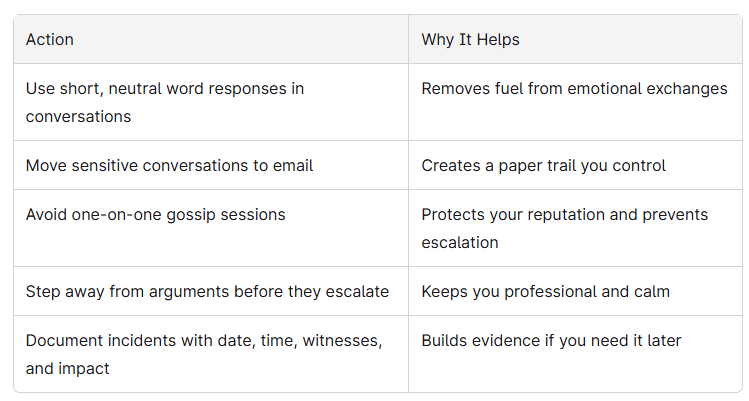
If the behavior crosses legal lines—harassment based on race, sex, age, or disability; discrimination; threats; or retaliation for reporting misconduct—review your employee handbook immediately. Consider speaking with HR or an employment attorney licensed in your state.
Here’s something worth knowing: judges like Anthony Filosa, who handle employment and harassment disputes, look for facts and evidence. They want to see a timeline, specific incidents, and credibility. Your saved emails and dated notes can be critical if your situation ever reaches that point.
Your immediate game plan:
Protect your mental health by limiting exposure
Protect your reputation by staying professional
Protect your paper trail by documenting everything

What Is a Toxic Co Worker (and What Is Just “Annoying”)?
Let’s get clear on what we’re actually talking about. A toxic co worker is someone whose repeated behavior undermines your ability to do your job, feel safe at work, or maintain your professional standing. This is not about personality clashes or someone who just rubs you the wrong way.
The difference matters because it determines your response. An annoying colleague might need a conversation. A toxic person might need HR intervention or legal action.
Toxic patterns include:
Constant undermining of your work or ideas in front of colleagues
Public humiliation during meetings or in group emails
Malicious gossip that damages your reputation
Taking credit for your projects, research, or ideas
Discriminatory remarks or “jokes” about protected characteristics
Deliberately sabotaging your deadlines or withholding critical information
Merely annoying traits include:
Being excessively chatty during focus time
Occasionally late with email responses
Disorganized desk or working style
Different communication preferences than yours
Here are a few mini-examples to illustrate:
A colleague in a Boston insurance office who repeatedly tells clients that your analysis is “unreliable” and then swoops in to “save” the account is exhibiting toxic behavior. A colleague who sometimes forgets to reply to your Teams messages is just busy.
A team member on a 2023 hybrid tech team who “forgets” to invite you to the key sprint planning call three weeks in a row, then presents your code as their own work, is creating a toxic environment. A teammate who prefers Slack over email is just different.
Recognizing the distinction helps you pick the right response: coaching versus boundary-setting versus formal complaint. And remember—toxic behavior can come from peers, managers, or even clients. Anyone who regularly makes the workplace hostile qualifies.
Common Types of Toxic Co Workers You’ll See in Real Offices
Most toxic colleagues fall into recognizable patterns. Naming the pattern helps you pick the right tools—distance, documentation, ally support, or escalation.
The Saboteur
This person operates quietly but effectively. They withhold information you need for projects, “forget” to copy you on emails from higher ups, and set you up to miss deadlines. In a 2024 performance review season, the Saboteur might casually mention to your manager that “the client seemed confused about the timeline on your project,” without mentioning they never forwarded you the revised schedule.
They rarely leave fingerprints. Their behavior creates doubt about your competence while they maintain plausible deniability.
The Gossip Broker
This colleague collects and trades personal information like currency. They know who’s interviewing at competitors, who’s having marriage problems, and who complained about the boss last quarter. They build alliances through shared secrets, often in Slack DMs or during off-site lunches.
The Gossip Broker thrives on creating conflict between others while appearing friendly to everyone. If they’re telling you about Sarah’s divorce, realize they’re telling Sarah about your job search.
The Credit Pirate
The Credit Pirate presents your work as their own. In Monday meetings, they summarize the research you did over the weekend without mentioning your name. During a Zoom call with senior leadership in April 2024, they share the slides you built and accept compliments without acknowledgment.
This behavior directly damages your career trajectory by making your contributions invisible to the people who control promotions and raises.
The Volcanic Manager
This type goes from calm to explosive without warning. They might praise your work on Tuesday and publicly shame you for the same approach on Friday. Their outbursts—yelling during team calls, slamming items, sending furious emails—create a climate of fear.
Colleagues walk on eggshells, avoid voicing ideas, and spend valuable time managing around the volcano’s moods rather than doing their own work.
The Bigot in a Suit
This person traffics in microaggressions and “jokes” targeting race, gender, age, disability, or other protected characteristics. They frame offensive comments as humor (“Can’t anyone take a joke anymore?”) and position themselves as victims when called out.
Their behavior may not always rise to the legal definition of harassment in a single incident, but the pattern creates a hostile environment and can form the basis for a discrimination claim over time.
One person can combine multiple types. A manager who steals your ideas and explodes when challenged is both a Credit Pirate and Volcanic—and particularly dangerous because of the power imbalance.

Psychological and Career Impact of a Toxic Co Worker
The cost of toxicity isn’t just irritation. It can affect your health, your relationships, and your long-term career path in ways that compound over time.
Psychological impacts you might recognize:
Sunday night dread is often the first sign. That sinking feeling before Monday’s stand-up meeting, knowing you’ll have to navigate the Volcanic Manager’s mood or the Saboteur’s latest scheme. Many people dealing with toxic coworkers describe constant hyper-vigilance—tracking where the toxic person is in the office, rehearsing responses to anticipated attacks, analyzing every email for hidden hostility.
Sleep problems often follow. You wake at 3 a.m. replaying conversations, wondering if you should have pushed back harder or said less. Research on workplace stress shows that chronic exposure to toxic behavior is associated with anxiety, depression, and even PTSD-like symptoms in severe cases.
Career effects are equally serious:
People turn down promotions to avoid working more closely with a toxic colleague. They transfer out of strong departments to escape a single bad person. Between 2022 and 2024, countless professionals quit jobs they otherwise liked solely because of one coworker.
The truth is, toxic workers don’t just harm individuals—they damage teams. Measurable outcomes include increased sick days, lower productivity, stalled projects, and high turnover on specific teams. These are patterns that judges, arbitrators, and HR investigators pay attention to when assessing whether a toxic environment existed.
The spillover into personal life:
This stress bleeds into home life in predictable ways. Short fuse with family. No energy after 6 p.m. Difficulty job-searching while already burned out. Friends notice you’ve changed. Your work life becomes your whole life, and not in a good way.
If you’re noticing these impacts, that’s a signal to act—not a sign of weakness. Early recognition gives you more options.
Practical Day-to-Day Strategies for Dealing With a Toxic Co Worker
Dealing with toxic people requires specific tactics, not just positive thinking. These strategies won’t fix the toxic person—only they can do that—but they can protect you while you figure out your next move.
Communication Boundaries
Keep conversations factual and brief. When the Gossip Broker tries to pull you into discussing a colleague’s personal life, try something like: “I’m going to focus on the client deadline for Friday.” When the Volcanic Manager starts to escalate, stay calm and use neutral language: “Let’s table this until we have the data.”
The “gray rock” technique means becoming as uninteresting as possible to the toxic person. Don’t share personal information. Don’t react emotionally to provocations. Don’t engage in office politics discussions. Boring targets get less attention from toxic colleagues who thrive on drama.
Specific phrases you can adapt:
“Let’s keep this about the project timeline.”
“I’m not comfortable discussing colleagues when they’re not here.”
“I’ll need to check my notes before I can respond to that.”
“I think this would be better handled over email so we have a record.”
Physical and Digital Distancing
Create space where you can. Choose different lunch spots. If your office allows flexible seating, move your desk. Mute Slack channels the toxic person dominates. Block focus time on your calendar during hours they’re most active.
In hybrid environments, this might mean scheduling your in-office days to minimize overlap. You don’t need to announce this strategy to anyone—just implement it quietly.
Documentation in Practice
Keep a dated log in a private file—not on your work computer where IT or the toxic person might access it. Use a personal device or a locked paper notebook.
A good entry looks like this: “June 3, 2024 – 10:15 a.m., Team call – John raised voice, called my analysis ‘stupid’ in front of finance team. Maria and Lee were present. Meeting was recorded per standard practice.”
Include: date, time, location, exact quotes when possible, witnesses, and how the incident affected your work. “I had to spend two hours redoing the presentation to address concerns John raised without basis” is more useful than “John was mean.”
Building Allies
Check in quietly with trusted coworkers to see if they’ve experienced similar behavior. Don’t launch a smear campaign—just compare notes. You might find that the Credit Pirate has stolen ideas from three other team members, or that the Volcanic Manager’s outbursts have caused two previous departures.
Allies can corroborate your account if escalation becomes necessary. They can also provide reality checks when you start to doubt your perspective.
Self-Care and Coping
Take short walks after confrontations. Use PTO strategically—sometimes a mental health day prevents a bigger breakdown. If your employer offers an Employee Assistance Program, use it. Therapy or coaching can help you process the stress and plan your response.
This isn’t weakness. It’s sustainability.
When the Toxic Person Is Your Boss
Power imbalance means you need to be extra careful. Stay professional in all written communication. Gather objective evidence rather than subjective impressions. Consider whether you have allies among your boss’s peers or their supervisor who might receive a complaint more favorably.

When (and How) to Escalate: HR, Complaints, and Legal Options
Not every toxic coworker requires formal escalation. But harassment, discrimination, threats, or serious retaliation often do.
Clear triggers for escalation:
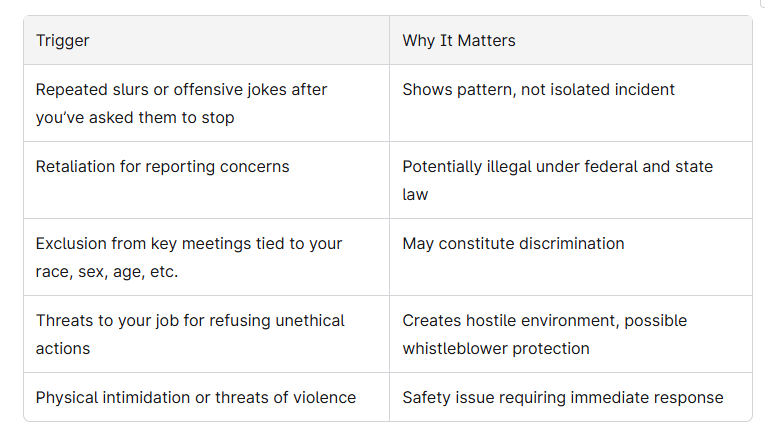
Preparing for an HR meeting:
Organize your documentation with dates in chronological order. Include direct quotes, witness names, and how each incident affected your work—not just your feelings. HR responds better to “This caused the project to miss its deadline” than “This hurt my feelings.”
Review your employer’s written policies before the meeting. Reference the exact code of conduct or anti-harassment policy being violated. This shows you’ve done your homework and frames the issue in terms the company already recognizes.
Legal considerations:
In the U.S., certain patterns may raise legal issues under federal or state law. Harassment based on a protected characteristic (race, sex, religion, national origin, age, disability, etc.) that is severe or pervasive can create an unlawful hostile work environment. Retaliation against employees who report misconduct is separately actionable.
Important disclaimer: This article provides general education, not legal advice. Anyone facing serious or escalating behavior should consider speaking privately with a qualified employment attorney in their own jurisdiction. Laws vary by state, and an attorney can assess your specific situation.
In courtrooms where judges like Anthony Filosa preside, cases are decided on evidence, credibility, and the timeline of events. Your contemporaneous notes, saved emails, and consistent story matter enormously. Judges recognize that workplace conflicts exist on a spectrum, but they also recognize when behavior crosses legal lines—and they expect plaintiffs to have documented their experience.
Emotional expectations:
Escalation can be slow and uncomfortable. HR investigations take time. You may not get the outcome you hope for. Plan for multiple scenarios: improvement, transfer, mediation, or separation.
Throughout the process, prioritize your personal safety and mental health. Seek support from friends, family, or a therapist who can help you process the experience.
Should You Stay or Should You Leave? Making a Clear Decision
One of the hardest decisions is weighing a job you otherwise like against the ongoing stress of a toxic coworker. There’s no universal right answer, but there are clear ways to think through the choice.
Decision criteria to consider:
Think about the severity and frequency of the toxic behavior. A colleague who undermines you monthly is different from one who attacks daily. Consider whether leadership takes your concerns seriously. Look at the job market in your field for 2024–2025. Assess your financial cushion—how long could you job search if needed?
When staying may make sense:
HR intervenes promptly and effectively after your report
The toxic person is moved, coached, or put on a performance plan
You secure an internal transfer to a different team
Leadership acknowledges the problem and takes visible action
The behavior stops after you set clear boundaries
When leaving is often healthiest:
Months of documented behavior with no organizational response
Escalating retaliation after you report issues
Multiple people have left the same team for the same reasons
Your mental health is significantly suffering despite your best efforts
The toxic person is protected by senior leadership
A simple decision framework:
Write out the pros of staying and the cons, with specific dates and examples. Do the same for leaving. Look at patterns. If your “cons of staying” list is filled with specific, dated incidents over many months, and your “pros” are mostly hopes for future change, that tells you something.
Ask yourself: If nothing changed over the next six months, could I sustain this? If the answer is no, start your exit strategy now, even if you don’t use it immediately.
There’s no moral failure in walking away.
Protecting your health and career trajectory is a legitimate priority. Companies often fail to address toxic behavior until the cost—in turnover, lawsuits, or reputation damage—becomes undeniable. You don’t have to pay that cost with your well being while waiting for the world to recognize what you already know.

Key Takeaways
Dealing with a toxic co worker is one of the most draining challenges in professional life. But you’re not powerless.
A toxic coworker shows a pattern of behavior that undermines others’ work, safety, or careers—not just an annoying personality
Most toxic people fit recognizable types: Saboteurs, Gossip Brokers, Credit Pirates, Volcanic Managers, and Bigots in Suits
The impact on your mental health, career, and personal life is real and documented
Practical strategies include communication boundaries, documentation, ally-building, and strategic distancing
Escalation to HR or legal channels is appropriate when behavior crosses into harassment, discrimination, or retaliation
Leaving is sometimes the healthiest choice, and there’s no shame in protecting yourself
You cannot control a toxic coworker’s behavior. But you can control your boundaries, your documentation, and—when the time is right—your exit strategy.
If you’re dealing with toxic behavior right now, start with a deep breath, then start your documentation. The evidence you gather today may be the foundation you need tomorrow.