
Why Apology Is Important
Key Takeaways
A timely, sincere apology can prevent small conflicts from escalating into relationship-ending disasters. Whether between spouses, longtime friends, or parties in a court dispute, research shows that early acknowledgment of harm reduces anger, lowers stress responses, and dramatically increases the chances of reconciliation. Most people underestimate how much a genuine apology can shift the trajectory of conflict.
Apology goes far beyond the simple words “I’m sorry.” A good apology involves taking responsibility for specific actions, showing empathy for hurt feelings, and committing to meaningful change. Without these elements, words alone ring hollow and can even make things worse.
Psychological barriers like pride, shame, and fear of appearing weak often prevent people from apologizing, even when doing so would help everyone involved. In legal and mediation settings, a well-crafted apology can lower hostility, open doors to settlement, and reduce the need for lengthy litigation. Learning how and when to apologize is a practical life skill that improves mental health, physical well-being, and long-term relationship stability.
Introduction: The Quiet Power of “I’m Sorry”
In 2023, a family gathered after a funeral to discuss an inheritance. Tensions ran high. One sibling said hurtful words about another’s absence during their parent’s final illness. The conflict threatened to fracture relationships that had lasted decades. Weeks later, that sibling reached out with a direct acknowledgment: “I was wrong to say what I said. I was grieving, but that doesn’t excuse how I treated you.” That moment became the turning point that allowed the family to work past their grief together rather than apart.
Apologies function in everyday life more powerfully than most people realize. They matter in marriage when harsh words are exchanged during an argument. They matter at work when a colleague feels disrespected. They matter between neighbors disputing property lines and between parties facing each other in court. Modern research from 2000 through 2024 consistently demonstrates that when someone receives an apology, measurable physiological changes occur: blood pressure decreases, heart rate slows, and breathing becomes steadier.
From a judicial and mediation perspective, apology often marks the precise moment when ongoing conflict transforms into durable resolution. Judges and mediators regularly witness how a single act of acknowledgment can unlock negotiations that seemed impossible. The rest of this article explores why apology matters, why it feels hard, when it’s wise, and how to do it well.
The Benefits of Apologizing

A meaningful apology benefits both the injured party and the person who caused harm. Understanding these benefits makes the temporary discomfort of admitting wrongdoing feel worthwhile.
Reducing Conflict in Personal Relationships
When spouses apologize after an argument, they interrupt the cycle of escalation that can otherwise spiral into lasting resentment. Consider a parent who snaps at a teenager after a stressful day at work. Without acknowledgment, that teen may feel hurt and withdraw. A simple “I spoke harshly, and you didn’t deserve that” can restore connection immediately.
Research shows that victims who receive an apology develop empathy toward their offenders more quickly, which accelerates the path to forgiveness. The mechanism works because acknowledging harm signals that the relationship matters more than protecting one’s ego.
Building and Rebuilding Trust
An effective apology signals reliability and moral accountability. When someone admits fault and takes responsibility, they demonstrate a deep sense of integrity that builds trust over time. In long-term relationships and professional partnerships, this matters enormously. Partners and colleagues need to know that when mistakes happen, acknowledgment and repair will follow.
Sincere apologies bring deeper respect, caring, and trust to relationships—often allowing bonds to grow stronger than before the harm occurred.
Mental and Physical Health Benefits
The benefits extend beyond relationships:
For the recipient: Lower blood pressure, calmer breathing, and reduced anxiety
For the apologizer: Relief from the debilitating effects of guilt and shame that can otherwise make someone feel physically ill
For both parties: Reduced rumination and resentment that can compromise mental health
Legal and Mediation Efficiency
In mediation and settlement conferences, a well-timed apology can soften hardened positions. When one party acknowledges harm, hostility decreases. This often leads to faster resolutions that avoid drawn-out court battles. People want to feel heard and respected, sometimes as much as they want financial outcomes.
Transforming Relationship Culture
Repeated, high-quality apologies over time can shift an entire relationship culture from adversarial to cooperative. Families, teams, and organizations that normalize acknowledgment and repair function more smoothly than those where mistakes become permanent grievances.
Why Apologizing Feels So Hard
Difficulty apologizing is normal. It’s rooted in human psychology, not simple stubbornness. Understanding these barriers makes it easier to move past them.
Emotional Barriers
Shame is one of the most powerful inhibitors. When you’ve caused harm, shame can trigger avoidance rather than repair. The discomfort of admitting fault feels overwhelming.
Fear of looking weak stops many people, particularly in contexts where power dynamics exist. A manager apologizing to an employee, or a parent to a child, may worry that acknowledging a mistake threatens their authority.
Fear of rejection also plays a role. What if the apology isn’t accepted? What if it’s used against you? These anxieties can paralyze even well-intentioned people.
Cognitive Barriers
Moral disengagement: Convincing yourself “I didn’t really do anything wrong”
Self-justification: Building narratives that explain why your behavior was understandable
Minimizing impact: Assuming the other person should be over it by now
Pride can take priority over relationships. Most people have experienced moments when they knew an apology was warranted but couldn’t bring themselves to offer one.
Legal Context Concerns
In legal settings, people sometimes avoid apology out of fear it will be construed as admission of liability. This is a significant barrier in accident cases, workplace disputes, and medical contexts. Some jurisdictions have enacted “apology laws” that limit this risk, recognizing that encouraging authentic acknowledgment serves justice better than silence.
The hopeful reality is that understanding these barriers makes them easier to overcome. You can offer a genuine apology without losing self respect.
When Is It Important to Apologize?
Timing and context matter significantly. Apologizing early often prevents escalation. Waiting too long allows resentment to calcify.
Clear Situations Requiring Apology
An apology is usually appropriate when you have:
Raised your voice or spoken harshly
Lied or concealed important information
Broken a promise or commitment
Damaged someone’s property
Caused emotional harm through words or actions
Made someone feel hurt, dismissed, or disrespected
Unintentional Harm
Intention and impact are different. You can care deeply and still cause harm without meaning to. Consider:
A 2022 traffic incident where distraction led to an accident
Missing a critical family event because of a work emergency
A comment meant as a joke that landed as an insult
In each case, acknowledging the impact matters even when your intention was innocent.
Complex Situations
Some situations involve partial responsibility in multi-party conflicts. Misunderstandings that happen online, in professional settings, or within long-standing family systems often benefit from apology even when causation isn’t entirely clear. You don’t need to be 100% at fault to acknowledge your part.
Structured Settings
Apology functions powerfully in mediation, restorative justice conferences, and settlement talks. A well-timed acknowledgment can unlock negotiations that seemed stuck. Mediators regularly observe that what people want most is recognition of their pain—not just financial compensation.
Personal Integrity
An apology is also important to your own integrity. Even if the other person doesn’t immediately forgive you, taking responsibility can restore your self-image as a fair, responsible person. This matters for moving forward without carrying the weight of unacknowledged harm.

What to Avoid When You Apologize
Bad apologies can make things worse than silence. They communicate that protecting your ego matters more than acknowledging harm.
Conditional Apologies
Avoid language like:
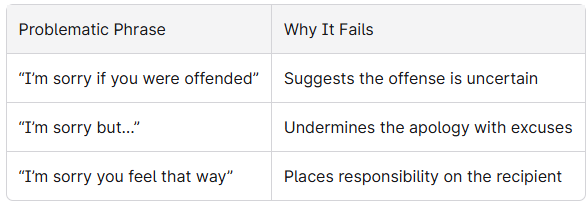
These phrases feel dismissive and invalidating because they frame the problem as the victim’s reaction rather than your behavior.
Blame-Shifting
Statements like “I’m sorry you’re so sensitive” or “I’m sorry, but you started it” are not apologies. They are attacks disguised as acknowledgment. Making excuses or rewriting history to protect your ego destroys credibility.
Empty Promises
Committing to change without any realistic plan is dangerous. When the same behavior repeats, empty promises become evidence of dishonesty. If you can’t genuinely commit to different behavior, acknowledge the harm without making promises you won’t keep.
Over-Apologizing
Apologizing for everything—especially things outside your control—weakens your message. When genuine apologies are needed, they carry less weight if you’ve diluted the currency with constant, unnecessary apologies.
Tone Problems
Keep your tone steady and respectful. Avoid:
Self-punishment: Excessive self-flagellation that shifts focus to your suffering
Defensiveness: Arguing about details rather than acknowledging impact
Self-pity: Making the conversation about how bad you feel
The goal is repair, not winning or generating sympathy.
How to Offer a Meaningful Apology
A good apology includes three essential components: regret, responsibility, and remedy. This framework provides structure while leaving room for genuine emotion.
Regret: Name the Offense and Express Sorrow
Be specific about what you did. Vague apologies (“I’m sorry for whatever happened”) communicate that you haven’t actually examined your behavior.
Example: “I’m sorry I spoke to you so harshly in front of our children yesterday.”
This names the behavior (harsh speech), identifies the context (in front of children), and locates it in time (yesterday). The person receiving this apology knows exactly what you’re acknowledging.
Responsibility: Use “I” Statements Without Excuses
Own the behavior clearly:
“I was wrong to say that”
“I should have called when I knew I’d be late”
“I broke my promise”
Avoid “but” statements that undermine responsibility. Even when circumstances were stressful, acknowledge that you—not circumstances—made the choice.
Remedy: Commit to Change or Make Amends
A complete apology addresses what happens next:
Behavioral change: “Going forward, I will step away when I feel my temper rising”
Practical amends: “I’ll pay for the repair” or “I’ll reschedule so we can celebrate properly”
New agreements: “Can we set up a system where I text you if I’m running more than ten minutes late?”
Example Apologies
Marital argument: “I was wrong to bring up your mother during our fight. That was hurtful and below the belt. I’m going to work on keeping our disagreements focused on the issue at hand, not bringing in other grievances.”
Workplace slight: “I realize I interrupted you several times in the meeting today. That was disrespectful and I’m sorry. I want to make sure you have space to share your ideas fully.”
Property damage: “I damaged your fence while backing out of my driveway. I should have been more careful. I’d like to pay for the repair—can you get me a quote?”
Leave Space for Feelings
Don’t pressure the other person for instant forgiveness. After apologizing, allow them to respond in their own time. Some people need moments to process; others need days. A good apology doesn’t demand quick resolution.

Apology, Forgiveness, and the Law
What works in personal relationships also applies in legal contexts. Judges, mediators, and attorneys regularly witness the power of acknowledgment in injury claims, business disputes, and family law conflicts.
Mediation and Settlement
In many mediation sessions, a sincere apology from one party can dramatically reduce hostility. When someone feels heard and acknowledged, their need for punitive outcomes often diminishes. This can help parties reach agreements without the expense and uncertainty of trial.
Restorative Justice Models
Some courts and legal programs developed between 2000 and 2024 have incorporated restorative justice models where apology and acknowledgment of harm are central to healing for victims. These approaches recognize that legal accountability divorced from genuine acknowledgment often leaves victims feeling unhealed.
Balancing Legal Protection and Human Acknowledgment
Individuals should seek legal advice in serious cases. However, humane acknowledgment of harm can coexist with protecting legal rights. A skilled attorney can help craft language that recognizes human impact while preserving legitimate defenses.
What Mediators Observe
Judges and mediators, when serving as neutrals, often witness that people want to feel heard and respected as much as they want financial or legal outcomes. A moment of authentic acknowledgment—recognizing the pain caused—can transform adversarial proceedings into collaborative problem-solving.
Apology is not merely a legal strategy. It is a moral act that can make legal systems more humane and outcomes more durable. When the legal process includes genuine acknowledgment, resolutions tend to hold because parties feel they’ve achieved something beyond technical victory.
Frequently Asked Questions
Does apologizing mean I’m admitting legal liability?
In everyday personal conflicts, apology is about moral responsibility, not necessarily legal liability. The two concepts operate in different domains. Some U.S. states and other jurisdictions have enacted “apology laws”—particularly in medical settings—that limit the use of apologies as evidence against the speaker. However, these laws vary significantly by location and type of case.
In serious incidents like car accidents, professional negligence, or criminal allegations, it’s wise to seek legal counsel about wording. A thoughtful approach can acknowledge human impact while preserving legal protections.
What if the other person refuses to forgive me?
You cannot control forgiveness. You can only control the sincerity and completeness of your apology. Some people need significant time and space to process harm before they can consider forgiveness.
Maintain respectful boundaries. Don’t repeatedly pressure for an answer or treat forgiveness as something you’re owed. Even when forgiveness doesn’t arrive, apologizing can restore your own integrity and reduce long-term guilt or regret. You’ve done what you can do.
How do I apologize for something that happened years ago?
Acknowledge the time gap directly: “I know this happened a long time ago, and I don’t know where you are with it now.” Recognize that the other person may have moved on or may still be carrying pain.
Emphasize listening. Offer your apology, then invite them to share how the event affected them—without interrupting or defending yourself. Older wounds can be sensitive; approach with humility and no expectation that the apology will erase the past.
Should I apologize if I didn’t mean to hurt anyone?
Yes. Intention and impact are different things. You can care deeply about someone and still cause harm without meaning to. The key is recognizing that your intention doesn’t determine their experience.
Apologize for the impact: “I see that what I said hurt you, and I’m sorry. That wasn’t my intention, but I understand why it landed that way.” This approach often strengthens relationships because it shows you value the other person’s feelings more than your ego.
Can an apology really fix a serious betrayal?
For serious betrayals—infidelity, financial deceit, significant lies—a single apology is not enough. It represents only the first step in a longer repair process that may take months or years.
Rebuilding trust after major betrayal requires consistent changed behavior over extended time, transparency about actions and decisions, and possibly professional counseling or mediation. However, even in deep betrayals, a sincere apology that fully acknowledges the seriousness of harm is often essential to any hope of rebuilding. Without that foundation, the injured party has nothing to build upon.
The important words “I’m sorry” are sometimes the most important words in language—but only when backed by genuine recognition of harm and commitment to doing better. Learning to apologize well is one of the most valuable skills you can develop for healthier relationships, personal peace, and more constructive conflict resolution. Start with one conversation where you take full responsibility for your part. You may be surprised at the doors it opens.