
Narcissist Therapist: How To Spot One, Protect Yourself, And Find Ethical Help
When you seek therapy, you’re placing extraordinary trust in another person. You’re often at your most vulnerable—processing traumatic events, navigating divorce or custody battles, or trying to heal from narcissistic abuse. The last thing you expect is for the person licensed to help you to become another source of harm.
Yet this is precisely what happens when a narcissist therapist enters the picture. Understanding how to recognize one could be the difference between healing and deeper trauma.
Quick Answer: What Is A Narcissist Therapist And Why It Matters
A narcissist therapist is a mental health provider who displays narcissistic personality traits or full narcissistic personality disorder npd while using their clinical authority to exploit, manipulate, or harm vulnerable clients. Unlike a therapist who simply has an off day or uses an outdated technique, a narcissist therapist systematically abuses the inherent power imbalance of therapy for personal gain.
This matters because the damage can exceed what original abusers caused. Clients enter therapy sessions already traumatized, seeking validation and healing. A narcissist therapist can cause retraumatization through gaslighting, drain finances through manufactured dependency spanning years, sabotage custody cases through biased court reports, or violate boundaries in ways that shatter a client’s sense of self entirely.
The five core warning signs include:
Chronic boundary violations (inserting themselves into your life events, inappropriate self-disclosure)
Intentional gaslighting and invalidation (denying prior statements, reframing your abuse as your fault)
Lack of empathy or visible delight in your pain
Control and isolation from family members and outside support
Superiority, shaming, and retaliatory behavior when questioned
Each of these will be unpacked with realistic survivor scenarios throughout this article.
This guide is written from an advocacy perspective similar to survivor-centered legal resources like JudgeAnthony.com, focused on client protection and practical steps. The goal is not to demonize all mental health professionals—most therapists genuinely strive to help. Rather, it’s to help you distinguish between ethical, trauma-informed professionals and covertly abusive narcissist therapists.

What Makes A Therapist “Narcissistic” (vs. Just Imperfect)
Not everyone who practices talk therapy is skilled at it, and not every therapeutic misstep indicates a mental health disorder. Understanding the difference between human imperfection and narcissistic personality is crucial.
According to the american psychiatric association’s diagnostic and statistical manual (DSM-5), narcissistic personality disorder involves a pervasive pattern of grandiosity, need for admiration, and lack of empathy. Key diagnostic features include:
An inflated sense of self importance
Preoccupation with fantasies of unlimited success or power
Belief in being uniquely special
Requirement of excessive admiration
Sense of entitlement
Interpersonal exploitiveness
Envy of others or belief others envy them
Arrogant behaviors
When these personality traits appear in a therapist, they manifest as self centered behaviors within the clinical relationship—positioning themselves as irreplaceable experts, demanding special treatment from clients, or viewing clients as objects for the therapist’s validation needs rather than individuals deserving proper treatment.
Pattern, not one bad session. A therapist with training gaps might dismiss complex PTSD due to ignorance but accept feedback, consult supervisors, and apologize. A narcissist therapist exploits power repeatedly without accountability, shows no remorse, doubles down on lies, or pathologizes the client for disagreeing.
You do not need a formal diagnosis of NPD to recognize danger. Impact matters. If you consistently leave therapy feeling more confused, dependent, and filled with self doubt rather than grounded and capable, that’s the warning sign.
5 Core Warning Signs Of A Narcissist Therapist
Recognizing narcissistic behaviors in a clinical setting requires looking beyond surface professionalism. The following five patterns distinguish dangerous therapists from those having ordinary human limitations.
1. Chronic Boundary Violations
Healthy therapy maintains strict boundaries—the therapy office is professional space with clear time, role, and financial limits. Narcissist therapists erode these boundaries progressively. This might start with oversharing personal dramas, then escalate to inviting clients to personal events, requesting attendance at weddings or graduations, initiating romantic contact, borrowing money, or engaging in social media stalking. Each violation blurs the line between therapist and something far more predatory.
2. Intentional Gaslighting and Invalidation
When a therapist denies making statements you clearly remember, tells you that your documented abuse is “your interpretation,” or insists you’re “misremembering” conversations you have notes about, this is gaslighting. It systematically causes you to doubt your own perception—a hallmark of narcissistic abuse transferred into the clinical setting.
3. Lack of Empathy or Delight in Pain
Trauma-informed care requires compassionate acknowledgment of suffering. A narcissist therapist may mock trauma stories, laugh at disclosures, show contempt when you’re vulnerable, or demonstrate visible satisfaction when you’re distressed. This failure to develop empathy for clients represents a fundamental unfitness for the role.
4. Control and Isolation
Classic coercive control tactics appear when a therapist discourages contact with family members or friends (“They’re toxic to your healing”), forbids second opinions (“No one else understands trauma like I do”), or schedules excessive sessions that crowd out other relationships. This creates cult-like dependency where the therapist becomes the only authority.
5. Superiority, Shaming, and Retaliation
When challenged, narcissist therapists respond with contempt. They may use jargon to confuse you, swear at you, abruptly end sessions, or write hostile documentation. If a therapist tells you “You’re too unstable for therapy” after you question their approach, this is retaliation, not treatment.
One isolated misstep followed by a sincere apology differs fundamentally from ongoing patterns where the therapist doubles down, blames you, or rewrites history.
Ill-Informed Therapist Or Narcissist Therapist?
Distinguishing incompetence from narcissistic abuse can feel nearly impossible when you’re already doubting yourself. Both may cause harm, but they require different responses.
An ill-informed therapist may minimize trauma or use outdated methods—perhaps dismissing emdr therapy for complex trauma because their training predated current research. However, they can typically accept feedback, consult colleagues, and correct course. After learning more, they might refer you to a specialist and acknowledge their limitation.
A narcissist therapist becomes defensive, punitive, or contemptuous when corrected. They forbid alternative approaches because “no one else is qualified” to treat you.
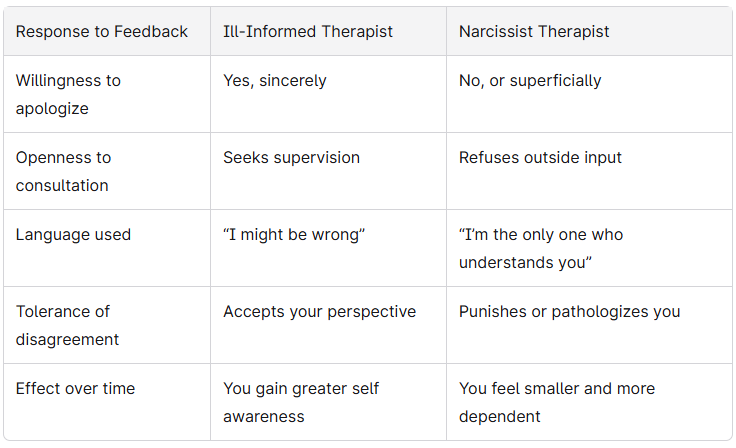
If therapy leaves you more confused and self-doubting over months rather than progressively more grounded, you may be experiencing narcissistic dynamics rather than simply a style mismatch.
Boundary Violations: When The Therapeutic Relationship Turns Predatory
The “therapeutic container” exists to protect clients. Therapy sessions should focus solely on your needs, occur in a professional setting, and maintain clear limits around time, roles, and money. When a narcissist therapist dismantles this container, the relationship turns predatory.
Specific boundary violations include:
Sexual or romantic relationships with clients
Invitations to personal events (weddings, births, graduations)
Inserting themselves into your milestones
Inappropriate self-disclosure that dominates sessions
Borrowing or lending money
Social media stalking or contact outside sessions
Enabling contact with your abuser in couples therapy despite documented violence
Consider this 2022 scenario: A therapist pressures a client to invite them to the client’s graduation ceremony. At the event, the therapist monopolizes conversations with family members, shares private information from therapy sessions as “helpful context,” and positions themselves as central to the family’s dynamics. The client leaves their own graduation feeling invaded and confused about where therapy ends and the therapist’s life begins.
If your therapist asks for sex, money, or to be part of your family events, it is not therapy anymore—this is exploitation.
Major violations like sexual contact are not “grey areas.” They constitute clear ethics breaches in every licensing code in the United States, often grounds for license revocation and civil lawsuits.

The image depicts two hands reaching toward each other, symbolizing support and connection, which can be crucial in therapy sessions for individuals dealing with mental health disorders such as narcissistic personality disorder. This gesture reflects the importance of building a therapeutic alliance and developing empathy in personal relationships.
Gaslighting, Invalidation, And Empathy Failures
Gaslighting involves systematically causing a client to doubt their memory, perception, or sanity. In therapy, this might mean denying previous statements, reinterpreting your trauma as your fault, or insisting your clear memories are distortions.
Common phrases narcissist therapists use:
“That never happened.”
“You’re too sensitive.”
“You’re misremembering what I said last week.”
“Have you considered that you provoked this?”
“I never said that—you must be confused.”
Ethical, trauma-informed validation looks entirely different. It involves naming the harm, acknowledging the client’s reality, and never pressuring premature forgiveness or reconciliation with abusers.
Consider this scenario: A survivor of sexual abuse discloses their experience. Instead of validation, the therapist says, “Let’s focus on your role in creating this situation.” The client leaves with significant distress, questioning whether they somehow caused their own abuse. Their low self esteem deepens. Over subsequent sessions, the therapist continues implying the client’s boundaries were unclear, their memory unreliable, their reactions excessive.
The damage compounds: a survivor already struggling with self worth now doubts whether their abuse even happened.
Feeling challenged in therapy is normal—effective therapy sometimes involves uncomfortable truths. But regularly leaving sessions feeling humiliated, crazy, or erased signals something far darker than therapeutic discomfort.
When Therapists Enable Abusers Or Weaponize Their Authority
Some narcissist therapists identify with abusers, side with the more powerful person in any dynamic, or see their role as “fixing” the victim by making them compliant. This creates devastating consequences, particularly when therapy intersects with legal matters.
Ways this manifests:
Siding with a violent partner during couples therapy
Writing misleading letters to courts or child protective services
Misdiagnosing victims as having borderline personality disorder or being “paranoid” to discredit them
Recommending unsupervised custody to a documented abuser
Mocking survivors’ fears about physical abuse
Consider a 2021-2025 family court custody dispute: A mother seeks a protective order after documented domestic violence. Her former therapist—someone she trusted during the marriage—writes a report characterizing her as “unstable” and “prone to exaggeration.” The therapist minimizes the father’s behavior while suggesting the mother has antisocial personality disorder with no basis for this claim. Judges and mediators, trusting the therapist’s perceived expertise, weigh this report heavily. The mother’s legitimate safety concerns are dismissed.
This weaponization of clinical authority can cause more lasting damage than the original abuse because it carries institutional credibility. Advocacy resources like JudgeAnthony.com specifically warn about professional misuse in family court settings, recognizing how mental health professionals can become instruments of further harm.
If your therapist appears to mock you, laugh at your disclosures, or consistently defend the abuser’s narrative, consult an outside trauma-informed professional immediately.
Isolation, Control, And “Cult-Like” Dependency
Narcissist therapist behavior frequently mirrors classic coercive control tactics: isolating the client from support systems to become the sole authority in their life.
Concrete isolation behaviors include:
Discouraging contact with certain family members or friends (“They’re not good for your mental health”)
Forbidding second opinions from other professionals
Insisting other therapists “don’t understand trauma”
Scheduling so many sessions that other relationships suffer
Positioning group therapy or support groups as inferior to their exclusive care
A client begins therapy to process childhood difficulties. Over months, the therapist gradually reinterprets every disagreement the client has with their parents as evidence of abuse—even ordinary conflicts that any family experiences. The therapist insists the parents are “too toxic” to maintain contact with. Simultaneously, the client is discouraged from discussing therapy with friends (“They wouldn’t understand”) and from seeking any outside perspective (“Other professionals will only confuse you”).
The client becomes utterly dependent on therapy as their sole source of support and interpretation of reality. Their interpersonal relationships narrow to a single point: the therapist.
Healthy therapists may suggest temporary distance from actively unsafe people. But they support your autonomy, encourage multiple perspectives, and never punish you for seeking other help.
No ethical therapist will punish you for getting a second opinion.
Superiority, Shaming, And Retaliation When Challenged
Narcissist therapists operate from a position of superiority—they are always right, always the expert, and clients who disagree become “difficult” or “disordered.”
Typical behaviors include:
Mocking clients’ questions about the treatment process
Using clinical jargon to confuse rather than clarify
Swearing at clients during sessions
Abruptly ending sessions when challenged
Writing hostile or misleading notes after any rupture
Diagnosing clients with additional mental disorders when they push back
In early 2024, a client questions their therapist’s recommendation for dialectical behavioral therapy, asking whether schema therapy might better address their early life experiences. The therapist becomes visibly angry, tells the client, “You’re too unstable for this work,” ends the session twenty minutes early, and later documents that the client was “threatening” with no factual basis.
This differs fundamentally from healthy countertransference management. Ethical therapists acknowledge difficult feelings that arise in sessions and seek supervision rather than lashing out or pathologizing the client.
Persistent contempt, insults, or threats from a therapist are never part of legitimate treatment. They should trigger immediate safety planning on your part.
How Ethical, Trauma-Informed Therapists Behave Instead
Understanding what healthy therapy looks like can help you recognize departures from it. Trustworthy mental health professionals demonstrate consistent behaviors that support your personal growth rather than their own ego.
Positive behaviors include:
Explaining confidentiality limits clearly at the outset
Actively inviting feedback about the therapeutic process
Validating traumatic events without minimizing or rushing
Supporting legal or safety planning referrals when needed
Never rushing forgiveness or reconciliation with abusers
Treating co occurring conditions with appropriate care
Collaboratively developing your treatment plan
Building distress tolerance skills you can use independently
Helping you learn skills for healthy relationships outside therapy
When an ethical therapist makes a mistake—and all humans do—they apologize genuinely, review notes transparently, and offer referral options if trust has been shaken. The therapeutic alliance becomes stronger through honest rupture repair.
Effective therapy embodies trauma-informed, victim-centered principles: safety, autonomy, and empowerment. You should leave sessions feeling more capable of navigating your life experience, not more dependent on your therapist’s interpretations.

The image depicts two hands reaching toward each other, symbolizing support and connection, which can be crucial in therapy sessions for individuals dealing with mental health disorders such as narcissistic personality disorder. This gesture reflects the importance of building a therapeutic alliance and developing empathy in personal relationships.
How To Vet Therapists And Avoid Narcissistic Predators
Prevention is far easier than recovery. Before committing to a therapist, take concrete screening steps.
Check credentials and history:
Verify active licensure through your state licensing board
Search for ethics complaints or disciplinary actions
Look for genuine specialization in complex PTSD, domestic violence, or your specific mental health conditions—not just generic “relationship issues”
Questions to ask in initial consultations:
“What is your approach to trauma and abuse?”
“What are your views on couples therapy when there’s been violence?”
“How do you handle complaints or ruptures in the therapeutic relationship?”
“What is your stance on dual relationships?”
Red flags during consultations:
Rushing you to commit
Making grandiose claims about being uniquely qualified
Oversharing personal information
Dismissing your previous life experience or concerns
Use brief, structured phone or video consultations with multiple therapists. Trust early gut reactions. If something feels wrong in the first meeting, that feeling deserves attention.
When therapy will intersect with legal matters—custody disputes, protective orders, divorces—cross-check therapist information with independent resources. State licensing sites, survivor advocacy platforms, and court-oriented resources like JudgeAnthony.com can provide valuable perspective.
While platforms offering large therapist pools can be convenient, still apply your own vetting criteria. Brand names don’t guarantee safety.
What To Do If You Suspect Your Therapist Is Narcissistic Or Abusive
Doubting your therapist is not “being difficult.” You are allowed to question and to leave.
Action steps:
Document concerning incidents with dates and direct quotes. Write them down immediately after sessions while your memory is fresh.
Seek an outside trauma-informed consultation. Another mental health provider can offer perspective on whether what you’re experiencing falls outside professional norms.
Develop a safe exit plan. This is especially important if your therapist is involved in active court cases or has any contact with a partner or former abuser.
Decide whether to report. State licensing boards accept complaints about ethical violations. In some cases, consulting an attorney experienced in malpractice may be warranted.
If your therapy intersects with custody or divorce proceedings, timing and documentation become crucial. A therapist with court involvement holds significant power, and extracting yourself requires strategy.
Unethical therapists have been held legally accountable. Malpractice suits succeed against mental health professionals who violate ethics codes. Resources focused on family-court-related harm, like those at JudgeAnthony.com, can help you understand your options.
Leaving a harmful therapist is an act of self protection, not failure. Many survivors later find ethical, healing-oriented professionals and rebuild trust in the treatment process.
Finding Real Help After A Narcissist Therapist
The trauma of therapist abuse creates specific wounds—deep mistrust of any helping professional. This is a logical response to betrayal, not a flaw in you requiring different antipsychotic medications or mood stabilizers.
Gentle reentry paths include:
Crisis lines for immediate support
Survivor-focused support groups (online or local)
Advocates through domestic violence or legal aid organizations
Carefully vetted trauma therapists with transparency about their approach
Questions to ask new providers:
“How do you address power imbalances in therapy?”
“What is your supervision structure?”
“How do you support clients who have been harmed by prior therapists?”
Pacing matters. It is acceptable to move slowly, set strong boundaries, and keep therapy focused entirely on your agenda. dialectical behavior therapy, gestalt therapy, or other structured approaches with clear frameworks might feel safer initially than open-ended talk therapy.
Treating npd or treating narcissistic personality disorder in former therapists isn’t your responsibility. Your job is to seek therapy that serves your healing, to manage symptoms of trauma, and to actively participate in your own recovery at whatever pace feels right.
With proper treatment and the right support, many survivors regain trust, build healthy support systems, and develop self awareness that serves them throughout their lives. Developmental factors and early childhood wounds can be addressed. Vulnerable narcissism in others can be recognized. Personal relationships can be rebuilt on foundations of mutual respect.
Key Takeaways: Protecting Yourself From Narcissist Therapists
A narcissist therapist exploits clinical authority through patterns of boundary violation, gaslighting, empathy failure, isolation, and retaliation. Recognizing these patterns is the first step toward self protection.
Most actionable guidance:
Trust your intuition when something feels wrong in therapy
Watch for patterns of boundary-breaking and gaslighting, not just isolated incidents
Seek second opinions—any therapist who forbids this is raising a red flag
Document incidents with dates and direct quotes
Know that you can change therapists at any time for any reason
If seeking treatment involves court or custody matters, consult legal advocacy resources
Most therapists strive to do no harm and genuinely support their clients’ self reflection and personal growth. But a small minority misuse their authority, and recognizing this reality helps clients advocate for themselves more effectively.
If you’re navigating both abuse and court or custody issues, connect with trauma-informed legal and advocacy resources to build a complete safety plan. Your sense of self deserves protection, and the key factors in your recovery include surrounding yourself with professionals who respect your autonomy.
Knowledge of narcissist therapist patterns is a powerful tool. Use it to protect yourself, to find mental health support that genuinely serves you, and to reclaim your voice in therapy and in life.\